Skip to content
You can now search across every topic, entity and event.What's new
Iran Conflict 2026
23AUG

EU refill doubles on a regulated base

4 min read
19:02UTC

GIE AGSI+ data put EU storage at 38.21% on 24 May with injection running at roughly 0.38 pp/day, double the prior week, yet almost none of it traces to a commercial signal.

ConflictDeveloping
Key takeaway

EU injection pace doubled to 0.38 pp/day, but on CRE, EBN and ARERA mandates, not a repaired commercial spread.

GIE AGSI+ primary data put EU fill at 37.45% on 22 May, 37.83% on 23 May and 38.21% on 24 May, a steady run of roughly 0.38 to 0.39 pp/day with 432.52 TWh in store against 423.88 TWh two days earlier 1. That is double the 0.17 pp/day the bloc recorded a week earlier , and a clear step up from the 0.248 pp/day reading on 7 May . The pace doubling, rather than the fill level it produced, is what the desk should read off the print.

France books storage at 100% under CRE regulation, Italy's ARERA pays a bonus covering the negative summer-winter spread, and the Netherlands injects through state company EBN, so the bulk of the aggregate gain is compelled or subsidised demand rather than arbitrage. The summer-winter strip stayed inverted throughout the window, leaving a commercial operator no intrinsic reason to fill .

At a sustained 0.38 pp/day the bloc lands near 69-70% by 1 November, a material move off the 55-65% the slower pace implied, but on a mandate-dependent footing. The refill unwinds the moment TTF slips back to the low EUR 40s and the regulated cover thins, which loads policy risk onto the storage-linked strip alongside the weather risk. The 22 May print of 3,243 GWh net ran well below the 23-24 May volumes, so a warm-weather demand dip freed cavern space at the same time, and the fill data alone cannot separate that from the mandate effect.

Deep Analysis

In plain English

Every summer, European countries fill underground caverns with natural gas to make sure there is enough fuel to heat homes and run factories through the winter. The European Union has a target of filling those caverns to 80% of capacity by 1 November each year. To fill storage, companies need to buy gas now (summer) and sell it later (winter) at a profit. When winter gas costs more than summer gas, that trade makes money. At the moment, however, summer gas in Europe is more expensive than winter gas, so there is no profit to be made from injecting gas into storage. No business fills its tanks at a loss. The only way the EU's underground stores are filling at all right now is because governments are ordering companies to do it anyway, or paying them bonuses to cover the loss. France and Italy are doing this through their energy regulators. The Netherlands is using a state company called EBN (Energie Beheer Nederland) to inject gas under a government order. The problem is that this government-mandated approach is more fragile than market-driven filling. If gas prices shift or the government orders are lifted, the injection could stop quickly, leaving Europe with less gas stored than it appears.

Deep Analysis
Root Causes

Three independent structural failures converge to produce this mandate-only injection dynamic.

First, the summer-winter TTF strip inversion removes the intrinsic incentive for commercial injection. When summer 2026 TTF trades more than EUR 0.5/MWh above winter 2026-27, every megawatt-hour injected commercially produces an immediate loss versus selling spot. No private operator can rationally inject against a negative spread without an offsetting subsidy or mandate.

Second, 58 mtpa of new global LNG export capacity expected online in H2 2026 (per Timera Energy) has shifted the structural forward curve: the market is pricing expected LNG abundance against a seasonally weaker winter demand backdrop, producing the inversion as a feature rather than a temporary anomaly.

The 2022 LNG supply surge that rescued European storage was a one-time reorientation of Atlantic flows; 2026 has a structurally larger global LNG supply base that pushes summer spot below winter rather than above it.

Third, the EU's 80% November storage regulation (Gas Storage Regulation 2022/1032) requires fill targets but provides no bloc-level financial instrument to fund injection against a negative spread. The fiscal gap is filled ad hoc by national regulators (CRE, ARERA) and state entities (EBN), creating a patchwork mandate architecture with no common backstop mechanism. Bruegel's EUR 26bn refill cost model, calibrated for 80% delivery, is already an undercount given the sub-target pace.

What could happen next?
  • Risk

    If TTF falls below EUR 47 before August, ARERA's injection bonus turns sub-economic and Italian commercial operators may exit the injection market, reducing EU aggregate pace below the mandate-funded floor.

    Short term · Assessed
  • Consequence

    At sustained 0.38 pp/day pace, EU storage lands near 69-70% on 1 November, 10-11 percentage points below the regulatory target, leaving a structural withdrawal shortfall entering winter.

    Medium term · Reported
  • Precedent

    A second consecutive season of sub-80% November fill despite active regulation would pressure the European Commission to propose a mandatory EU-level financial injection instrument, moving beyond the current national-mandate patchwork.

    Long term · Suggested
First Reported In

Update #12 · EU refill doubles on mandates as TTF fades

Gas Infrastructure Europe· 26 May 2026
Read original
Causes and effects
This Event
EU refill doubles on a regulated base
A storage number reached on mandate is structurally weaker than the same number reached on arbitrage, because it unwinds the moment TTF slips below the level that covers the spread.
Different Perspectives
Hizballah
Hizballah
Has not commented on the US Treasury's 20 August designation of ten people, including named couriers, over a cash network Treasury says moved money to it from the IRGC-Qods Force. ACLED recorded a sharp rise in attacks around it the same day.
Kuwait
Kuwait
Kuwait's Chief of the General Staff, Lieutenant General Khaled al-Shriaan, co-chaired the 16th US-Kuwait Joint Military Commission at the Pentagon on 21 August. Kuwait has not published what was agreed; only a summary of the meeting's existence and attendees is sourced.
Qatar
Qatar
Has not commented publicly on the $4.5bn KC-46A tanker Foreign Military Sale notification the State Department approved on 20 August. The notification opens a sale process; Doha has not confirmed whether it will proceed to a signed transfer.
Mohammad Bagher Ghalibaf
Told a Baghdad business meeting on 20 August that Iran will not endure a hungry population regardless of its military strength, against 87.9% point-to-point inflation and 128.1% food inflation for Tir. His fellow Majlis Economic Committee member Samsami separately warned a petrol price rise would ignite unrest.
US Navy
US Navy
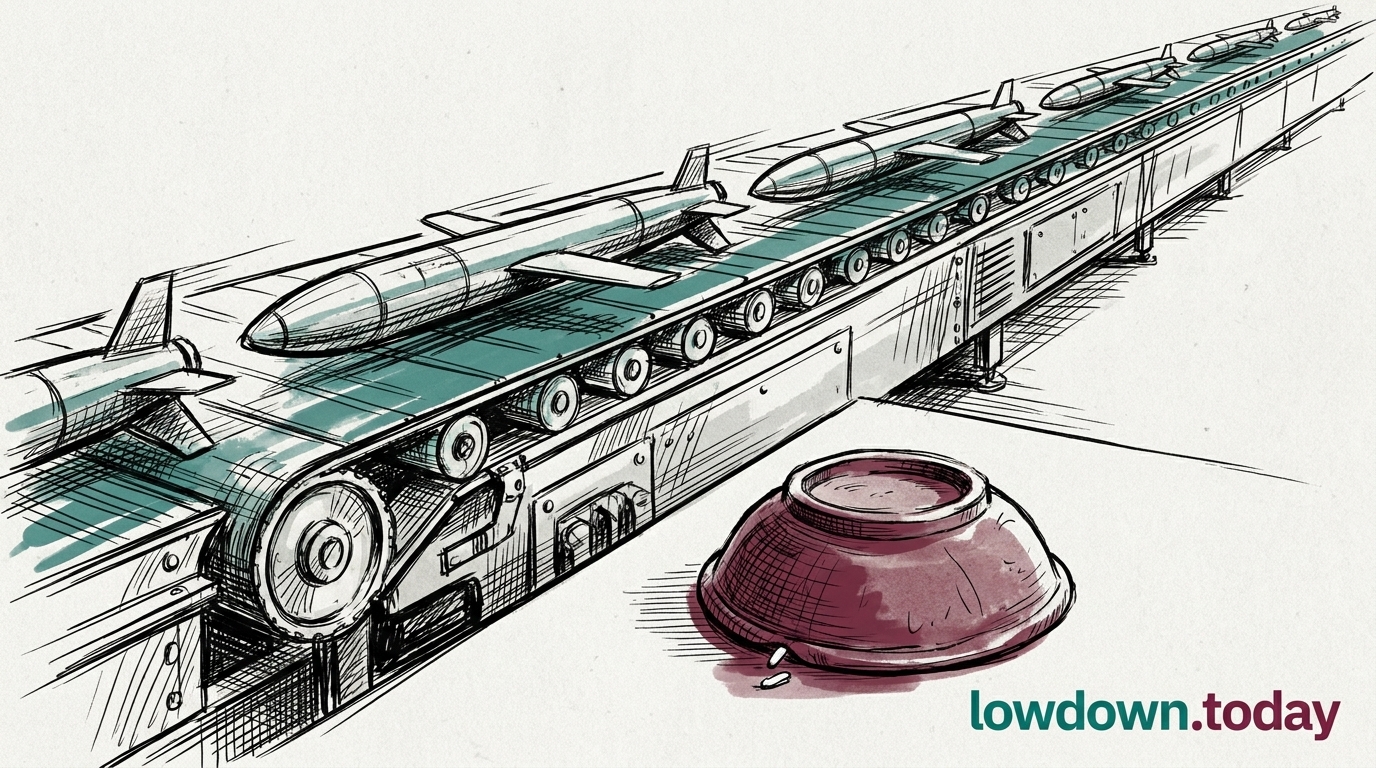
Signed a $22.9bn, seven-year contract with Raytheon on 17 August to raise Tomahawk output from about 60 a year to more than 1,000. The Acting Navy Secretary, quoted via an X post, framed it as the "Arsenal of Freedom" initiative; it replaces the 850 missiles fired by 1 April in about ten months at the new rate.
UK Maritime Trade Operations
UKMTO logged six armed men boarding a tanker 136 nautical miles east of Al Mukalla on 20 August and redirecting it toward Somalia. A vessel steered toward the Somali coast reads as an attempted seizure, a distinct hazard from the stand-off strikes the same lane has seen before.