Skip to content
You can now search across every topic, entity and event.What's new
Iran Conflict 2026
23JUL

Fourth US troop killed in Iran strike

2 min read
19:27UTC

Iranian munitions penetrated a fortified operations centre, killing a fourth service member in under 72 hours, as the Joint Chiefs chairman warned publicly that the casualty count will keep rising.

ConflictDeveloping
Key takeaway

Iran's demonstrated ability to strike a hardened, fortified command facility signals targeting intelligence of a quality that threatens every fixed US command node in the region, not merely troops in the open.

CENTCOM confirmed a fourth US service member was killed when Iranian munitions struck a fortified tactical operations centre, with five more seriously wounded. Three service members had been confirmed dead on Saturday — the first US combat fatalities since the campaign began. Total US losses: four dead and at least ten wounded in under 72 hours.

The munitions penetrated a hardened tactical operations centre — a facility built to withstand indirect fire and fragmentation. CENTCOM has not disclosed which installation was hit or what type of Iranian ordnance was used. A Ballistic missile penetrating a reinforced position implies a different threat to forward-deployed forces than a drone or cruise missile strike on a soft target, and would affect force-protection planning at every declared US facility in the theatre — including the roughly 2,500 personnel at bases in Iraq now facing attacks from Shia militias as well as Iranian launchers.

Gen. Caine's statement at Sunday's Pentagon briefing — "We expect to take additional losses" — is the first acknowledgement from a Joint Chiefs chairman that the casualty count will continue rising. President Trump has said the campaign will last "four weeks or less" and described it as "ahead of schedule". Caine's admission sits uncomfortably against that framing. War powers votes already scheduled for this week in Congress will now carry the weight of named casualties, and the domestic political equation around sustained combat deaths has not been tested since thirteen service members were killed at Abbey Gate in Kabul on 26 August 2021.

Deep Analysis

In plain English

A tactical operations centre is a hardened command post — a reinforced facility built to withstand attack — where officers coordinate military operations. That Iran successfully struck one means they either knew precisely where it was, or have the surveillance capability to find and hit protected military headquarters. This is qualitatively more alarming than hitting troops in the open: it suggests Iran can target the people giving the orders, raising the threat level for the most senior and most protected personnel in theatre.

Deep Analysis
Synthesis

The TOC strike combined with the friendly-fire aircraft losses (Event 0) means US forces are simultaneously absorbing attrition of air assets and command infrastructure. Neither in isolation is operationally decisive, but together they create compounding pressure on commanders managing a five-front conflict without confirmed air superiority — a combination that historically accelerates the operational tempo to force a decision before the command layer degrades further.

Root Causes

A hardened TOC being successfully struck points to one of two structural failures: specific location intelligence obtained through signals or human intelligence penetration of US operational security, or a semi-permanent position whose coordinates were derivable from pattern-of-life analysis — a known vulnerability in fixed forward command posts that doctrine has repeatedly flagged but operational convenience has consistently overridden. Either finding has serious implications for US OPSEC across the theatre.

Escalation

The deliberate targeting of command infrastructure — rather than simply inflicting casualties on troops — signals Iran has adopted a strategy of attriting US decision-making capacity. If Iran holds reliable targeting data on additional command nodes, the risk to senior personnel increases disproportionately and may compress US operational timelines as commanders disperse or harden their positions.

What could happen next?
  • Risk

    If Iran's targeting intelligence extends to other fixed US command nodes, CENTCOM's forward headquarters at Al Udeid Air Base in Qatar — hosting approximately 10,000 personnel — becomes a high-value target requiring immediate reassessment of its protection posture.

    Immediate · Assessed
  • Consequence

    Casualties at the current pace trigger mandatory Congressional notification and reporting requirements under the War Powers Resolution, adding a legal-political layer that constrains operational flexibility.

    Short term · Assessed
  • Risk

    Sustained daily casualties at the current rate create polling pressure that historically erodes the permissive domestic environment for extended operations, compressing the administration's operational window to approximately three to four weeks before political sustainability becomes the binding constraint.

    Medium term · Suggested
First Reported In

Update #10 · Friendly fire kills three US jets in Kuwait

NBC News· 2 Mar 2026
Read original
Different Perspectives
India
India
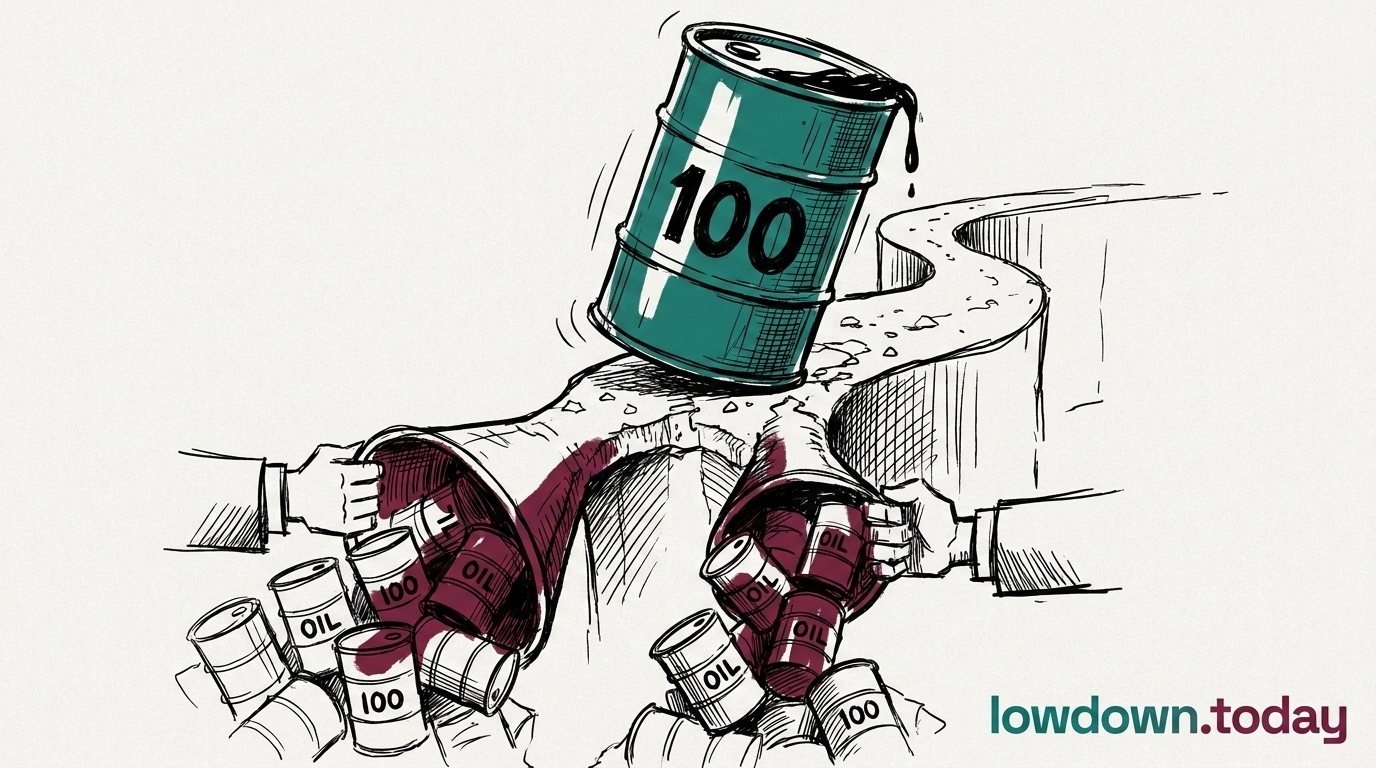
India buys more Saudi crude than any other country and has 2.5 million nationals working in the kingdom, so a $100 Brent and a live strike on Saudi tankers reach New Delhi through both fuel bills and remittance risk. Neither channel has an alternative route the way Saudi Arabia's own pipeline does.
Qatar
Qatar
Qatar co-authored the four-mediator ten-day ceasefire proposal alongside Egypt, Pakistan and Oman, centred on resuming Hormuz navigation, while separately pursuing its dated compensation claim against Iran at the UN Security Council filed on 21 July. Doha is mediating and litigating in the same week.
Israel
Israel
Israeli intelligence, reported by the Wall Street Journal, assesses Iran moved thousands of centrifuges and part of its roughly 440kg enriched-uranium stock into Pickaxe Mountain after the June 2025 strikes on its three main nuclear sites. Some of the US refuelling aircraft now deploying to the region are bound for Israeli bases and Ramon Airport.
Houthis
Houthis
Yahya Saree announced the missile and drone strikes on the Encelia and Layla on 22 July as enforcement of the embargo his forces had declared by radio warning alone two days earlier. Six vessels already turned back on the broadcast; the strike shows Houthi forces will use weapons once warnings stop working.
Saudi Arabia
Saudi Arabia
Saudi Arabia's state news agency confirmed only a fire on the Encelia's bow, with the crew safe; the Layla strike remains unconfirmed by Riyadh. The kingdom built its Petroline pipeline specifically to bypass Hormuz through the Red Sea, so the tanker fire lands on the route Riyadh had already spent billions escaping.
United States
United States
Washington is weighing both ten-day proposals but wants a longer truce than either offers, and moved F-16 and F-35 jets plus refuelling aircraft into the region while it decides. That deployment, not Trump's Pickaxe Mountain remarks, is the measurable US action, buying options for the day talks fail rather than betting on them.