Skip to content
Briefings are running a touch slower this week while we rebuild the foundations.See roadmap
Iran Conflict 2026
1JUN

WPR clock ticks toward 29 April on zero instruments

3 min read
08:32UTC

Lowdown Analysis

ConflictAssessed
Key takeaway

The 29 April WPR deadline may pass on the argument the war is winding down, without any signed Iran paper.

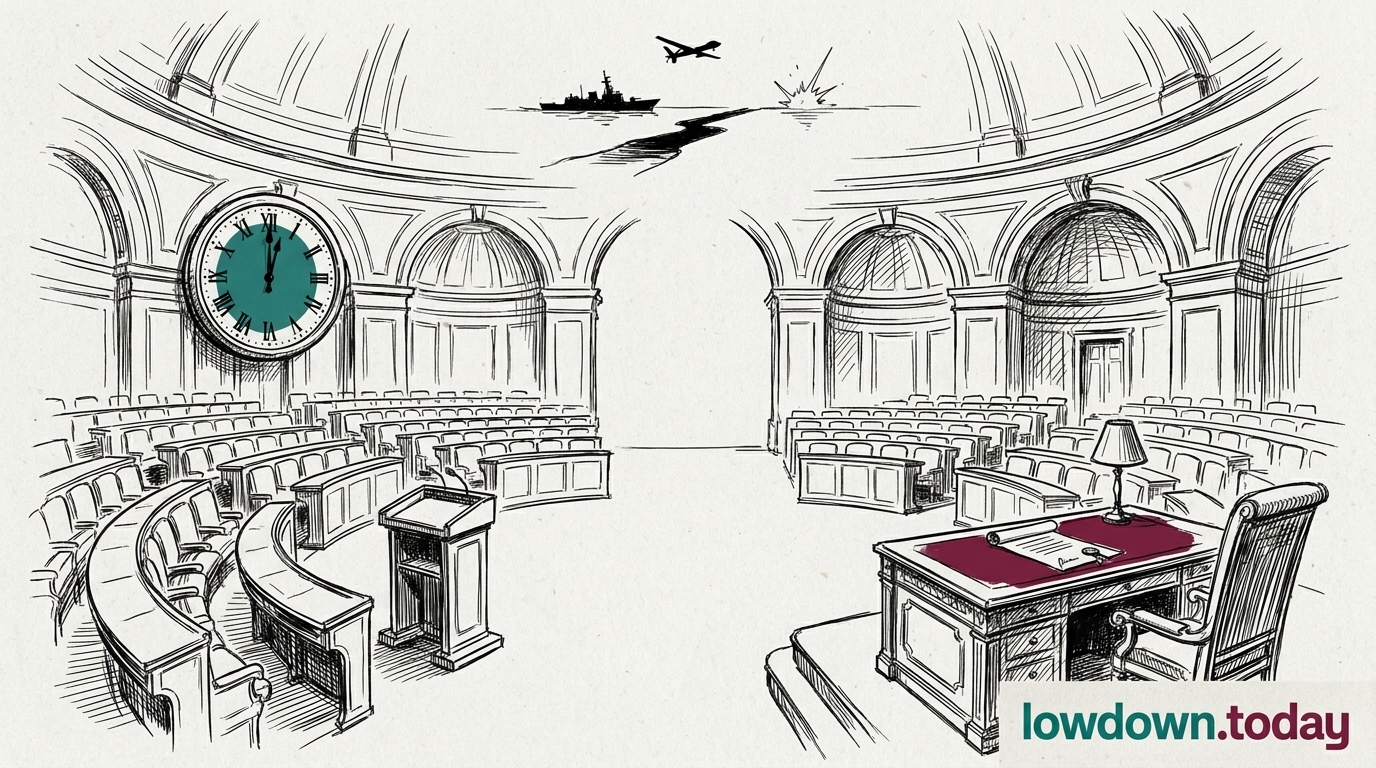
The War Powers Resolution (WPR, the 1973 statute giving Congress 60 days to authorise or end a hostility) clock that started on the 28 February outbreak runs out on 29 April. Behind it sits an operation with zero executive instruments on the Iran file. Senator Josh Hawley's Authorization for Use of Military Force (AUMF, the statutory authority Congress grants a president for specific hostilities) push was conditioned on the war neither ending nor winding down 1.

The Senate had blocked an earlier WPR last week, short of the threshold by five votes . The indefinite extension supplies the White House the political argument that the war is winding down, which is precisely the linguistic window Hawley's condition left open. Fifty-three consecutive days now sit behind the White House tracker with the same number in the Iran column: zero . The 29 April mark may pass on the same pattern that got it here, and if it does, the first signed Iran instrument of the war will not exist.

Deep Analysis

In plain English

The War Powers Resolution is a 1973 US law that limits how long a president can keep US forces in combat without congressional approval. The clock started on 28 February when fighting with Iran began, and it expires on 29 April , 60 days later. Normally, this would force Congress to either vote to authorise the war or require withdrawal. Congress already tried to enforce the law and failed by a single vote, 213-214, in the House. Trump's indefinite extension post now gives the White House a 'winding down' argument that may satisfy the law's exception even without a ceasefire deal. Since no presidential document on Iran has been signed in 53 days, the 29 April deadline may pass without any formal response , which is what has happened at every other forcing moment in this conflict.

Deep Analysis
Root Causes

The WPR clock's approach to 29 April without a signed instrument reflects the same deliberate executive discretion strategy documented across the full Iran file: keeping operational authority in the executive by avoiding the paper that would make congressional oversight actionable.

The specific Hawley mechanism, conditioned on war not winding down, was inadvertently disabled by the extension's indefinite framing, which provides exactly the 'winding down' language Hawley's condition excluded.

What could happen next?
  • Risk

    If 29 April passes without a congressional vote or judicial challenge, the WPR's enforceability in future conflicts is further eroded , a constitutional precedent that outlasts this conflict.

  • Consequence

    Hawley's AUMF push effectively ends on 29 April without its triggering condition being met, removing the one Senate mechanism that could have forced the first signed Iran instrument.

First Reported In

Update #76 · Trump posts an exit Iran can't reach

Al Jazeera· 22 Apr 2026
Read original
Different Perspectives
Human rights monitors (Hengaw, Amnesty International, Iran HRM)
Monitors documented a second death sentence for Zahra Tabari, 68, reported cemetery record deletions at Behesht-e Zahra, and a poll showing 81.5% of medical residents want to emigrate, against a background of 200+ confirmed executions since February. Iran's security courts operate at uninterrupted wartime tempo regardless of the diplomatic track.
Pakistan (mediator)
Pakistan (mediator)
Islamabad carried Trump's revised MOU demanding HEU destruction to Iranian negotiators, formally inheriting the role of sole active mediator after Oman's forced withdrawal. Pakistan lacks Oman's banking infrastructure for frozen-asset routing and carries its own regional stakes, making it a less structurally neutral broker.
Kuwait
Kuwait
Kuwait intercepted Iranian missiles and drones for a second time in days on 1 June, with air-raid sirens sounding nationwide, after invoking Article 51 self-defence on 28 May following the Ali Al Salem ballistic-missile strike. The repeated interceptions test whether Kuwait's domestic politics can sustain hosting US forces as a de facto co-belligerent.
China (PRC)
China (PRC)
Beijing sent scholars to Shangri-La rather than its defence minister and addressed Taiwan without mentioning Iran, maintaining bilateral energy corridor protection with Tehran while refusing diplomatic exposure at multilateral forums. Trump barred China as an HEU custodian on 27 May, removing Beijing from the deal architecture while China continues supplying DPI hardware that caps Iran's internet.
Lloyd's of London / war-risk underwriters
Lloyd's held its Hormuz war-risk designation at $10-14 million per voyage while Brent recovered to $93.91, maintaining the structural divergence from futures pricing that has persisted since late May. Underwriters require a UN Security Council resolution or government certification letter, not diplomatic optimism.
Gulf Cooperation Council states (Saudi Arabia, UAE, Bahrain, Qatar)
Five Gulf states wrote to the IMO on 21 May rejecting Iran's PGSA transit authority over international waters; Saudi Arabia and the UAE have not confirmed participation in the European Hormuz mission. The GCC is navigating between US security guarantees and exposure to Iranian fire, with no Gulf state formally co-belligerent except Kuwait.