Skip to content
Briefings are running a touch slower this week while we rebuild the foundations.See roadmap
Iran Conflict 2026
2MAR

Dow drops 543; markets price a long war

3 min read
14:45UTC

Brent crude holds at $85–90 per barrel — well short of the $110–130 worst-case forecasts — while equities fall in orderly fashion. Markets are positioning for weeks of supply disruption, not a shock.

ConflictDeveloping
Key takeaway

The tight differential between modest equity losses (1.1–1.6%) and a sustained crude premium of 16–23% reveals that markets price conflict duration into energy without yet treating the broader economy as impaired — a distinction that collapses if Brent breaches $100.

US equity markets opened lower on Monday. The DoW Jones fell 543 points (1.1%), the S&P 500 dropped 1.1%, and the Nasdaq lost 1.6% — steeper than pre-market futures had indicated but within the range of orderly decline.

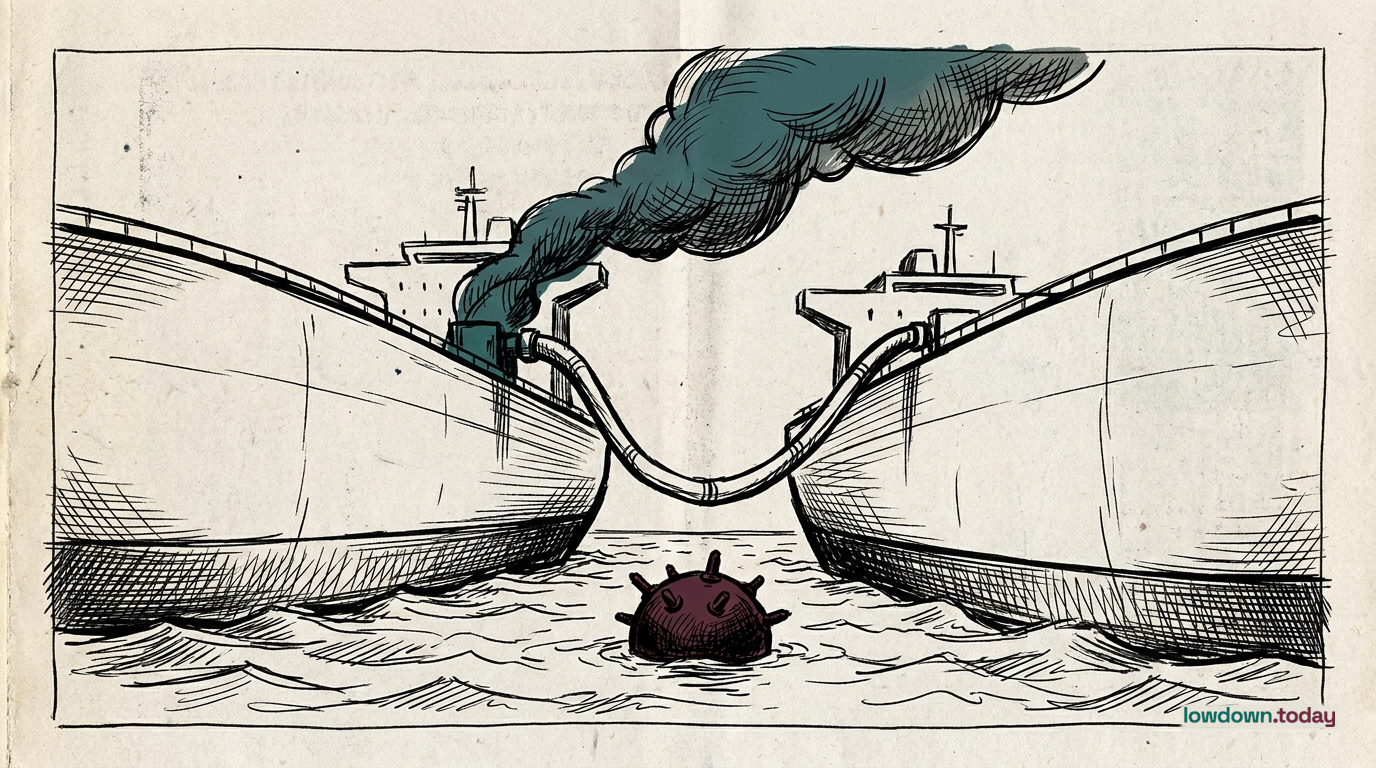
The equity losses are secondary to the oil signal. Brent Crude held at $85–90 per barrel, the same range it reached over the weekend , up from roughly $73 before the strikes began. The price has stabilised rather than continuing to climb, despite Strait of Hormuz vessel traffic falling 70% and six major container lines — CMA CGM, Hapag-Lloyd, Maersk, Nippon Yusen, Mitsui, and Kawasaki Kisen — halting Gulf transits entirely . OPEC+'s 220,000 barrel-per-day production increase and the US Strategic Petroleum Reserve's 415 million barrels provide a buffer, but neither addresses the core vulnerability: roughly one-fifth of the world's traded oil transits the Hormuz Chokepoint.

Goldman Sachs has forecast a Brent peak of $110 per barrel; JP Morgan projects $120–130 if the conflict is prolonged and raised its US recession probability to 35%. The $20–45 gap between current pricing and those forecasts measures the escalation risk the market has not yet absorbed.

A spike followed by retreat would indicate short-term panic. A sustained elevated range — which is what the data shows — indicates institutional positioning for weeks of disrupted supply. Gen. Caine confirmed in Sunday's Pentagon briefing that the US expects "additional losses." CMA CGM's emergency surcharge of $2,000–$4,000 per container will flow through to consumer prices within weeks, while the crude increase compresses margins for energy-intensive industries from European manufacturing to Asian petrochemicals. The question is no longer whether the conflict affects the global economy, but at what rate the costs accumulate.

Deep Analysis

In plain English

Stock markets fell about 1%, which sounds alarming but is actually a contained reaction given that a major war has started. Oil prices, however, are significantly higher than before the strikes and holding there steadily rather than spiking and falling back. This pattern tells us two things: investors think the oil supply disruption could last months rather than days, but they haven't yet concluded the global economy is in serious danger. Think of it as markets saying 'this is expensive and prolonged, but probably survivable' — and that assessment will be stress-tested each day the conflict continues.

Deep Analysis
Synthesis

The Nasdaq's steeper decline (−1.6%) versus the Dow (−1.1%) reflects growth stocks' higher beta to risk-off moves rather than specific regional supply chain exposure — a sign this remains a macro risk-off event, not yet a sectoral crisis. More significantly, if Brent breaches $100, historical data from the 2007–08 oil shock suggests that threshold simultaneously tips consumer sentiment surveys and central bank communications into contractionary territory, producing a second and larger equity leg down that is qualitatively different from the current contained decline.

Root Causes

The $73→$85–90 step-change reflects Iran's roughly 3.2–3.5 million barrels per day of export capacity being treated as partially or fully at risk. Saudi Arabia holds approximately 2–3 mb/d of spare capacity that could theoretically cushion the loss, but markets are discounting its deployment: Riyadh's political exposure to a US-led campaign against a regional rival creates ambiguity about whether it will stabilise prices on the coalition's behalf or observe production discipline for revenue maximisation.

What could happen next?
  • Risk

    If Brent sustains above $90, pass-through inflation pressures will complicate Federal Reserve rate decisions, potentially forcing a hold-or-hike bias at a time when growth concerns are already elevated — a stagflationary squeeze the Fed has no clean instrument to address.

    Short term · Assessed
  • Consequence

    OPEC members face a strategic fork: deploy spare capacity to moderate prices and assist the US-led coalition, or withhold output and maximise windfall revenue — Gulf states' Abraham Accords alignment suggests the former is more likely but is not guaranteed.

    Short term · Suggested
  • Opportunity

    Energy exporters outside the conflict zone — Norway, Canada, and US shale producers — gain sustained windfall revenue at $85–90 Brent, accelerating their fiscal positions relative to oil-importing economies.

    Short term · Assessed
  • Risk

    A Brent breach of $100 per barrel would likely trigger a qualitatively different second leg of equity decline as consumer sentiment and central bank rhetoric shift simultaneously into contractionary mode.

    Short term · Suggested
First Reported In

Update #10 · Friendly fire kills three US jets in Kuwait

NBC News· 2 Mar 2026
Read original
Different Perspectives
Gulf shipping and insurance markets
With Hormuz and Bab el-Mandeb both hostile at once, war-risk underwriters face their first dual-chokepoint pricing problem; the rerouting hedge that absorbed one closure is gone for Israeli-linked hulls. Any deal that reopens Hormuz without a Houthi stand-down clause delivers only partial shipping relief.
Russia and China
Russia and China
Russia and China met IAEA chief Grossi jointly in Geneva on 5 June to coordinate an advance blocking position against Washington's censure resolution, the first documented instance of proactive pre-session obstruction rather than reactive post-vote dissent. Beijing's move came four days after OFAC designated Shanghai Qianye Energy under Iran energy sanctions.
Saudi Arabia
Saudi Arabia
Saudi Arabia was left out of the emergency $4.01 billion Patriot waiver Qatar received on 2 May as its own PAC-3 stocks ran near-empty from intercepting Iranian salvoes over Aramco facilities. Riyadh is on a standard 18-month FMS queue behind a production line booked through 2030, with no equivalent priority to Qatar's Al Udeid basing role.
Houthis (Ansar Allah)
The Houthis declared a complete ban on Israeli Red Sea navigation on 8 June and struck Jaffa, their first attack on Israeli territory since April, seven days after the Tasnim authorisation to activate other fronts including Bab el-Mandeb. The declaration put both chokepoints under hostile authority simultaneously.
Iran
Iran
Iran agreed the 9 June mutual halt after the Mahshahr exchange and coordinated with Russia and China to block Washington's IAEA censure resolution, using the Board as a second front while the bilateral pause held on the military one. Tehran's acceptance of the Lebanon carve-out contradicts the linkage position it stated on 1 June.
Benjamin Netanyahu and the IDF
Israel struck the Karun Petrochemical plant at Mahshahr on 8 June over Trump's explicit objection, then agreed a halt with Iran the following day scoped on Israeli terms with Lebanon carved out. Netanyahu's posture is that the IDF will not accept Iranian missile factories as off-limits regardless of US diplomatic timelines.