Skip to content
You can now search across every topic, entity and event.What's new
European Oil Markets
18JUN

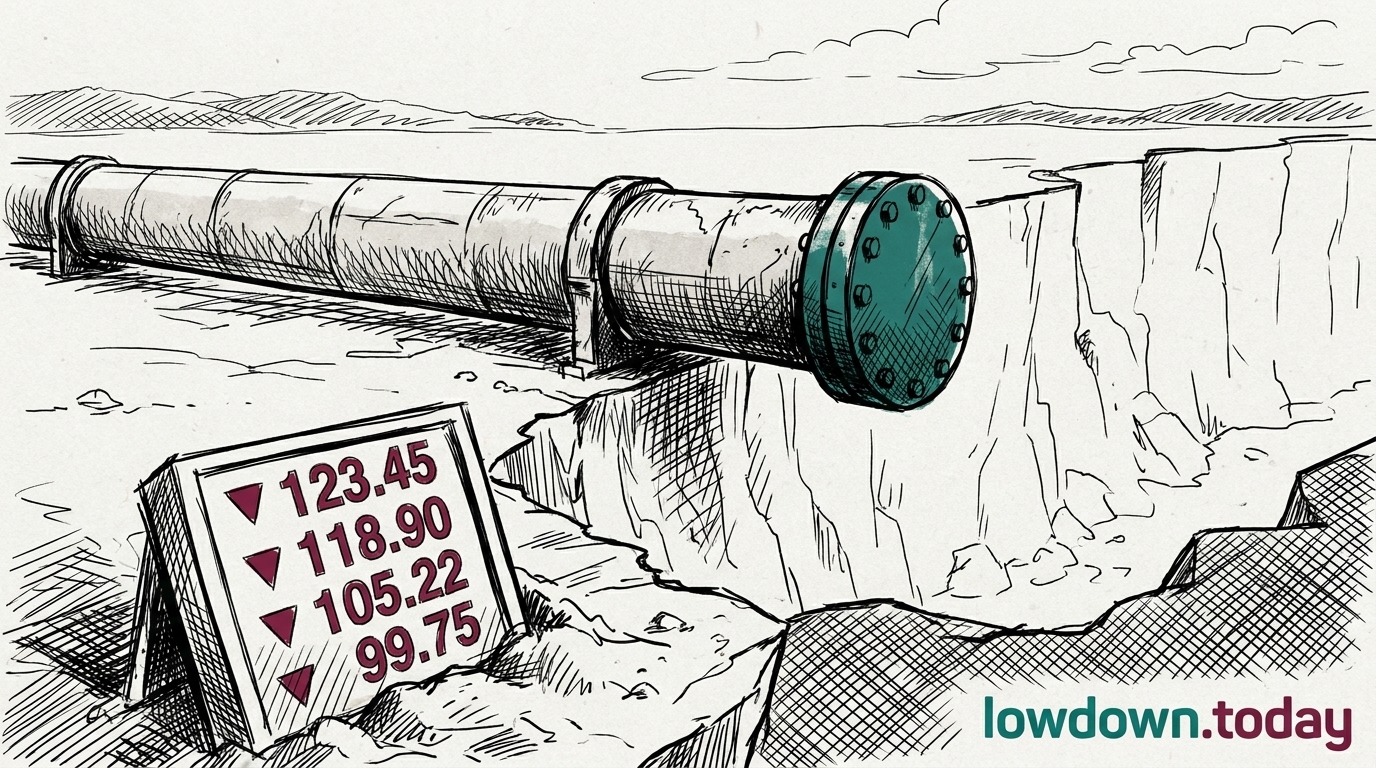
Brent falls 8% on phantom peace talks

1 min read
12:45UTC

Brent crude dropped to $97 on Trump's negotiation claims, despite Iran's categorical rejection.

EconomicAssessed
Key takeaway

Oil prices reflect Trump's rhetoric, not Iran's actions; the paper-physical disconnect is at record levels.

Brent Crude (the international oil benchmark) fell to $96.68 per barrel on Wednesday, down from $104 at the start of the week but still 43% above the pre-war baseline of $67.41. The slide began Sunday when Donald Trump announced his 15-point ceasefire plan and continued despite Iran's categorical rejection.

Sunday's 10.9% crash to $99.94 reversed to $102-104 within 48 hours . Physical crude tells a different story from futures: the record $14.20-per-barrel spot premium means refiners pay an effective $111 or more for delivered barrels, even as paper barrels trade at $97. The Strait of Hormuz remains closed; the physical price is more likely to pull paper up than reverse.

For British drivers, the war has added roughly 15p per litre at the pump since February. A return to the $126 peak would push that toward 30p. Goldman Sachs head of oil research Daan Struyven raised the probability of US recession to 25% at oil above $120 .


Deep Analysis

In plain English

Oil prices dropped because traders believe Trump is close to a deal with Iran. But Iran publicly rejected the deal. When that gap closes, prices will jump back up and petrol will get more expensive again.

What could happen next?
  • Risk

    Rapid upward correction likely when rejection registers

  • Consequence

    Record backwardation strains refiner working capital

First Reported In

Update #48 · Iran rejects ceasefire; Kharg fortified

CNBC· 26 Mar 2026
Read original
Causes and effects
This Event
Brent falls 8% on phantom peace talks
Markets are pricing rhetoric over reality; when Iran's rejection registers, a rapid correction could strain derivatives markets at record backwardation.
Different Perspectives
Gulf oil producer
Gulf oil producer
Secured OPEC's confirmed 188,000 b/d September increment with the next meeting set for 6 September, but the Secretariat's own 2 August release says nothing about the fourth quarter. Output guidance beyond September remains undisclosed even as delegate sourcing keeps filling that gap.
Money manager positioned in WTI
Added 21,402 lots to a 108,307 net long in NYMEX WTI in the week to 28 July, against just 1,485 added to Brent's 15,740, a roughly fourteen-to-one split. Conviction sits in the American benchmark even as the European diesel story sets the record.
Indian refiner buying Urals
Bought Russian crude at a discount that narrowed to $1-2 a barrel in the week to 29 July from over $10, as Hormuz risk pushed it toward Urals. If that risk eases with the strike now called off, the discount it is currently enjoying could re-widen just as fast.
Russian diesel exporter
Novak tied any lifting of the diesel export ban, due to lapse 31 July, to an unspecified market recovery with no date, and pushed the gasoline ban to end-2026. An open-ended constraint suits an exporter benefiting from the record European crack it feeds.
War-risk underwriter
Withdrew war-risk cover for Saudi-linked hulls on 24 July and has not reinstated it, holding Bab el-Mandeb tanker transits near 7.5 a day. A cancelled strike does not by itself trigger the committee review needed to re-accept the class.
Northwest European refiner
Sources only 17% of diesel imports from Saudi Red Sea ports against the Mediterranean's 24%, so the ARA crack at $85.86 trails the Med print by $5.81. Lower Red Sea exposure is cushioning it against the rerouting cost, not eliminating it.



