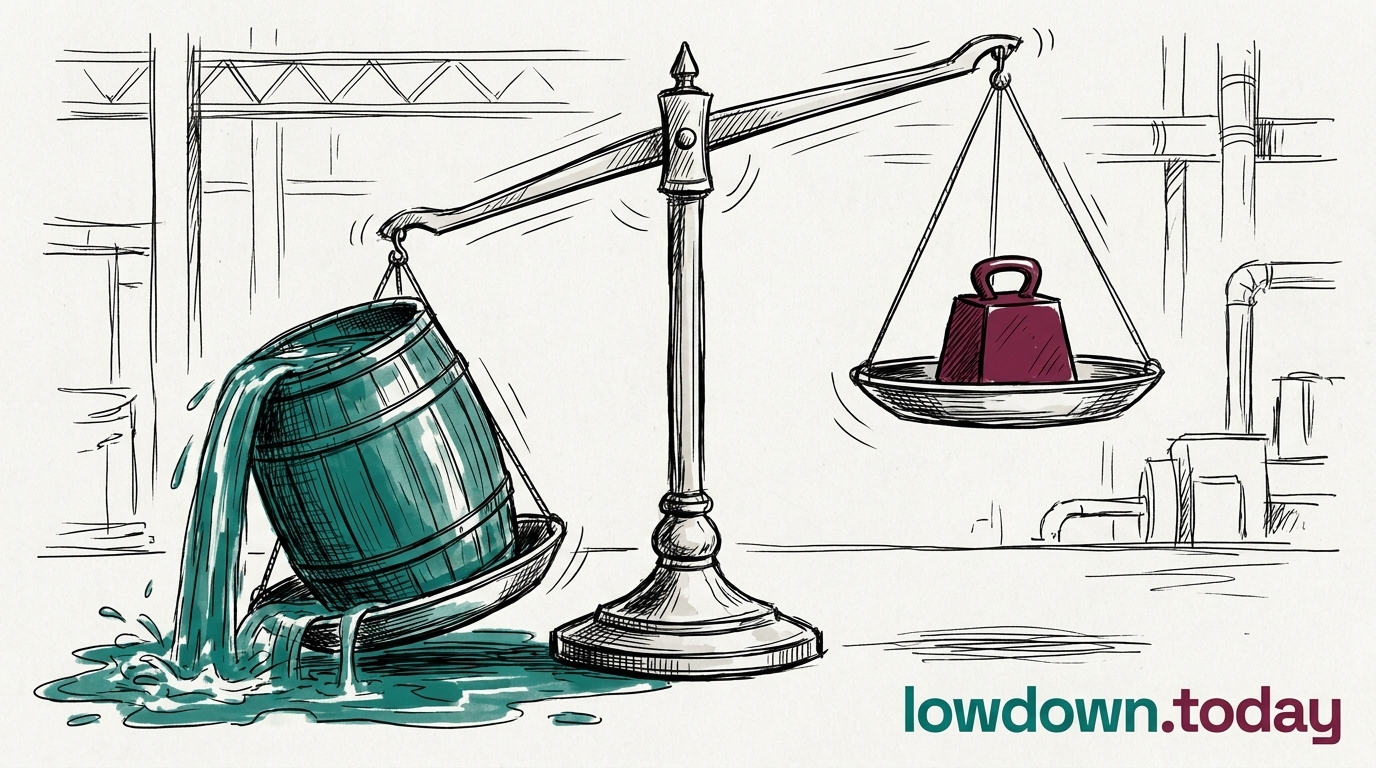
Brent Crude hit $119.50 per barrel on Monday morning — the highest since 2022 and a 77% rise from $67.41 on 27 February, the day the war began. WTI reached $119.48. By the US close, Brent had settled at $98.96, sinking below $90 in after-hours trading. WTI settled at $94.77. The $30 intraday reversal was driven by Trump's 'very soon' language on ending the war and profit-taking on overcrowded long positions.
The $30 swing dwarfs normal oil market volatility. Brent's average daily range through 2025 was approximately $2. Even during the 2020 pandemic price collapse, intraday moves rarely exceeded $10. Last Friday, US crude futures posted a 35.63% weekly gain — the largest since the contract began trading in 1983. Qatar's energy minister warned of $150 per barrel if Hormuz remains closed. The market touched $119 and flinched — but the flinch was triggered by a presidential remark, not by any change in the physical supply picture. Brent had been at $116.08 just three days ago, itself a 72% rise in under two weeks. The 1990 Iraqi invasion of Kuwait doubled oil prices over two months; this war achieved the same effect in ten days and then gave back a third of it in an afternoon.
The underlying supply disruption has not changed. Tanker traffic through Hormuz remains down approximately 70%. Kuwait's force majeure removed 300,000 barrels per day from export markets. Combined with Iraq's curtailments of approximately 1.5 million barrels per day, roughly 3.5 million barrels per day of Gulf production capacity is shut in or unable to reach market. No tanker insurance has been restored. No diplomatic off-ramp for Hormuz has materialised. The fundamental imbalance — supply removed, demand unchanged — is identical to what it was at $119 in the morning. What moved was sentiment, and sentiment moved on words.
The question for Tuesday's Asian open is whether $90 or $100 becomes the new floor. If $90 holds, the oil shock remains a market event — painful but absorbable for import-dependent economies, even those already strained (South Korea's KOSPI triggered two circuit breakers in four sessions,. If $100 holds, it crosses into macroeconomic damage: compressed industrial margins, inflationary pressure on food and transport costs across Asia and Europe, and political pressure on governments to release strategic petroleum reserves or seek bilateral supply deals outside The Gulf. The market is not pricing oil. It is pricing the probability that one man's 'very soon' means what it says.




