Skip to content
Briefings are running a touch slower this week while we rebuild the foundations.See roadmap
European Energy Markets
4MAY

EU storage at 34.3% before 12 May test

3 min read
13:52UTC

EU aggregate gas storage reached 34.3% on 7 May, an injection pace of 0.248 pp/day that sits 0.009 pp/day below the 0.257 pp/day floor needed for 80% by 1 November.

EconomicDeveloping
Key takeaway

The 12 May 35% test is now four working days away with the pace 0.009 pp/day inside the November floor.

EU aggregate gas storage reached 34.3% on 7 May, GIE AGSI+ (Aggregated Gas Storage Inventory) data shows, a 1.24 percentage-point gain on the 33.06% reading from 2 May . The implied pace, 0.248 pp/day, sits 0.009 pp/day inside the 0.257 pp/day floor that update #7 set as the threshold for clearing 80% by 1 November . The 35% threshold sits 0.7 pp away with four working days before the 12 May WATCH FOR resolves.

GIE AGSI+ is the EU's transparency feed for member-state and facility-level fill, published daily. The pace floor is not arbitrary: it is what the 1 November target requires from a 33.06% start. Below it, every session adds a forward-curve problem the front month cannot reflect, because the gap compounds rather than resolves.

At the 0.248 pp/day pace, the 35% threshold crosses on 10 or 11 May. A holiday-weekend deceleration or any aggregate slip pushes that crossing past the 12 May test. Bruegel's EUR 26 billion refill model assumes the floor is met, not stress-tested for the inverse case where merchant operators face inverted spreads. Germany's structural shortfall is the composition risk inside the aggregate, and the next event takes that down to facility level.


Deep Analysis

In plain English

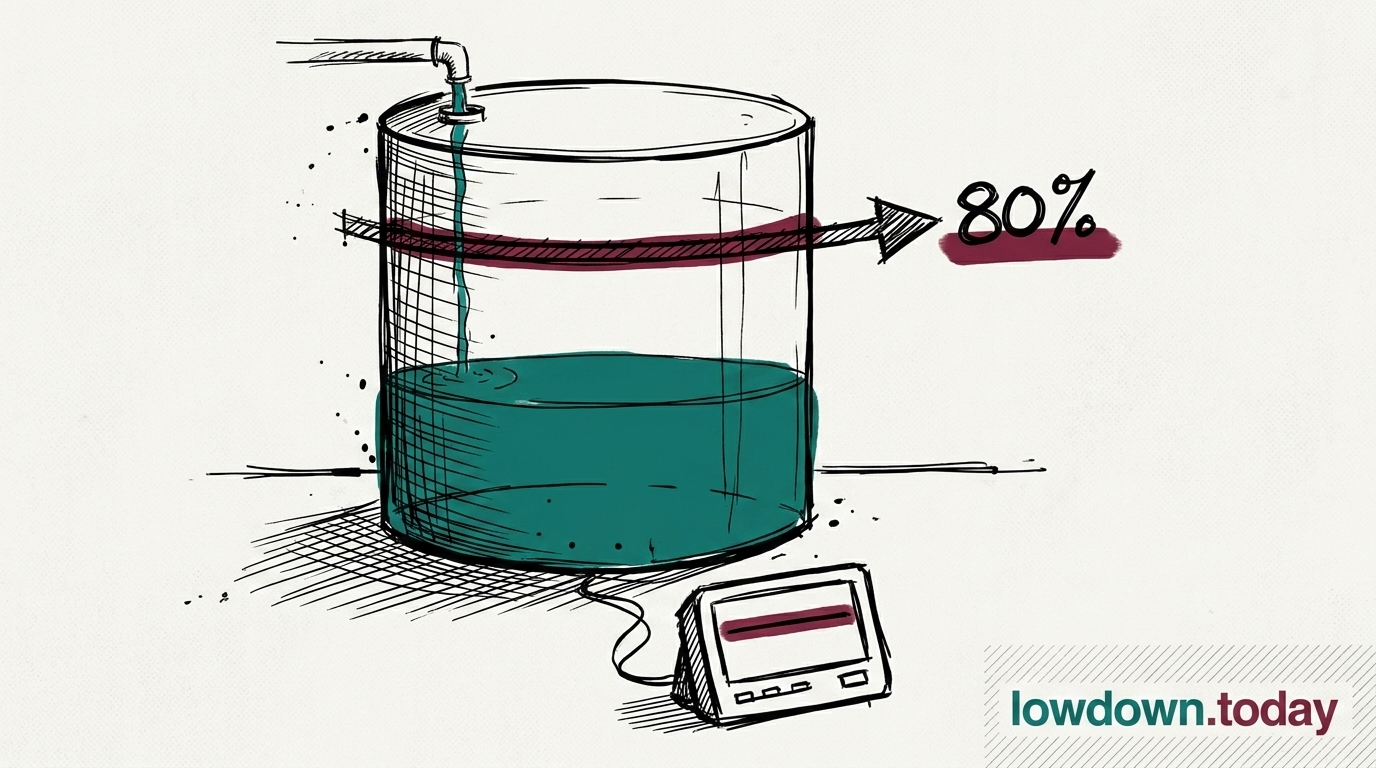
Each year, European countries spend the warm months pumping natural gas into underground storage tanks to prepare for winter. There is a target: reach 80% full by 1 November. Think of it like filling a reservoir before a dry season. As of 7 May, the fill level is 34.3%, rising at 0.248 percentage points per day. To reach 80% by November, Europe needs 0.257 points per day. The gap is small, nine thousandths of a percentage point, but it compounds each day it persists. On 12 May there is a test date: if storage has not crossed 35% by then, it signals the shortfall is structural rather than a slow week. Structural means fixing it becomes progressively harder because the required catch-up rate increases daily.

Deep Analysis
Root Causes

The 0.257 pp/day floor was set against a storage baseline of 33.06% on 2 May (ID:3029) with 183 days remaining to 1 November. The required pace follows directly from that starting point. What makes the shortfall structural rather than seasonal is the removal of the gas storage levy on 1 January 2026, the instrument that previously shifted merchant incentives toward injection at spreads where commercial logic would otherwise favour withdrawal or deferred commitment.

Without the levy, injection pace is a function of the summer–winter TTF spread adjusted for storage capacity rental, injection energy cost, and financing cost. At EUR 44/MWh TTF front-month against a EUR 52–55/MWh Cal-26 Q4 implied level, the spread may not clear the all-in injection cost for high-marginal-cost cavern operators.

Bruegel's EUR 26bn refill model (ID:2822) bakes in the floor being met; it does not stress-test the case where below-floor pace is the market-clearing outcome rather than the deviation.

What could happen next?
  • Risk

    If EU aggregate pace stays at 0.248 pp/day through June, the November fill projects to 73-75%, below the 80% threshold, triggering Commission emergency review procedures.

    Medium term · 0.7
  • Consequence

    Below-floor pace removes the core assumption in Bruegel's EUR 26bn refill model (ID:2822); the inverse scenario where the same spend buys 73% rather than 80% fill has not been publicly costed.

    Short term · 0.8
  • Precedent

    The removal of the gas storage levy on 1 January 2026 is the first test of whether the EU can achieve its November fill target on commercial incentives alone, without the levy's injection subsidy.

    Long term · 0.85
First Reported In

Update #8 · Storage 34.3 as 12 May test nears; Hammerfest silent

EnergyRiskIQ (aggregating GIE AGSI+)· 8 May 2026
Read original
Different Perspectives
Hungary and Slovakia
Named in ACER's derogation list as the two EU member states most dependent on TurkStream, Hungary and Slovakia face a binary regulatory path: grant derogations exempt them from REMIT standards at the Russian gas entry point from 5 August, or compliance requires a third-country cooperative step neither Russia nor Turkey has treaty-based reason to provide.
Asian LNG buyers (China, Japan, South Korea)
With JKM sitting USD 2.90-3.30/MMBtu above TTF and European buyers below the cargo-diversion breakeven by USD 0.95-1.25/MMBtu, flexible Atlantic LNG cargoes continue routing east. Asian buyers are the primary beneficiaries of any reopening dividend until the JKM-TTF spread compresses below the diversion threshold.
Iran / IRGC
Iran / IRGC
Iran converted Hormuz operational control into a codified permit system on 7 May, formalising the wartime gain through a named institution, the Persian Gulf Strait Authority, and fee-charging arrangements. TTF's non-reaction to both Project Freedom's launch and its 48-hour collapse confirms markets treat Iran's Hormuz position as structural, not temporary.
European Commission (DG Energy)
The Commission's AccelerateEU decision on 22 April, confirmed at the Cyprus summit, chose untargeted consumer relief over any storage injection mechanism. At 0.248 pp/day, that choice is producing the outcome Bruegel's model did not stress-test: the EUR 26bn bill may buy 73% rather than 80% without a pace instrument.
ACER
ACER
ACER's 6 May derogation opinions formalise the structural limit of EU network code enforcement: where Russian and Turkish TSOs are counterparties, EU standards bind only to the EU border, and Hungary and Slovakia bear the derogation exposure. The Commission, not ACER, holds the final decision on whether to grant the derogations ahead of 5 August.
Equinor
Equinor
Equinor reported USD 9.77bn adjusted operating income in Q1 2026 and confirmed a second USD 375m share buyback, but passed its most natural disclosure opportunity without issuing any Hammerfest LNG return-date guidance. The company's institutional pattern, silence until restart, leaves market positions priced against a July return the empirical record does not support.
