Skip to content
You can now search across every topic, entity and event.What's new
European Energy Markets
31JUL

Majlis approves Hormuz toll bill

2 min read
09:44UTC

A key Majlis committee approved the Hormuz toll bill, advancing legislation that would permanently ban US and Israeli vessels and require fees in Iranian rial from all other shipping. Once codified, the toll becomes reversible only through domestic political process ; no future ceasefire can unwind it.

EconomicDeveloping
Key takeaway

Committee approval advances legislation that would make Hormuz's contested status a matter of Iranian domestic law, not merely military posture.

The Majlis committee approved the Hormuz toll legislation on 1 April, advancing a bill that permanently bans US and Israeli vessels from the strait and requires fees in Iranian rial from all other shipping. The bill had been drafted in parliament on Day 25, moved to committee stage on Day 32, and has now cleared committee. Full parliamentary vote, Guardian Council review, and presidential signature remain.

There is a fundamental difference between the IRGC imposing a toll because it controls a strait and the Iranian Parliament enacting a law that makes the toll a statutory requirement. The first is a military fact reversible by military defeat. The second is a legal instrument reversible only by domestic political process. Iran had already demanded Hormuz sovereignty as a formal peace condition ; the legislation converts that negotiating demand into permanent law.

The bill bans US and Israeli vessels explicitly and requires fees in Iranian rial, forcing buyers to transact in a sanctioned currency. The NPT withdrawal bill is advancing on the same legislative track . Both bills are designed to survive any ceasefire: a ceasefire can stop the shooting, but it cannot repeal domestic Iranian legislation.

The IRGC's toll system had already been operating since around Day 12, with Chinese state ships paying and crossing . Codifying the practice into permanent law removes any ambiguity about whether a future Iranian government could unilaterally rescind it. If Trump withdraws in two to three weeks without securing this bill's reversal, the US leaves behind a legal architecture that makes Hormuz permanently contested.


Deep Analysis

In plain English

The Iranian parliament is voting on a law that would permanently charge ships money to use the Strait of Hormuz ; a narrow channel through which about one in five barrels of the world's oil passes. Right now, Iran is blocking the strait militarily during the war. This law would make that blockade permanent and legal under Iranian law, even after the war ends. American and Israeli ships would be banned outright. This matters because there is a big difference between Iran blocking the strait with soldiers, which can be reversed, and Iran blocking it with a law, which can only be reversed by Iran itself choosing to change the law.

Deep Analysis
Root Causes

The toll bill was drafted as a direct response to US and Israeli strikes on Iranian infrastructure. It converts an emergency military response into a permanent economic instrument, institutionalising the leverage Iran discovered it holds over global energy markets.

What could happen next?
  • Precedent

    First instance of a state attempting to codify transit fees for an international strait into domestic law, potentially triggering a global UNCLOS legal challenge.

    Long term · Assessed
  • Consequence

    A ceasefire that leaves the Hormuz toll law in place fails to address the economic cause of the oil price spike.

    Medium term · Assessed
  • Risk

    Guardian Council and presidential signature stages create multiple veto points, but each ratification stage makes repeal politically harder.

    Short term · Reported
First Reported In

Update #54 · Trump declares victory and withdrawal

Fraunhofer ISE energy-charts (redistributing Bundesnetzagentur SMARD under CC BY 4.0)· 1 Apr 2026
Read original
Different Perspectives
Spain's LNG terminal operators
Spain's 9,145 GWh terminal inventory is the largest single stock in the EU LNG network, an option value that can reroute cargoes wherever the winter strip pays best rather than a cavern gas obligation tied to a fixed date. That flexibility matters more as Germany's cavern shortfall pushes more of the winter security question onto import infrastructure.
European Commission
European Commission
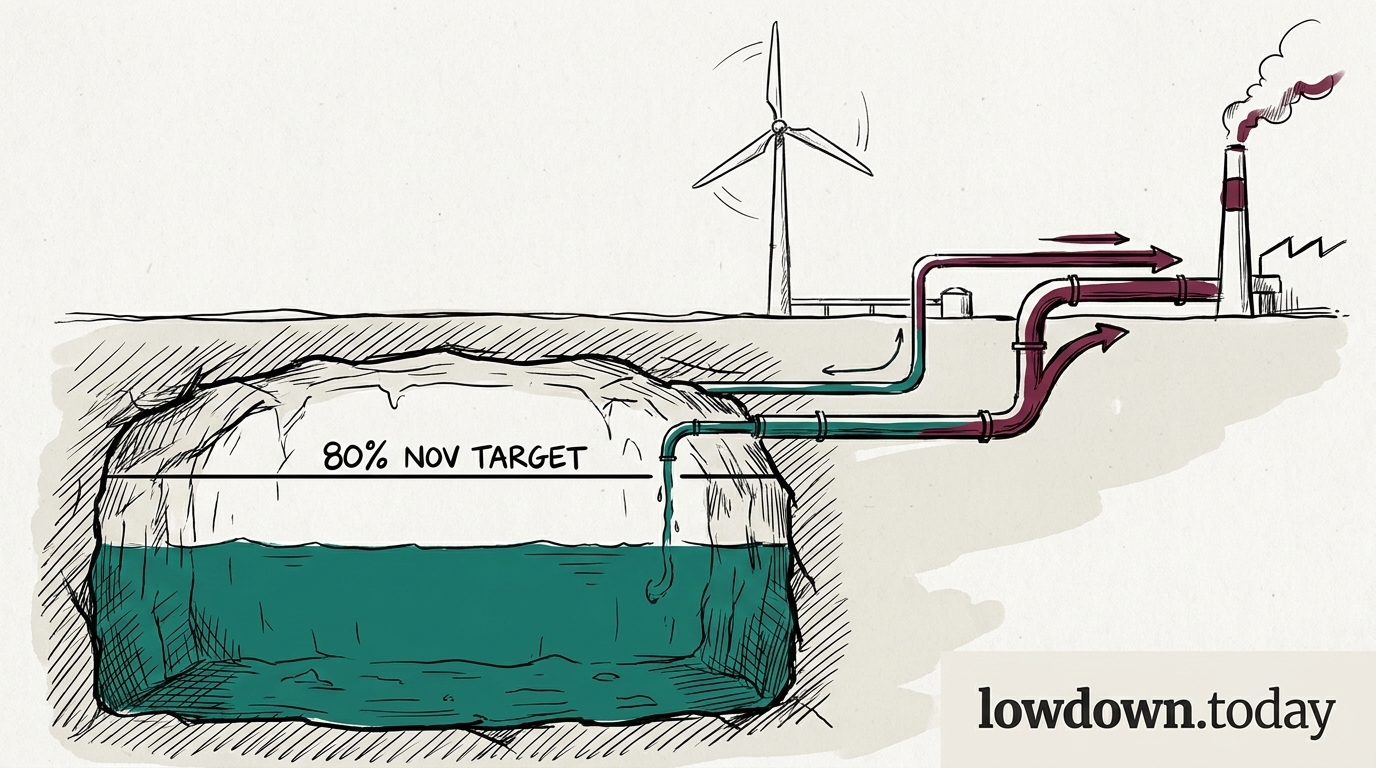
Brussels holds the bloc to 90% on a flexible window while Germany, holding roughly a quarter of EU storage capacity, tracks toward missing its own lower 80% figure by 21 points. A national shortfall this size in the anchor market matters more to bloc security than the flexible timetable alone can absorb.
French power exporters and CRE
French day-ahead rose in step with Germany but by less, reopening a EUR 7-17 premium that makes northward export flows commercially attractive again after the EUR 43.09 discount evaporated in days. CRE separately authorised RTE and Enedis to buy flexibility locally, betting the coming winter's binding constraint is grid congestion rather than a shortage of firm capacity.
TTF trading desk
TTF trading desk
A visible national shortfall like Germany's 21-point gap is a directional signal, not noise, for a desk holding the summer-winter spread. TTF's flat EUR 58-60 range through this week's German price swings says the market has not yet chosen to reprice refill risk into the front of the curve.
German cavern and CCGT operators
German caverns kept buying prompt gas at TTF near EUR 58-60 through the inversion; the wind collapse to 2.4 GW then flipped the spark spread to plus EUR 29 and put turbines back in the same queue. Every day turbines win that bid, injection at a third of the 877 GWh/day pace needed falls further behind.
Slovakia
Slovakia
Slovakia says it dropped its hold-out on the 21st sanctions package only after Ursula von der Leyen personally signed written gas-price and supply guarantees. The Council of the European Union's own 17,238-character release on the package names neither Slovakia nor any guarantee, leaving Bratislava's account unconfirmed by the institutional record.



