Skip to content
You can now search across every topic, entity and event.What's new
European Energy Markets
31JUL

Iran cluster warhead hits three cities

2 min read
09:44UTC

The first confirmed cluster-warhead ballistic missile in this conflict turned three cities into area targets on the same day Israel's missile shield neared zero.

EconomicDeveloping
Key takeaway

Iran is matching new weapons to Israel's defence gap, turning each missile into an area threat.

A ballistic missile carrying a cluster-bomb warhead struck central Israel on 31 March, scattering submunitions across Bnei Brak, Ramat Gan, and Petah Tikva. 1 Six people were lightly injured. It was the first confirmed use of a cluster warhead on a ballistic missile in this conflict.

Cluster munitions scatter bomblets across a wide area. Against urban targets, they bypass the point-defence logic of interceptors: even a successful interception may not catch every submunition. The tactical shift suggests Iran is adapting to the interception window that remains before Arrow-3 stocks run out entirely. The USS Tripoli arrived days ago with 3,500 Marines , confirming that Tehran's intelligence services have demonstrated awareness of coalition planning. The cluster warhead's timing, coinciding with RUSI's projected Arrow-3 exhaustion, may reflect similar intelligence-driven calibration.

The three cities hit sit in the Greater Tel Aviv area, the densest urban corridor in Israel. If cluster warheads become standard payload on Iranian medium-range missiles, each launch becomes an area-wide threat rather than a single-point strike. The multiplication effect on civilian risk is substantial. Israel's 6,131 hospitalisations since 28 February already exceed total casualties from the entire 2006 Lebanon War. Undefended cluster warhead strikes would accelerate that count sharply.


Deep Analysis

In plain English

A cluster bomb is a weapon that opens in mid-air and releases dozens or hundreds of smaller bomblets over a wide area, rather than hitting one point. Iran put this type of warhead on a ballistic missile and fired it at central Israel for the first time. Six people were lightly injured this time. The worry is what happens when Israel's missile defence system, which intercepts incoming missiles, runs out of interceptors. RUSI projected that might happen by end of March. If the shield is exhausted and these area-effect weapons keep arriving, they land across entire city blocks rather than one building. That changes the casualty risk from dozens to potentially hundreds per strike.

Deep Analysis
Root Causes

GPS jamming across both Hormuz and Bab al-Mandeb has degraded missile accuracy for both sides. Iran's shift to cluster warheads bypasses the precision problem: area-effect weapons achieve their tactical purpose without requiring a direct hit.

Arrow-3 depletion creates a window of opportunity. Against an undefended target, even a conventional warhead lands with certainty. A cluster warhead against a partially defended target increases the probability that at least some submunitions reach civilians even if the main body is intercepted. This is military adaptation to a specific defence gap rather than an arbitrary escalation.

Iran's IRGC Aerospace Force has faced internal criticism over mismanagement and near-suicidal launch conditions. Switching to a weapon that does not require precision reduces the operational demand on crews while maintaining psychological pressure on Israeli urban populations.

What could happen next?
  • Risk

    If cluster warheads become standard Iranian payload, each missile launch becomes an area-wide threat rather than a single-point strike, multiplying civilian casualty risk in any city targeted.

    Immediate · 0.8
  • Consequence

    Even partially successful interceptions may not catch all submunitions, reducing the practical effectiveness of remaining missile defence assets.

    Immediate · 0.85
  • Precedent

    First confirmed use of cluster warheads on ballistic missiles in this conflict establishes a qualitative threshold that may prompt Israeli or US pressure for expanded rules of engagement.

    Short term · 0.7
  • Risk

    Post-conflict unexploded submunitions in urban Israeli areas will cause civilian casualties for years after any ceasefire.

    Long term · 0.9
First Reported In

Update #53 · Trump drops Hormuz goal; toll becomes law

Times of Israel· 31 Mar 2026
Read original
Causes and effects
This Event
Iran cluster warhead hits three cities
Cluster warheads on ballistic missiles shift the threat from single-point strikes to area-wide civilian danger, arriving as upper-tier interceptors approach exhaustion.
Different Perspectives
Spain's LNG terminal operators
Spain's 9,145 GWh terminal inventory is the largest single stock in the EU LNG network, an option value that can reroute cargoes wherever the winter strip pays best rather than a cavern gas obligation tied to a fixed date. That flexibility matters more as Germany's cavern shortfall pushes more of the winter security question onto import infrastructure.
European Commission
European Commission
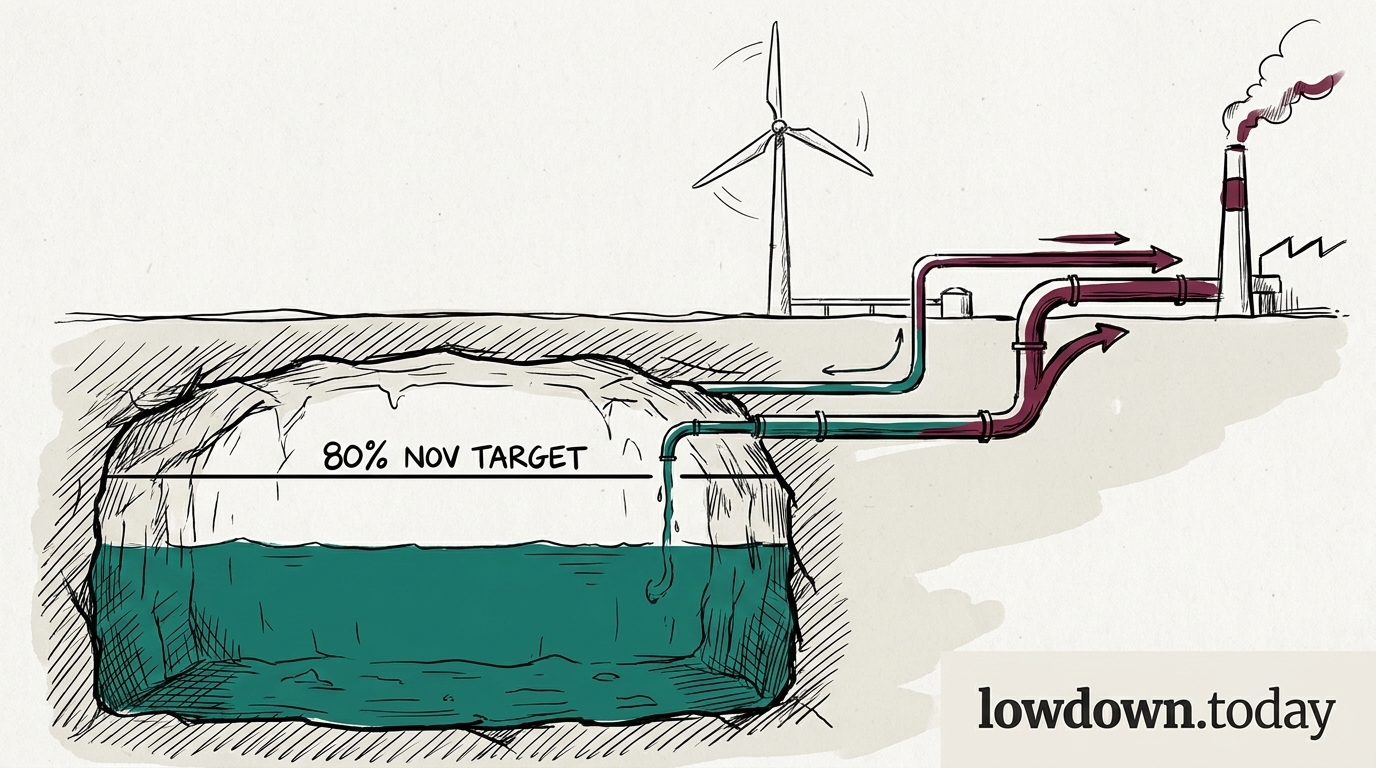
Brussels holds the bloc to 90% on a flexible window while Germany, holding roughly a quarter of EU storage capacity, tracks toward missing its own lower 80% figure by 21 points. A national shortfall this size in the anchor market matters more to bloc security than the flexible timetable alone can absorb.
French power exporters and CRE
French day-ahead rose in step with Germany but by less, reopening a EUR 7-17 premium that makes northward export flows commercially attractive again after the EUR 43.09 discount evaporated in days. CRE separately authorised RTE and Enedis to buy flexibility locally, betting the coming winter's binding constraint is grid congestion rather than a shortage of firm capacity.
TTF trading desk
TTF trading desk
A visible national shortfall like Germany's 21-point gap is a directional signal, not noise, for a desk holding the summer-winter spread. TTF's flat EUR 58-60 range through this week's German price swings says the market has not yet chosen to reprice refill risk into the front of the curve.
German cavern and CCGT operators
German caverns kept buying prompt gas at TTF near EUR 58-60 through the inversion; the wind collapse to 2.4 GW then flipped the spark spread to plus EUR 29 and put turbines back in the same queue. Every day turbines win that bid, injection at a third of the 877 GWh/day pace needed falls further behind.
Slovakia
Slovakia
Slovakia says it dropped its hold-out on the 21st sanctions package only after Ursula von der Leyen personally signed written gas-price and supply guarantees. The Council of the European Union's own 17,238-character release on the package names neither Slovakia nor any guarantee, leaving Bratislava's account unconfirmed by the institutional record.



