Skip to content
You can now search across every topic, entity and event.What's new
European Energy Markets
31JUL

Iran writes Hormuz toll into statute

3 min read
09:44UTC
EconomicDeveloping

Iran's Islamic Consultative Assembly (the Majlis) is drafting legislation to formalise the strait of Hormuz toll as Iranian domestic law, with finalisation due next week, according to an unnamed lawmaker cited by Fars news agency. 1 The bill would codify what began as an IRGC field improvisation into statute, transforming a wartime military mechanism into a permanent legal claim over one of the world's critical waterways.

The significance of the timing cannot be overstated. IRGC Navy Commander Admiral Alireza Tangsiri, the man who personally built the toll and vetting system from scratch, was killed in an Israeli airstrike hours before this legislation was publicly confirmed. He was killed at 3am on Wednesday. By that afternoon, the Majlis legal committee in Tehran was drafting his toll system into permanent law. Twenty-six vessels have now transited under the IRGC vetting regime; operators submit IMO numbers, cargo manifests, and crew names to IRGC-connected intermediaries, receive a clearance code, and follow an approved route under escort past Larak Island. At least two paid in Chinese yuan. India continues to transit while denying it pays. 2

Iran's UN representative told the IMO this week that vessels linked to 'aggressor parties' have forfeited the right of innocent passage, the international law principle that merchant ships may transit straits freely. 3 Iran frames its vetting system not as a blockade but as legitimate self-defence, a framing designed to survive any post-ceasefire legal challenge.

The closest historical parallel is Egypt's 1957 Suez Canal nationalisation law, which survived the tripartite invasion and became the permanent legal basis for Egyptian canal authority. Iran appears to be following the same playbook: establish physical control during a crisis, then legislate before the crisis ends, so that any resolution begins from the new legal baseline rather than the pre-war status quo. The right of innocent passage existed for decades before this week. Iran told the IMO it no longer applies to hostile parties. If that position is codified in domestic law, every future negotiation over Hormuz will begin from the position that Iran holds a legal claim, not merely a physical one.


Deep Analysis

In plain English

Iran is writing a law that says it can permanently charge ships to pass through the Strait of Hormuz, not just during the war. About 20% of the world's oil travels through this narrow waterway. If that law passes, every barrel of oil, every container of goods, and every tonne of grain that moves through the strait costs more, because a toll gets baked into the price. That cost eventually lands on consumers worldwide in fuel prices, heating bills, and food costs. The clever part, from Iran's perspective, is that a law is much harder to undo than a military order: bombing a toll booth is one thing, repealing another country's legislation is something else entirely.

Deep Analysis
Root Causes

Iran is not merely closing a strait but creating a domestic legal framework that will require treaty-level renegotiation, not just military pressure, to dismantle.

The Majlis drafting process converts a wartime military mechanism into permanent domestic statute. Once codified, reversal requires legislative repeal, not military defeat.

The underlying structural cause is Iran's three-sided physical control of the strait, which no military operation can alter without permanent occupation.

First Reported In

Update #49 · Hormuz toll into law; Tangsiri killed

Bloomberg· 27 Mar 2026
Read original
Different Perspectives
Spain's LNG terminal operators
Spain's 9,145 GWh terminal inventory is the largest single stock in the EU LNG network, an option value that can reroute cargoes wherever the winter strip pays best rather than a cavern gas obligation tied to a fixed date. That flexibility matters more as Germany's cavern shortfall pushes more of the winter security question onto import infrastructure.
European Commission
European Commission
Brussels holds the bloc to 90% on a flexible window while Germany, holding roughly a quarter of EU storage capacity, tracks toward missing its own lower 80% figure by 21 points. A national shortfall this size in the anchor market matters more to bloc security than the flexible timetable alone can absorb.
French power exporters and CRE
French day-ahead rose in step with Germany but by less, reopening a EUR 7-17 premium that makes northward export flows commercially attractive again after the EUR 43.09 discount evaporated in days. CRE separately authorised RTE and Enedis to buy flexibility locally, betting the coming winter's binding constraint is grid congestion rather than a shortage of firm capacity.
TTF trading desk
TTF trading desk
A visible national shortfall like Germany's 21-point gap is a directional signal, not noise, for a desk holding the summer-winter spread. TTF's flat EUR 58-60 range through this week's German price swings says the market has not yet chosen to reprice refill risk into the front of the curve.
German cavern and CCGT operators
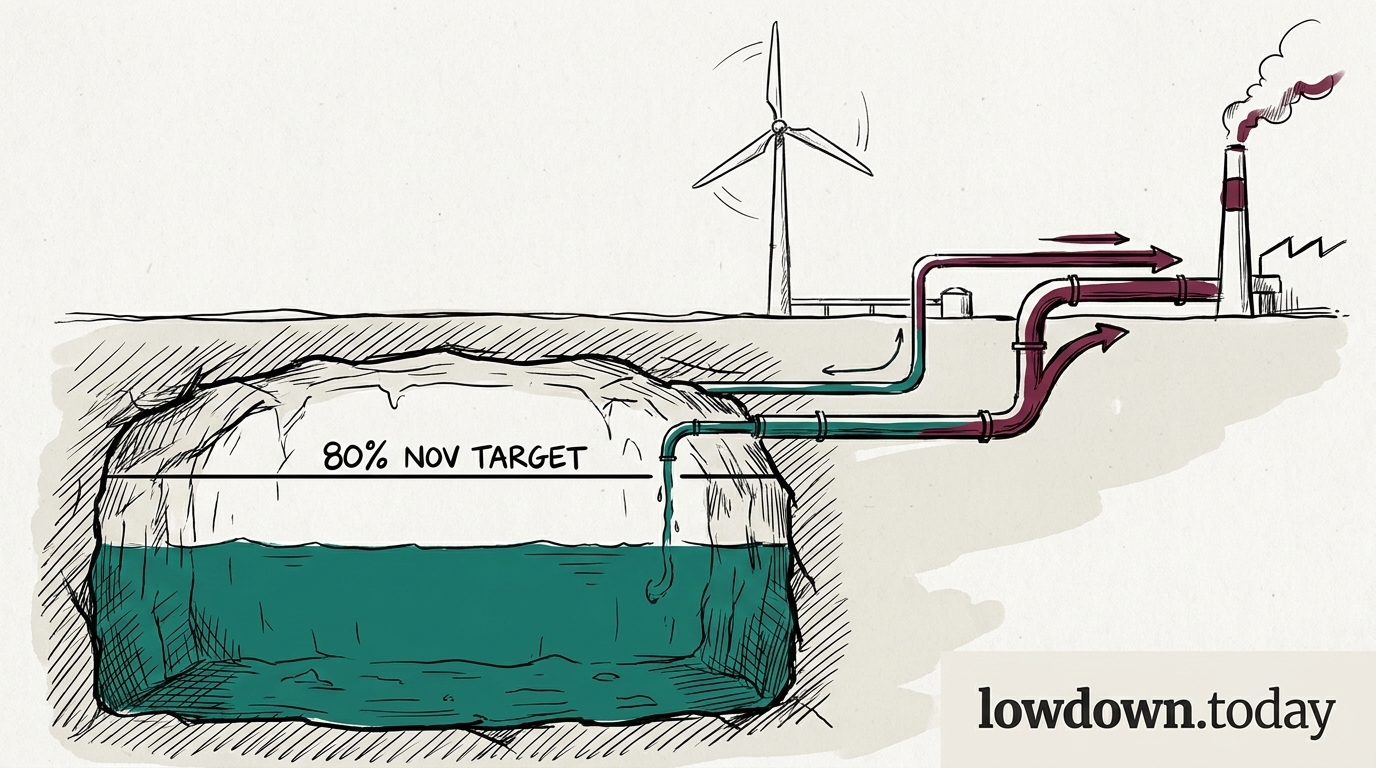
German caverns kept buying prompt gas at TTF near EUR 58-60 through the inversion; the wind collapse to 2.4 GW then flipped the spark spread to plus EUR 29 and put turbines back in the same queue. Every day turbines win that bid, injection at a third of the 877 GWh/day pace needed falls further behind.
Slovakia
Slovakia
Slovakia says it dropped its hold-out on the 21st sanctions package only after Ursula von der Leyen personally signed written gas-price and supply guarantees. The Council of the European Union's own 17,238-character release on the package names neither Slovakia nor any guarantee, leaving Bratislava's account unconfirmed by the institutional record.



