Skip to content
You can now search across every topic, entity and event.What's new
European Energy Markets
31JUL

Iran tables bill to leave NPT

2 min read
09:44UTC

A bill to withdraw from the Non-Proliferation Treaty appeared on parliament's portal as priority legislation. If passed, Iran would be the second state after North Korea to leave.

EconomicAssessed
Key takeaway

The bill's filing converts a threat into a legislative fact.

MP Malek Shariati uploaded the NPT withdrawal bill to the Islamic Consultative Assembly's parliamentary portal on 28 March, tagged as 'priority legislation.' 1 National security Commission spokesman Ebrahim Rezaei stated the treaty 'has had no benefit for us.' The bill would simultaneously revoke all JCPOA restrictions and propose a replacement nuclear treaty with SCO and BRICS member states.

Strikes hit the yellowcake facility at Yazd and the Khondab Heavy Water Complex near Arak. The IAEA has not verified 440 kg of 60%-enriched uranium for eight months . If the NPT did not prevent those strikes and cannot enforce its own verification framework, the incentive to remain evaporates.

The Majlis has not held formal sessions since 28 February. A vote is not imminent. But that may be the point: the bill exists as a loaded instrument that can be advanced the moment parliament reconvenes. The deterrence value comes from its existence, not its passage. North Korea withdrew from the NPT in 2003 and tested its first nuclear weapon three years later. No mechanism existed to restore oversight. Iran has studied that precedent carefully.

A counter-argument: filing a bill is cheap signalling; Iran has threatened NPT withdrawal before without acting. That reading underestimates the changed context. The IAEA's incident centre is activated to monitor repeated strikes on an operating nuclear reactor. The monitoring body designed to prevent a radiological catastrophe may lose its legal standing to act before the strikes stop. This is the nuclear safety paradox of Day 31: the institution is being targeted from above by projectiles and undermined from below by legislation.


Deep Analysis

In plain English

The NPT, or Nuclear Non-Proliferation Treaty, is an international agreement signed by most countries promising not to develop nuclear weapons. In exchange, countries with nuclear weapons agreed to help others use nuclear power peacefully. Iran has been a member but has had arguments with international inspectors for years. Now Iran's parliament has filed a bill that would have Iran leave the treaty entirely. If passed, the international inspectors monitoring Iran's nuclear sites would have to leave. There would be no international oversight of what Iran does with its nuclear materials. Only one country, North Korea, has ever left the NPT before. It tested a nuclear bomb three years after leaving.

Deep Analysis
Root Causes

Iran's calculation is explicit: if membership in the NPT did not prevent strikes on the Yazd yellowcake facility, the Khondab Heavy Water Complex, and repeated attacks on Bushehr, the treaty provides no security guarantee.

The IAEA has been unable to verify 440 kg of 60%-enriched uranium for eight months, demonstrating that Iran has already effectively suspended cooperation while remaining formally within the treaty. Withdrawal formalises a reality that exists operationally.

What could happen next?
  • Risk

    Passage would remove all IAEA oversight of Iranian nuclear facilities at the precise moment the incident centre is activated for repeated strikes on an operating reactor.

    Medium term · 0.85
  • Precedent

    A second NPT withdrawal would effectively terminate the treaty's deterrence value; no state would view NPT membership as a binding constraint in a security crisis.

    Long term · 0.9
  • Meaning

    The SCO and BRICS replacement framework proposal signals Iran is building a parallel nuclear governance structure aligned with China and Russia rather than the Western-dominated IAEA system.

    Medium term · 0.8
First Reported In

Update #52 · Trump wants Iran's oil; 3,500 Marines land

Al Jazeera / Tasnim News· 30 Mar 2026
Read original
Causes and effects
This Event
Iran tables bill to leave NPT
The bill converts a latent nuclear threat into a procedural fact. Passage would end all IAEA access to Iranian nuclear facilities and remove every legal constraint on weapons development.
Different Perspectives
Spain's LNG terminal operators
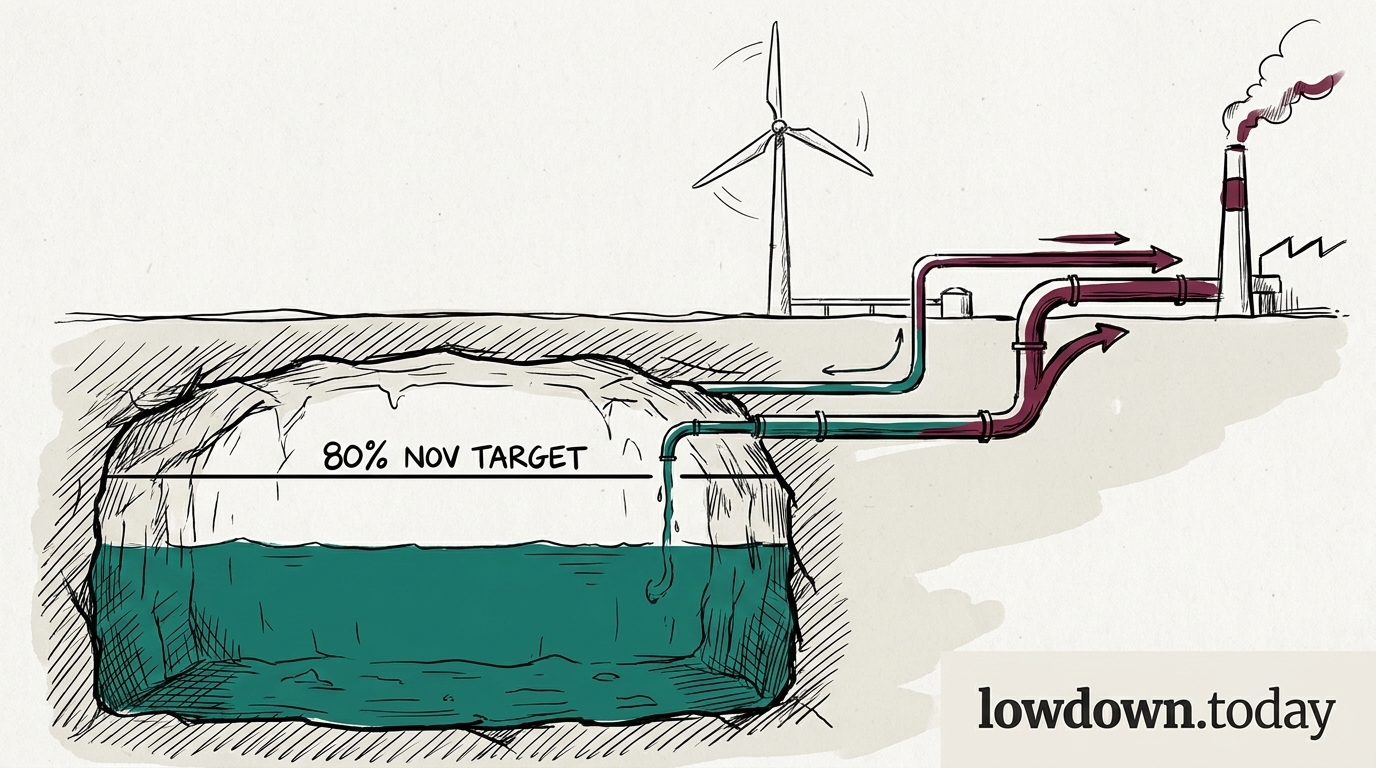
Spain's 9,145 GWh terminal inventory is the largest single stock in the EU LNG network, an option value that can reroute cargoes wherever the winter strip pays best rather than a cavern gas obligation tied to a fixed date. That flexibility matters more as Germany's cavern shortfall pushes more of the winter security question onto import infrastructure.
European Commission
European Commission
Brussels holds the bloc to 90% on a flexible window while Germany, holding roughly a quarter of EU storage capacity, tracks toward missing its own lower 80% figure by 21 points. A national shortfall this size in the anchor market matters more to bloc security than the flexible timetable alone can absorb.
French power exporters and CRE
French day-ahead rose in step with Germany but by less, reopening a EUR 7-17 premium that makes northward export flows commercially attractive again after the EUR 43.09 discount evaporated in days. CRE separately authorised RTE and Enedis to buy flexibility locally, betting the coming winter's binding constraint is grid congestion rather than a shortage of firm capacity.
TTF trading desk
TTF trading desk
A visible national shortfall like Germany's 21-point gap is a directional signal, not noise, for a desk holding the summer-winter spread. TTF's flat EUR 58-60 range through this week's German price swings says the market has not yet chosen to reprice refill risk into the front of the curve.
German cavern and CCGT operators
German caverns kept buying prompt gas at TTF near EUR 58-60 through the inversion; the wind collapse to 2.4 GW then flipped the spark spread to plus EUR 29 and put turbines back in the same queue. Every day turbines win that bid, injection at a third of the 877 GWh/day pace needed falls further behind.
Slovakia
Slovakia
Slovakia says it dropped its hold-out on the 21st sanctions package only after Ursula von der Leyen personally signed written gas-price and supply guarantees. The Council of the European Union's own 17,238-character release on the package names neither Slovakia nor any guarantee, leaving Bratislava's account unconfirmed by the institutional record.



