Skip to content
You can now search across every topic, entity and event.What's new
European Energy Markets
31JUL

Greece halts shipping in 24-hour strike

3 min read
09:44UTC

The world's largest shipowning nation shut down all maritime operations for 24 hours — the conflict's first labour action in a NATO member state.

EconomicDeveloping
Key takeaway

A Greek maritime strike timed to peak Gulf disruption is not an additive supply shock but a multiplicative one: it withdraws capacity from the alternative routes that global shipping is depending on to maintain non-Gulf trade flows.

Greece's Panhellenic Seamen's Federation enacted a 24-hour nationwide strike on Wednesday, halting all Greek ferry and ship operations. The federation confirmed at least 10 Greek-flagged vessels with 85 Greek crew stranded in the Persian Gulf, with more than 325 ships bearing Greek maritime interests in the broader region.

Greece is the world's largest shipowning nation by tonnage. The strike shut down domestic ferry services to Greek islands and inter-island transport — extending The Gulf's disruption into the daily lives of Greek citizens thousands of kilometres from the conflict. The connection between a Persian Gulf war and a ferry to Crete is the Panhellenic Seamen's Federation itself: the same union represents crews on Gulf tankers and Aegean ferries, and it used the only tool available to force political attention to stranded members.

The strike is a direct downstream consequence of the P&I insurance collapse. When Gard, NorthStandard, and three other major clubs cancelled war risk cover , Greek shipowners lost the ability to insure vessels for Gulf transits. Greek crews already inside The Gulf became trapped. the Union's position is straightforward: if the state and the shipowners cannot guarantee crew safety and repatriation, the Union will not permit any Greek maritime operations to continue.

The chain — insurance withdrawal, vessel stranding, labour action, domestic transport disruption — is self-reinforcing. Each link generates the next independent of whether the underlying military conflict continues or stops. Even a ceasefire would not immediately reverse it: insurers will not reinstate coverage on announcement, stranded vessels will not move until coverage is restored, and unions will not lift strikes until members are safe. The economic damage from The Gulf conflict is acquiring its own momentum.


Deep Analysis

In plain English

Greece owns more cargo ships than any other country — roughly one in five tonnes of goods shipped globally travels on a Greek-controlled vessel. When Greek maritime workers strike, even briefly, a substantial portion of the world's available shipping capacity stops moving. With Gulf ships already stuck at anchor, the total global cargo capacity drops sharply at exactly the moment it is most needed. Fewer ships available means higher freight rates, and higher freight rates mean higher import prices for goods ranging from electronics to clothing to food — effects that typically reach consumers within four to eight weeks.

Deep Analysis
Synthesis

The strike reveals a second-order feedback loop absent from Gulf War 1990: the conflict strands seafarers, stranded seafarers generate union political pressure, that pressure produces labour action, labour action further reduces global shipping capacity, reduced capacity raises freight rates, and higher rates create additional economic pressure for conflict resolution — a dynamic that compresses the political timeline for resolution independently of military developments.

Root Causes

Greek maritime unions retain unusually broad strike rights under Greek labour law, and the 'solidarity with stranded crew' framing provides political legitimacy that the Greek government would struggle to legally suppress — particularly given cross-party parliamentary support for maritime labour rights. The Federation's action is thus not purely economic but political, using the crisis to force the Greek state and the IMO to take a more active role in seafarer repatriation.

Escalation

If the Panhellenic Seamen's Federation extends or repeats the strike — likely if stranded crew members remain unrepatriated — and if Filipino, Indian, or Indonesian maritime unions (who collectively crew the majority of global vessels) act in solidarity, the labour dimension of the shipping crisis could become self-sustaining independent of the conflict's resolution.

What could happen next?
  • Meaning

    The strike signals that the conflict's maritime disruption has reached a threshold where it is generating domestic political consequences in non-belligerent NATO states, complicating alliance management for Washington.

    Immediate · Assessed
  • Consequence

    Freight rates on non-Gulf routes will rise as Greek-affiliated capacity is temporarily withdrawn from service, pushing up import costs for goods with no direct Gulf supply chain exposure.

    Short term · Assessed
  • Risk

    Solidarity action by Filipino or Indonesian maritime unions — who crew the majority of global vessels — could convert a 24-hour Greek action into a prolonged global seafarer labour crisis that outlasts the conflict itself.

    Short term · Suggested
  • Precedent

    This strike may establish a pattern in which maritime labour unions in dominant flag states use geopolitical crises to extract permanent concessions on war risk pay, evacuation guarantees, and hardship compensation.

    Long term · Suggested
First Reported In

Update #22 · IRGC drones hit Azerbaijan; CIA link cut

Greek City Times· 5 Mar 2026
Read original
Causes and effects
This Event
Greece halts shipping in 24-hour strike
The strike demonstrates how Gulf disruption propagates through insurance collapse, vessel stranding, and union response into domestic European economies far from the conflict.
Different Perspectives
Spain's LNG terminal operators
Spain's 9,145 GWh terminal inventory is the largest single stock in the EU LNG network, an option value that can reroute cargoes wherever the winter strip pays best rather than a cavern gas obligation tied to a fixed date. That flexibility matters more as Germany's cavern shortfall pushes more of the winter security question onto import infrastructure.
European Commission
European Commission
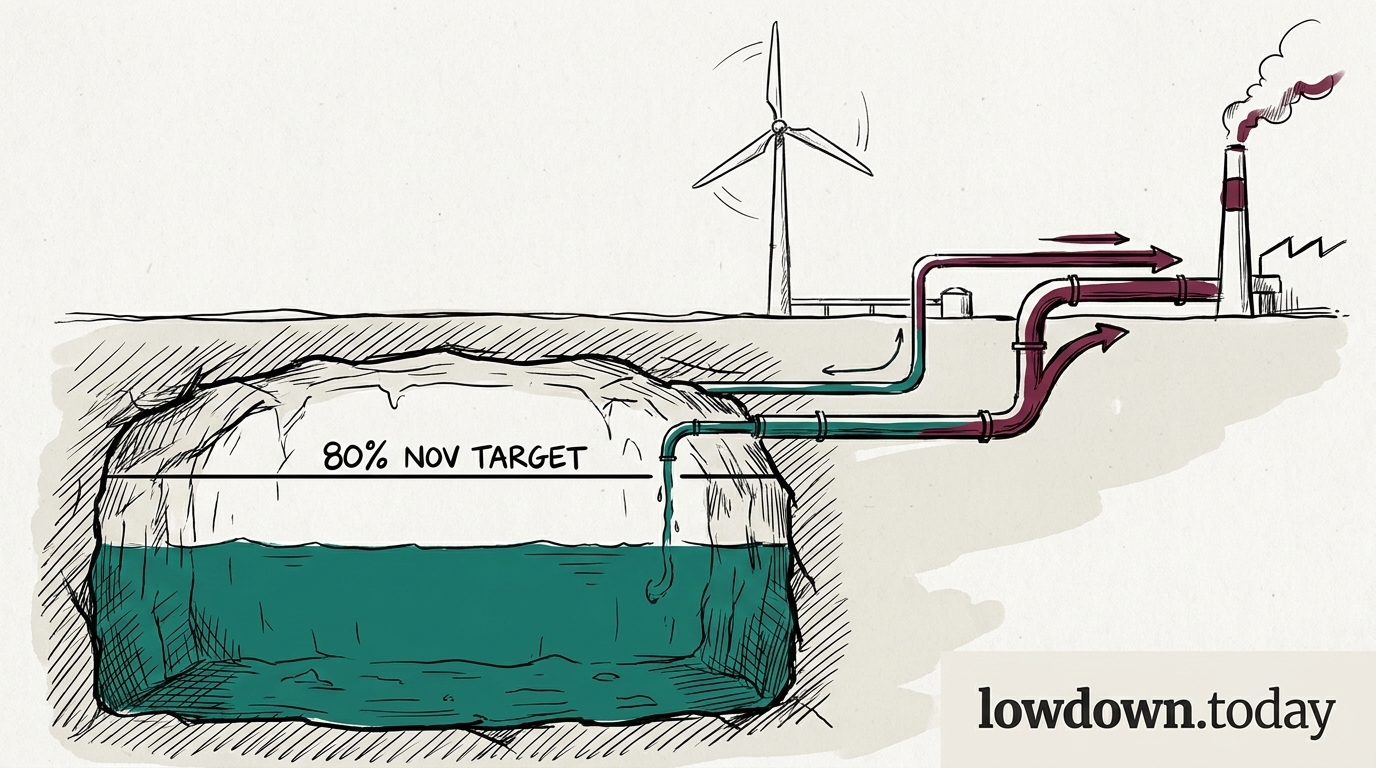
Brussels holds the bloc to 90% on a flexible window while Germany, holding roughly a quarter of EU storage capacity, tracks toward missing its own lower 80% figure by 21 points. A national shortfall this size in the anchor market matters more to bloc security than the flexible timetable alone can absorb.
French power exporters and CRE
French day-ahead rose in step with Germany but by less, reopening a EUR 7-17 premium that makes northward export flows commercially attractive again after the EUR 43.09 discount evaporated in days. CRE separately authorised RTE and Enedis to buy flexibility locally, betting the coming winter's binding constraint is grid congestion rather than a shortage of firm capacity.
TTF trading desk
TTF trading desk
A visible national shortfall like Germany's 21-point gap is a directional signal, not noise, for a desk holding the summer-winter spread. TTF's flat EUR 58-60 range through this week's German price swings says the market has not yet chosen to reprice refill risk into the front of the curve.
German cavern and CCGT operators
German caverns kept buying prompt gas at TTF near EUR 58-60 through the inversion; the wind collapse to 2.4 GW then flipped the spark spread to plus EUR 29 and put turbines back in the same queue. Every day turbines win that bid, injection at a third of the 877 GWh/day pace needed falls further behind.
Slovakia
Slovakia
Slovakia says it dropped its hold-out on the 21st sanctions package only after Ursula von der Leyen personally signed written gas-price and supply guarantees. The Council of the European Union's own 17,238-character release on the package names neither Slovakia nor any guarantee, leaving Bratislava's account unconfirmed by the institutional record.



