Skip to content
You can now search across every topic, entity and event.What's new
European Energy Markets
31JUL

Germany and France print sub-zero hours

2 min read
09:44UTC

German day-ahead printed minus EUR 15.01/MWh in its lowest quarter-hour on Saturday 25 July, France minus EUR 11.32, the first sub-zero prints of the window.

EconomicAssessed
Key takeaway

Negative quarter-hours arrived while the daily mean held near EUR 90, a within-day shape problem.

German day-ahead power printed minus EUR 15.01/MWh in its lowest quarter-hour on Saturday 25 July, and France minus EUR 11.32, the first sub-zero prints of this window after a hard zero floor earlier in the week, when German day-ahead was still clearing near EUR 100 on an already negative spark . 1

The daily mean tells a different story from the extremes. Germany still averaged EUR 89.90/MWh that day, because 18.86 GW of solar met a Saturday load of 44.4 GW. 2 Midday oversupply drove a handful of quarter-hours below zero while the evening ramp kept the average up. Anyone hedged on daily averages saw an unremarkable summer weekend; anyone dispatching against quarter-hourly prices saw hours they had to pay to generate into.

A secondary tracker put Saturday's German day-ahead at EUR 85.11/MWh. 3 This desk's EUR 89.90 averages every quarter-hourly print of that day, published by SMARD under Bundesnetzagentur licence. The two figures measure different things and both can be right, which is worth knowing before anyone reconciles a position against the wrong series.


Deep Analysis

In plain English

For a few fifteen-minute periods on Saturday, both Germany and France were briefly paid to take electricity rather than paying for it, the first time either market had gone below zero in this run. That sounds dramatic, but it only happened for a handful of quarter-hours; across the whole day, average prices in both countries stayed well above zero. It happens because some power stations, like nuclear reactors, cannot simply switch off for fifteen minutes when there is a brief surplus, so the price goes negative instead to persuade someone to use the extra power.

Deep Analysis
Root Causes

A negative quarter-hour does not mean supply exceeded demand across the whole day, only that inflexible generation, must-run thermal plant, nuclear baseload and subsidised renewables that keep running regardless of price, could not be curtailed fast enough to avoid a brief oversupply window; Germany's EUR 89.90 daily mean on the same day shows the problem was confined to specific quarter-hours rather than the day as a whole.

The structural driver is the mismatch between fifteen-minute price granularity and generation that cannot ramp on that timescale, which is why the two negative quarter-hours arrived on the softest-demand day of the week rather than the highest-wind day.

What could happen next?
  • Meaning

    The first sub-zero quarter-hours of the window are a granular oversupply signal, not evidence that either market's daily price level has broken down.

First Reported In

Update #30 · Wind, not peace, sank the German spark

SMARD / Bundesnetzagentur via Fraunhofer ISE energy-charts· 27 Jul 2026
Read original
Causes and effects
This Event
Germany and France print sub-zero hours
Negative quarter-hours alongside a daily mean near EUR 90 make this a shape problem inside the day, not a collapse in the level.
Different Perspectives
Spain's LNG terminal operators
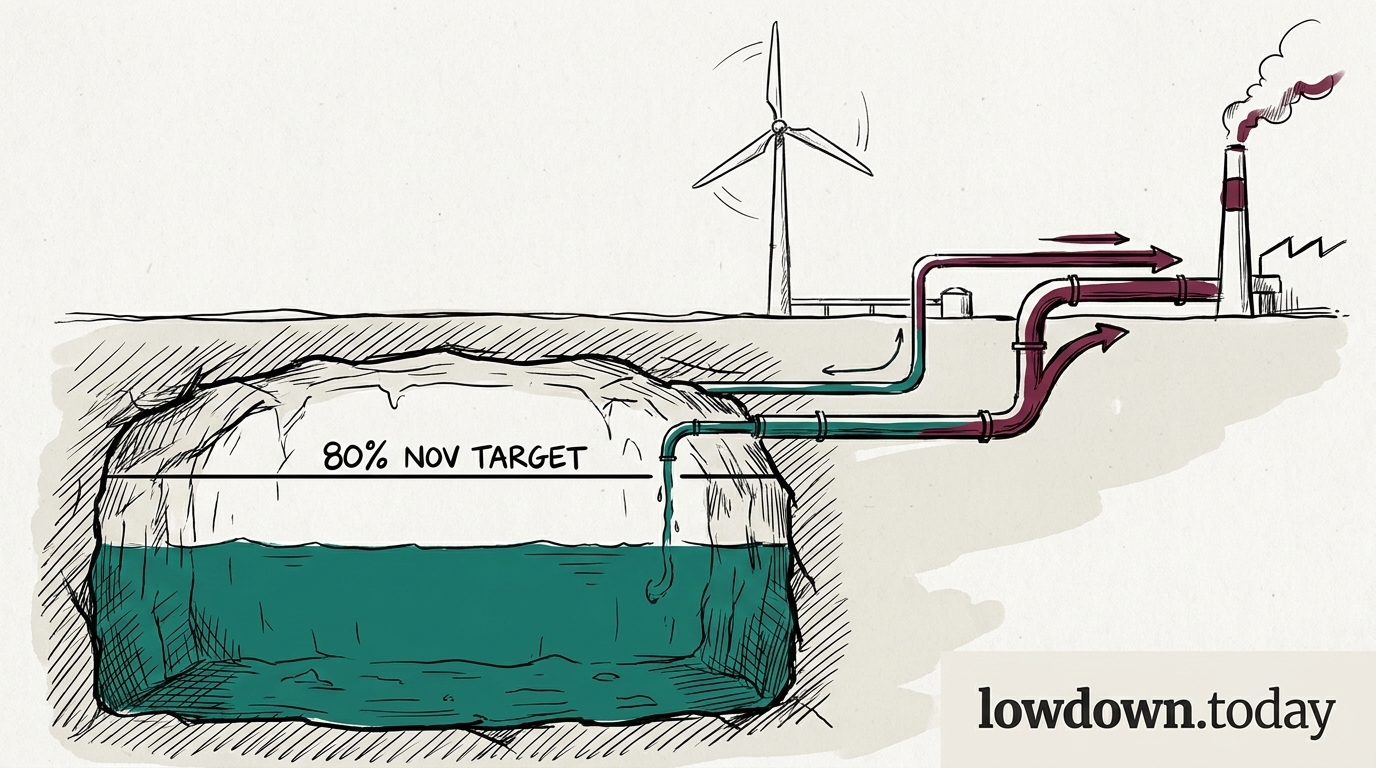
Spain's 9,145 GWh terminal inventory is the largest single stock in the EU LNG network, an option value that can reroute cargoes wherever the winter strip pays best rather than a cavern gas obligation tied to a fixed date. That flexibility matters more as Germany's cavern shortfall pushes more of the winter security question onto import infrastructure.
European Commission
European Commission
Brussels holds the bloc to 90% on a flexible window while Germany, holding roughly a quarter of EU storage capacity, tracks toward missing its own lower 80% figure by 21 points. A national shortfall this size in the anchor market matters more to bloc security than the flexible timetable alone can absorb.
French power exporters and CRE
French day-ahead rose in step with Germany but by less, reopening a EUR 7-17 premium that makes northward export flows commercially attractive again after the EUR 43.09 discount evaporated in days. CRE separately authorised RTE and Enedis to buy flexibility locally, betting the coming winter's binding constraint is grid congestion rather than a shortage of firm capacity.
TTF trading desk
TTF trading desk
A visible national shortfall like Germany's 21-point gap is a directional signal, not noise, for a desk holding the summer-winter spread. TTF's flat EUR 58-60 range through this week's German price swings says the market has not yet chosen to reprice refill risk into the front of the curve.
German cavern and CCGT operators
German caverns kept buying prompt gas at TTF near EUR 58-60 through the inversion; the wind collapse to 2.4 GW then flipped the spark spread to plus EUR 29 and put turbines back in the same queue. Every day turbines win that bid, injection at a third of the 877 GWh/day pace needed falls further behind.
Slovakia
Slovakia
Slovakia says it dropped its hold-out on the 21st sanctions package only after Ursula von der Leyen personally signed written gas-price and supply guarantees. The Council of the European Union's own 17,238-character release on the package names neither Slovakia nor any guarantee, leaving Bratislava's account unconfirmed by the institutional record.



