Skip to content
You can now search across every topic, entity and event.What's new
European Energy Markets
31JUL

German gas plants ignore cheaper fuel

2 min read
09:44UTC

German fossil-gas generation fell from 4.37 GW on 24 July to 2.09 GW on the 26th and 2.85 GW on the 27th, over the same days that gas itself got cheaper.

EconomicAssessed
Key takeaway

German gas output fell as gas got cheaper, because the merit order had already left these units behind.

German fossil-gas generation ran 4.37 GW on 24 July, 2.09 GW on Sunday the 26th and 2.85 GW on Monday the 27th, falling across the very days the fuel got cheaper. 1 The CCGT fleet did not come back, and the reason is arithmetic rather than sentiment.

Dispatch responds to the fuel price only while the plant is close enough to the money for the fuel price to decide the outcome. Once the spread runs to roughly minus EUR 40/MWh, no hour that a wind farm can cover will call a gas turbine, and a few euros off the cargo does not close a gap that size. The merit order had already moved past these units; cheapening their input moved it back by a rounding error.

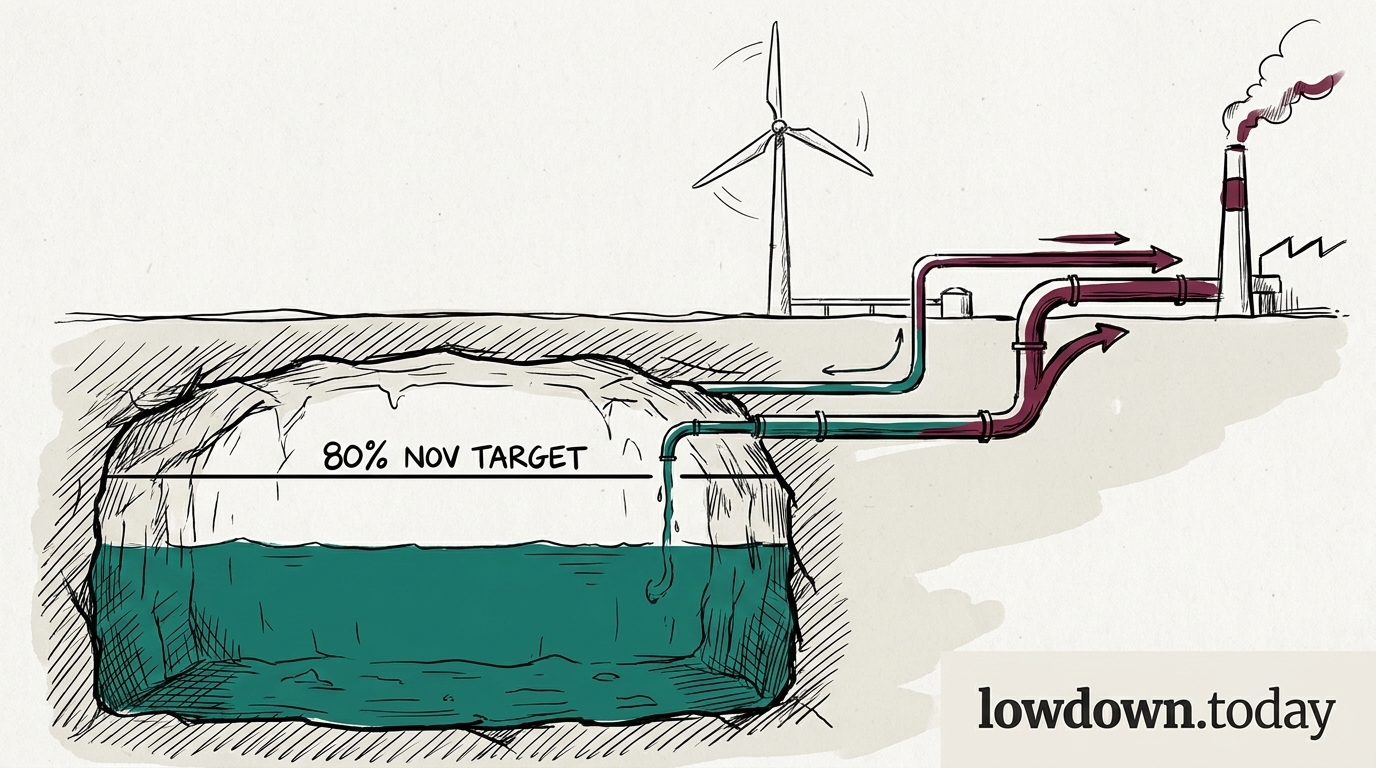
German storage got there first, stopping its bids for prompt cargoes on 21 July with injection down to 0.8 GWh a day , because a cavern's alternative buyer for a prompt cargo is a gas plant that will not run. No storage reading fresher than 22 July could be sourced this window, so this briefing will not tell you where the fill sits today. What it can tell you is that the demand-side case for refilling has not improved on cheaper gas, and that is the sentence any 2027 or 2028 gas-plant investment case now has to answer: a regime exists in which an eight per cent fall in the fuel price makes the asset less profitable, not more.


Deep Analysis

In plain English

Even though gas got cheaper this week, German gas power stations still ran less, not more. That sounds backwards, but it makes sense once you know that these plants had already stopped being profitable at any price close to what gas actually costs; the problem is not the cost of the fuel; it is that wind power is now supplying so much electricity that gas plants are not needed as often, whatever they burn.

Deep Analysis
Root Causes

Below roughly minus EUR 40/MWh on the spark spread, the fuel price stops being the variable that decides dispatch, because no plausible level of demand clears at a price high enough to cover the plant's marginal cost; cheaper gas lowers that marginal cost only slightly, from around EUR 123/MWh to EUR 117/MWh across this window, nowhere near the EUR 77 to EUR 84/MWh power actually cleared at.

That is why fossil-gas generation kept falling, 4.37 GW to 2.85 GW, through the same four sessions TTF fell 8 per cent: the plant is not being priced out by expensive fuel, it is being priced out by cheap wind, and cheaper fuel cannot fix a revenue problem.

What could happen next?
  • Meaning

    German gas-fired generation now tracks the residual load left after wind and solar, not the TTF gas price, a structural shift from how the fleet behaved earlier in the cycle.

First Reported In

Update #30 · Wind, not peace, sank the German spark

SMARD / Bundesnetzagentur via Fraunhofer ISE energy-charts· 27 Jul 2026
Read original
Different Perspectives
Spain's LNG terminal operators
Spain's 9,145 GWh terminal inventory is the largest single stock in the EU LNG network, an option value that can reroute cargoes wherever the winter strip pays best rather than a cavern gas obligation tied to a fixed date. That flexibility matters more as Germany's cavern shortfall pushes more of the winter security question onto import infrastructure.
European Commission
European Commission
Brussels holds the bloc to 90% on a flexible window while Germany, holding roughly a quarter of EU storage capacity, tracks toward missing its own lower 80% figure by 21 points. A national shortfall this size in the anchor market matters more to bloc security than the flexible timetable alone can absorb.
French power exporters and CRE
French day-ahead rose in step with Germany but by less, reopening a EUR 7-17 premium that makes northward export flows commercially attractive again after the EUR 43.09 discount evaporated in days. CRE separately authorised RTE and Enedis to buy flexibility locally, betting the coming winter's binding constraint is grid congestion rather than a shortage of firm capacity.
TTF trading desk
TTF trading desk
A visible national shortfall like Germany's 21-point gap is a directional signal, not noise, for a desk holding the summer-winter spread. TTF's flat EUR 58-60 range through this week's German price swings says the market has not yet chosen to reprice refill risk into the front of the curve.
German cavern and CCGT operators
German caverns kept buying prompt gas at TTF near EUR 58-60 through the inversion; the wind collapse to 2.4 GW then flipped the spark spread to plus EUR 29 and put turbines back in the same queue. Every day turbines win that bid, injection at a third of the 877 GWh/day pace needed falls further behind.
Slovakia
Slovakia
Slovakia says it dropped its hold-out on the 21st sanctions package only after Ursula von der Leyen personally signed written gas-price and supply guarantees. The Council of the European Union's own 17,238-character release on the package names neither Slovakia nor any guarantee, leaving Bratislava's account unconfirmed by the institutional record.



