Skip to content
You can now search across every topic, entity and event.What's new
European Energy Markets
31JUL

EU refill surges once the heat breaks

2 min read
09:44UTC

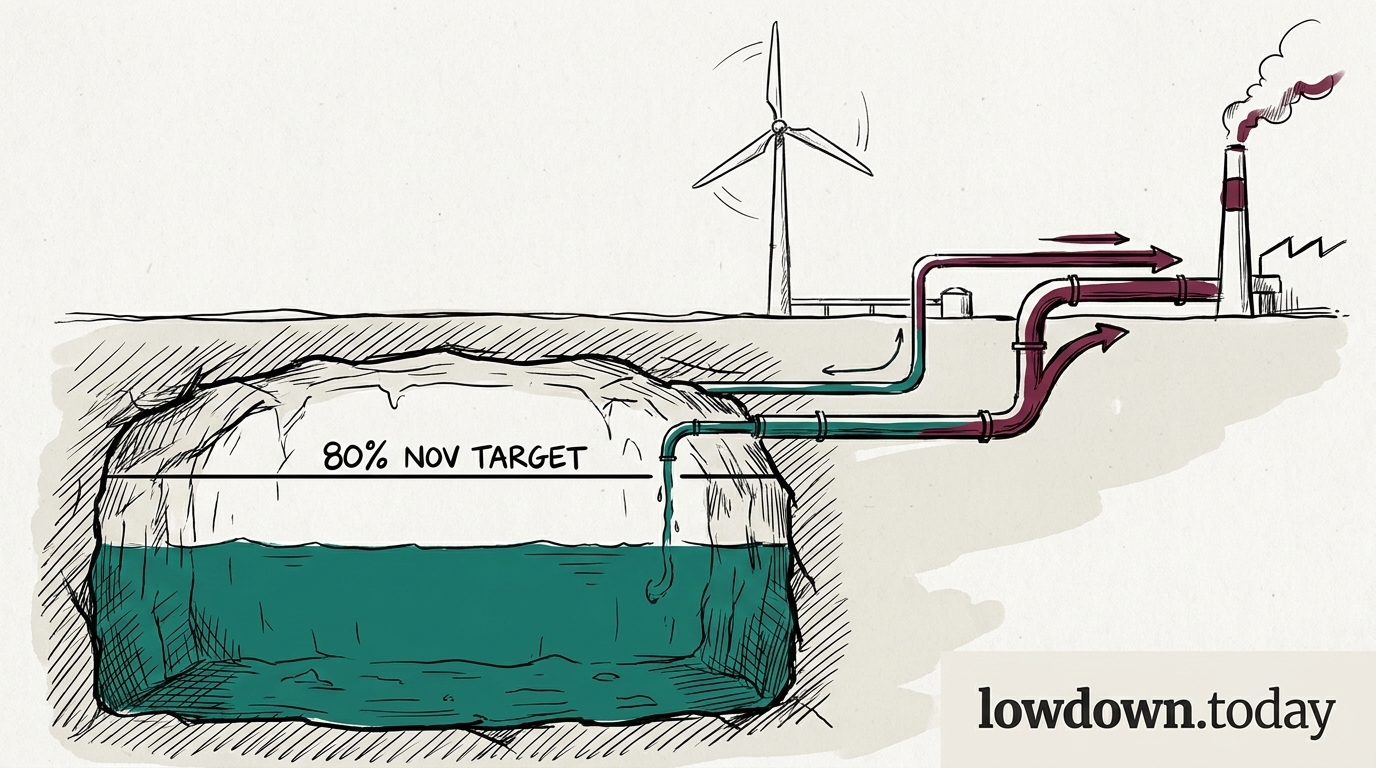
EU net injection jumped to 3,721 GWh/day on 27 June after the late-June heat broke, lifting aggregate fill to 48.62% and clearing the November-floor pace by 29%.

EconomicDeveloping
Key takeaway

EU injection rebounded to 3,721 GWh/day post-heat, running 29% above the pace November storage targets need.

Across the bloc, EU net injection jumped to 3,721 GWh/day on 27 June once the late-June heat broke, with gross injection at 3,924 GWh/day against just 203.6 GWh/day of withdrawal 1. Aggregate fill rose from 47.97% to 48.62% over two gas days, a pace of 0.32 points per day.

The readings come from GIE AGSI+, the EU gas storage transparency platform every trading desk watches for daily fill. They settle the question left hanging after the late-June heat: did cooling demand burn through enough gas to dent the refill path? The dip never came. Net injection sagged only around 25 to 26 June, then reversed hard as temperatures eased.

Fill read 47.4% in the 26 June briefing ; the sessions since have added more than a point. Injections had been running 16% below last year as recently as 22 June, widening the year-on-year deficit to nine points . The 27 June surge is the first stretch this month to beat that comparison rather than trail it, running 29% above the 2,889 GWh/day pace the November floor requires 2.


Deep Analysis

In plain English

When temperatures are very high, people use more air conditioning, which means power stations burn more gas to generate electricity. That gas has to come from somewhere, and it competes with the gas that operators want to put into underground storage for winter. During the late-June heat wave, storage companies had to share their gas supply with power stations, so daily injection volumes fell to the legal minimum required by EU rules. Once the heat eased on 27 June, power stations stopped needing as much gas and storage operators could buy freely again. The result was the biggest single daily injection rate of the late-June period: 3,721 gigawatt-hours, roughly 29% above the daily amount needed to reach the EU's 80% winter fill target. However, Europe still needs about 354 terawatt-hours of gas before November, and a large portion of that depends on tanker ships arriving from the Persian Gulf, whose routes were disrupted by tensions in late June.

Deep Analysis
Root Causes

The late-June heat wave of 24-27 June competed with EU injection for the same prompt molecules by lifting gas-for-cooling electricity demand into peak generation hours. CCGT gas demand effectively displaced a share of the non-mandate injection slot, holding the EU net pace at 2,889 GWh/day, the statutory minimum. When temperatures normalised on 27 June, CCGT demand retreated from around-the-clock to peak-hour-only dispatch, releasing the off-peak prompt supply back to injection.

The three mandated operators (EBN, CRE, ARERA) had maintained their statutory pace throughout the heat event, establishing the floor. Germany's commercial injection, which had been held back by the EUR 47-52 spring prices through May and early June but had resumed on the EUR 40-44 prompt after 17 June, added the above-floor volume that lifted the aggregate reading from 2,889 GWh/day to 3,721 GWh/day.

The surge was not a structural step-change but the simultaneous release of two suppressed injection channels: the heat demand that had crowded commercial operators, and the high spring prices that had crowded them before that.

What could happen next?
  • Consequence

    The 3,721 GWh/day rebound demonstrates that the EU 80%-floor mandate successfully defended the injection pace through the heat event, with the three mandated operators maintaining the floor even as commercial injection stalled.

  • Risk

    Gazprom's projection that EU fill may not reach 70% before the heating season remains the downside scenario if heat events recur in July-August and the year-on-year nine-point deficit cannot be closed at current injection rates.

First Reported In

Update #22 · Germany refills as the autumn cliff nears

GIE AGSI+· 30 Jun 2026
Read original
Different Perspectives
Spain's LNG terminal operators
Spain's 9,145 GWh terminal inventory is the largest single stock in the EU LNG network, an option value that can reroute cargoes wherever the winter strip pays best rather than a cavern gas obligation tied to a fixed date. That flexibility matters more as Germany's cavern shortfall pushes more of the winter security question onto import infrastructure.
European Commission
European Commission
Brussels holds the bloc to 90% on a flexible window while Germany, holding roughly a quarter of EU storage capacity, tracks toward missing its own lower 80% figure by 21 points. A national shortfall this size in the anchor market matters more to bloc security than the flexible timetable alone can absorb.
French power exporters and CRE
French day-ahead rose in step with Germany but by less, reopening a EUR 7-17 premium that makes northward export flows commercially attractive again after the EUR 43.09 discount evaporated in days. CRE separately authorised RTE and Enedis to buy flexibility locally, betting the coming winter's binding constraint is grid congestion rather than a shortage of firm capacity.
TTF trading desk
TTF trading desk
A visible national shortfall like Germany's 21-point gap is a directional signal, not noise, for a desk holding the summer-winter spread. TTF's flat EUR 58-60 range through this week's German price swings says the market has not yet chosen to reprice refill risk into the front of the curve.
German cavern and CCGT operators
German caverns kept buying prompt gas at TTF near EUR 58-60 through the inversion; the wind collapse to 2.4 GW then flipped the spark spread to plus EUR 29 and put turbines back in the same queue. Every day turbines win that bid, injection at a third of the 877 GWh/day pace needed falls further behind.
Slovakia
Slovakia
Slovakia says it dropped its hold-out on the 21st sanctions package only after Ursula von der Leyen personally signed written gas-price and supply guarantees. The Council of the European Union's own 17,238-character release on the package names neither Slovakia nor any guarantee, leaving Bratislava's account unconfirmed by the institutional record.



