Skip to content
You can now search across every topic, entity and event.What's new
European Energy Markets
16JUL

Russian LNG short-term ban lands without grace period

3 min read
09:48UTC

Squire Patton Boggs guidance on 22 April confirmed the 25 April short-term ban has no compliance window; Arc7 is the only narrow carve-out.

EconomicDeveloping
Key takeaway

No grace period on Friday's Russian LNG ban leaves Arc7 vessel-class ambiguity as the only narrow loophole.

Squire Patton Boggs published guidance on 22 April 2026 confirming the EU Russian LNG short-term contract ban enters force on 25 April with no compliance grace period and no transition window 1. Legacy long-term contracts remain grandfathered to 1 January 2027, a structural asymmetry that rewards long-dated buyers and gives spot and short-term buyers a hard stop on Friday. EU insurers face significant constraints on paying claims where funds could reach state-owned entities outside listed exemptions.

The guidance closes a door traders had been watching. Compliance teams had modelled scenarios around a phase-in for counterparties with existing short-term positions; the firm's reading of the recast text removes that path. Approximately 1.5 bcm per month of potential inbound disappears from the addressable short-term market on 25 April, compounding the Hammerfest removal landing in the same week.

The Arc7 Yamal ice-class shipping lane is the only narrow carve-out. 11 of 15 Arc7 vessels are European-owned (Seapeak Maritime, Dynagas), and the recast text does not explicitly prohibit rerouting or resale, leaving vessel-level ambiguity that traders will test immediately. Squire Patton Boggs note no FAQ guidance addresses Arc7 specifically. The loophole lands at the molecule level narrower than the market had hoped: a vessel-class carve-out rather than a contract-class one, meaning case-by-case legal exposure rather than a general exemption pathway.


Deep Analysis

In plain English

From 25 April 2026, European companies can no longer buy Russian natural gas under short-term contracts. Longer contracts signed before this date can continue until early 2027, but any new or rolling short-term deal is banned. A loophole exists for a specific type of Arctic-rated tanker called Arc7, but lawyers disagree on whether companies can use it without breaking the rules.

What could happen next?
  • Consequence

    Spot buyers without long-term Atlantic LNG contracts face a structurally tighter procurement market from 25 April, with no analogous volume available at comparable pricing.

    Immediate · 0.9
  • Risk

    Arc7 rerouting activity will begin immediately after 25 April; ACER has no published enforcement guidance on indirect acquisition via non-Russian intermediaries, creating legal exposure for the first movers that test the loophole.

    Short term · 0.72
  • Precedent

    The long-term/short-term grandfather asymmetry establishes a legislative template that future sanctions rounds can replicate, progressively ratcheting down Russian LNG access without triggering long-term contract breach.

    Long term · 0.85
First Reported In

Update #4 · AccelerateEU skips gas; three removals land

Squire Patton Boggs· 22 Apr 2026
Read original
Causes and effects
This Event
Russian LNG short-term ban lands without grace period
Compliance teams lose any grace-period hope three days out, and the Arc7 shipping-class ambiguity becomes the only operative loophole for the roughly 1.5 bcm per month of short-term volumes removed from the market.
Different Perspectives
LNG spreads desk
LNG spreads desk
The JKM-TTF arb flipped to a TTF premium of roughly USD 0.6/MMBtu on 15 July, the first time this cycle Europe has outbid Asia, yet no Atlantic cargo has rerouted west. Until a cargo actually moves, the desk reads the Hormuz premium as unconfirmed and the EUR 55 print as vulnerable to a fast reversal.
United States
United States
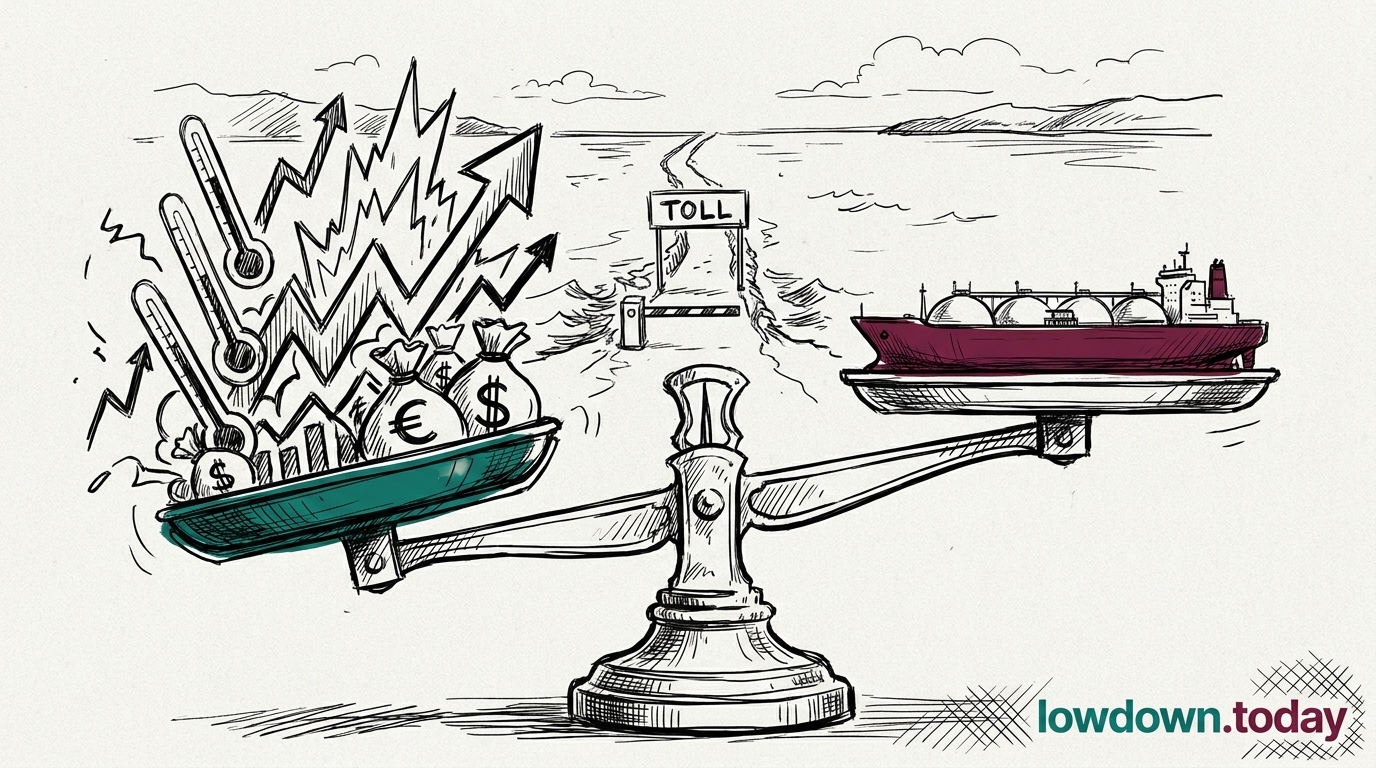
Washington reimposed a blockade on Iranian ports and a 20% Strait of Hormuz cargo toll on 13 July, driving TTF's 9% two-session rally to EUR 54.995/MWh. The posture is again setting Europe's gas benchmark by sentiment rather than by any confirmed change in cargo flows.
EDF
EDF
EDF slipped the Bugey 3, Golfech 2 and Chooz 2 restarts to 19, 22 and 25 July, pushing all three past the 20 July Bugey heat exemption, after river-cooling limits on the Rhone, Garonne and Meuse forced the cuts. The same thermal ceiling has capped the fleet in every major heatwave since 2003, and this cycle is no exception.
German power desk
German power desk
German day-ahead power climbed from EUR 126 to EUR 156/MWh over 14-16 July as the heat dome held, flipping the clean spark spread positive for the first time since 14 July. Gas-for-power demand is now back in competition with mandate storage injection right as the injection margin itself is thinning.
EU carbon and storage regulators
EUA carbon broke EUR 81/tonne on 13 July as the ETS Market Stability Reserve's scheduled withdrawals met fresh fuel-switching demand from France's nuclear curtailment. Brussels' mandatory storage-fill rule kept German and French injection running regardless of the TTF swings, the mechanism working as designed four years after the 2022 shock.
Equinor
Equinor
Equinor returned its Asgard field from maintenance on 11 July, lifting Gassco's exit nominations to 319.8 mcm/day just as TTF round-tripped on Hormuz risk. The restart gave Norway spare pipeline capacity to help Europe absorb the gas rally without drawing down storage, reinforcing its role as the post-2022 swing supplier.
