Skip to content
You can now search across every topic, entity and event.What's new
European Energy Markets
16JUL

Italy-France day-ahead spread hits EUR 153/MWh

3 min read
09:48UTC

Italy-France day-ahead electricity spread reached EUR 153/MWh on Sunday 26 April, with France clearing at EUR -43.73/MWh and Italy at EUR 109.38/MWh. Germany cleared at EUR 1.49/MWh on strong wind and solar.

EconomicDeveloping
Key takeaway

France cleared negative while Italy cleared above EUR 109/MWh on 26 April, an interconnector constraint outside the gas curve.

The day-ahead electricity spread between Italy and France reached EUR 153/MWh on Sunday 26 April, with the French zone clearing at EUR -43.73/MWh and the Italian zone at EUR 109.38/MWh 1. Germany cleared at EUR 1.49/MWh on strong wind and solar output.

Negative power prices in the French zone alongside three-figure positive prices in Italy on the same delivery day says the Franco-Italian interconnector was constrained on the limit on Sunday. The day-ahead market is the European power market that clears for next-day delivery on national zonal coupling; spreads of this magnitude across an HVDC link are normally the indicator that one zone has surplus renewable output the link cannot evacuate, while the receiving zone runs gas peakers to cover residual demand.

The trade implication is that Italian power-sector gas demand on a renewable-rich Sunday is still bound by the interconnector envelope rather than by the TTF benchmark. Italian gas storage sits at 48.15% fill, the leading large EU storage market; even with a comfortable inventory position, day-ahead power separates from the gas curve when the link binds. For procurement desks pricing Italian forward power against TTF spot, the EUR 153/MWh spread is a constraint not in the curve and not in recent ENTSOG or ACER coverage. The same constraint matters for EDF's French nuclear export envelope through summer 2026 , since France clearing negative on a Sunday means renewables and nuclear together exceed both domestic demand and the link's evacuation capacity. Southern European industrial users pay a constraint premium that the gas-side balance does not show, and the same dynamic is what gives Bruegel's Spain evidence credibility: when renewables clear the local zonal price, the interconnector becomes the binding constraint, not the marginal gas plant.


Deep Analysis

In plain English

Day-ahead power prices are the prices electricity generators and buyers agree for power delivered the following day. On 26 April, power in France was essentially free, France had more wind and solar generation than it could use, so prices went negative at minus EUR 43.73 per megawatt-hour. Germany was also nearly free at EUR 1.49, also on strong renewables. But Italy cleared at EUR 109.38 per megawatt-hour, a difference of EUR 153 from France. This happens when the cable and grid connections between France and Italy cannot carry enough power across the border to equalise prices. Cheap French power is physically stranded on the French side, while Italian power plants charge full price. The constraint is a known infrastructure problem; the upgrade to fix it is not scheduled until 2027.

What could happen next?
  • Risk

    The EUR 153/MWh Italy-France spread is not reflected in Italian power forward curves, meaning Italian industrial buyers and retailers with 2026 fixed-price supply contracts face unhedged exposure if the constraint recurs on high-renewable output days.

First Reported In

Update #5 · Ban day muted; Germany doubles injection rate

euenergy.live· 26 Apr 2026
Read original
Causes and effects
This Event
Italy-France day-ahead spread hits EUR 153/MWh
An interconnector constraint of this size between two of Europe's largest power markets sits outside the gas curve and outside recent storage coverage; southern European industrial users carry a premium that headline benchmarks miss.
Different Perspectives
LNG spreads desk
LNG spreads desk
The JKM-TTF arb flipped to a TTF premium of roughly USD 0.6/MMBtu on 15 July, the first time this cycle Europe has outbid Asia, yet no Atlantic cargo has rerouted west. Until a cargo actually moves, the desk reads the Hormuz premium as unconfirmed and the EUR 55 print as vulnerable to a fast reversal.
United States
United States
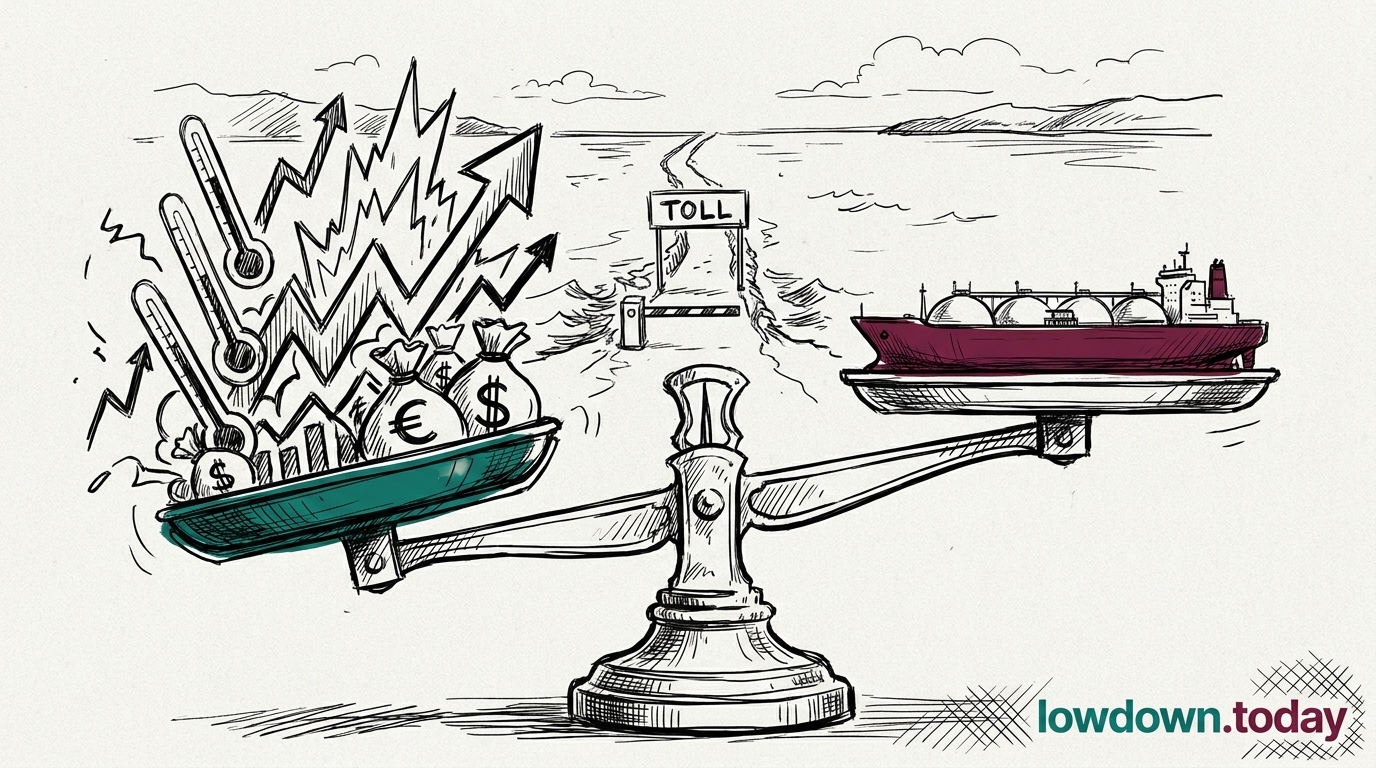
Washington reimposed a blockade on Iranian ports and a 20% Strait of Hormuz cargo toll on 13 July, driving TTF's 9% two-session rally to EUR 54.995/MWh. The posture is again setting Europe's gas benchmark by sentiment rather than by any confirmed change in cargo flows.
EDF
EDF
EDF slipped the Bugey 3, Golfech 2 and Chooz 2 restarts to 19, 22 and 25 July, pushing all three past the 20 July Bugey heat exemption, after river-cooling limits on the Rhone, Garonne and Meuse forced the cuts. The same thermal ceiling has capped the fleet in every major heatwave since 2003, and this cycle is no exception.
German power desk
German power desk
German day-ahead power climbed from EUR 126 to EUR 156/MWh over 14-16 July as the heat dome held, flipping the clean spark spread positive for the first time since 14 July. Gas-for-power demand is now back in competition with mandate storage injection right as the injection margin itself is thinning.
EU carbon and storage regulators
EUA carbon broke EUR 81/tonne on 13 July as the ETS Market Stability Reserve's scheduled withdrawals met fresh fuel-switching demand from France's nuclear curtailment. Brussels' mandatory storage-fill rule kept German and French injection running regardless of the TTF swings, the mechanism working as designed four years after the 2022 shock.
Equinor
Equinor
Equinor returned its Asgard field from maintenance on 11 July, lifting Gassco's exit nominations to 319.8 mcm/day just as TTF round-tripped on Hormuz risk. The restart gave Norway spare pipeline capacity to help Europe absorb the gas rally without drawing down storage, reinforcing its role as the post-2022 swing supplier.
