Skip to content
You can now search across every topic, entity and event.What's new
European Energy Markets
16JUL

Five finance ministers push windfall levy on energy

3 min read
09:48UTC

Germany, Italy, Spain, Portugal and Austria wrote jointly to Commissioner Wopke Hoekstra on 4 April calling for a new EU-wide contribution modelled on the 2022-23 solidarity levy.

EconomicDeveloping
Key takeaway

Five capitals have put a windfall levy on the table before the Commission's April energy calendar closes.

Finance ministers of Germany, Italy, Spain, Portugal and Austria wrote jointly to EU Climate Commissioner Wopke Hoekstra on 4 April calling for a new EU-wide windfall contribution on energy company profits, modelled on the 2022-23 solidarity levy 1. Eurozone inflation rose to 2.5% in March from 1.9% in February, largely on energy.

The political mechanism is familiar from the 2022 solidarity levy: governments facing renewed household cost-of-living pressure look for a revenue instrument that does not require direct fiscal transfer and lands on politically visible corporate profits. The signatories are the five member states running the highest consumer-facing gas tariffs relative to pre-2022 baselines, and the Ember analysis showed EU household gas bills still 16% above 2021 levels .

The Commission's position is more constrained than the 2022 moment. The reduced 80% November storage target is already a concession to the supply-side difficulty of the Bruegel EUR 35 billion refill ; stacking a windfall contribution on top of a Russian LNG ban implementation in the same fortnight compresses the room for negotiation with industry. If adopted, the levy redistributes cost from consumer to energy-profit balance sheets; if deferred, it becomes a campaign issue in member states with 2026 elections on the calendar.

The operational read for energy-sector finance leads is that the 4 April letter is a forward commitment, not a proposal. It places a funded position on the table before the 40th Gas Regulatory Forum convenes in Madrid on 29 April context, which means the Forum's agenda now includes a redistribution argument the Commission did not choose to open.


Deep Analysis

In plain English

When gas prices spike, energy companies making much higher profits than normal on existing contracts and assets receive what are called 'windfall profits'. In 2022-23, during the last major energy crisis, the EU introduced a one-off levy on energy companies to capture some of these extra profits and use them to support consumers. On 4 April 2026, the finance ministers of Germany, Italy, Spain, Portugal, and Austria jointly wrote to the EU's Climate Commissioner calling for a new version of this levy. They cited a rise in eurozone inflation from 1.9% to 2.5% in March, largely driven by energy costs. The proposal faces the same design challenge as last time: if the levy reduces the financial incentive for energy companies to invest in new supply infrastructure, it could worsen the very shortage that is causing the high prices.

What could happen next?
  • Risk

    A hastily designed levy repeating 2022-23's national divergence would face legal challenge across multiple member states, delaying any consumer relief by 12-18 months.

  • Opportunity

    If designed with the UK EPL's investment allowance structure, a 2026 levy could fund consumer relief while preserving incentives for LNG terminal expansion investment that Europe requires to close the 180-cargo structural gap.

First Reported In

Update #2 · TTF EUR 42 as Russian LNG ban enters range

European Commission· 15 Apr 2026
Read original
Different Perspectives
LNG spreads desk
LNG spreads desk
The JKM-TTF arb flipped to a TTF premium of roughly USD 0.6/MMBtu on 15 July, the first time this cycle Europe has outbid Asia, yet no Atlantic cargo has rerouted west. Until a cargo actually moves, the desk reads the Hormuz premium as unconfirmed and the EUR 55 print as vulnerable to a fast reversal.
United States
United States
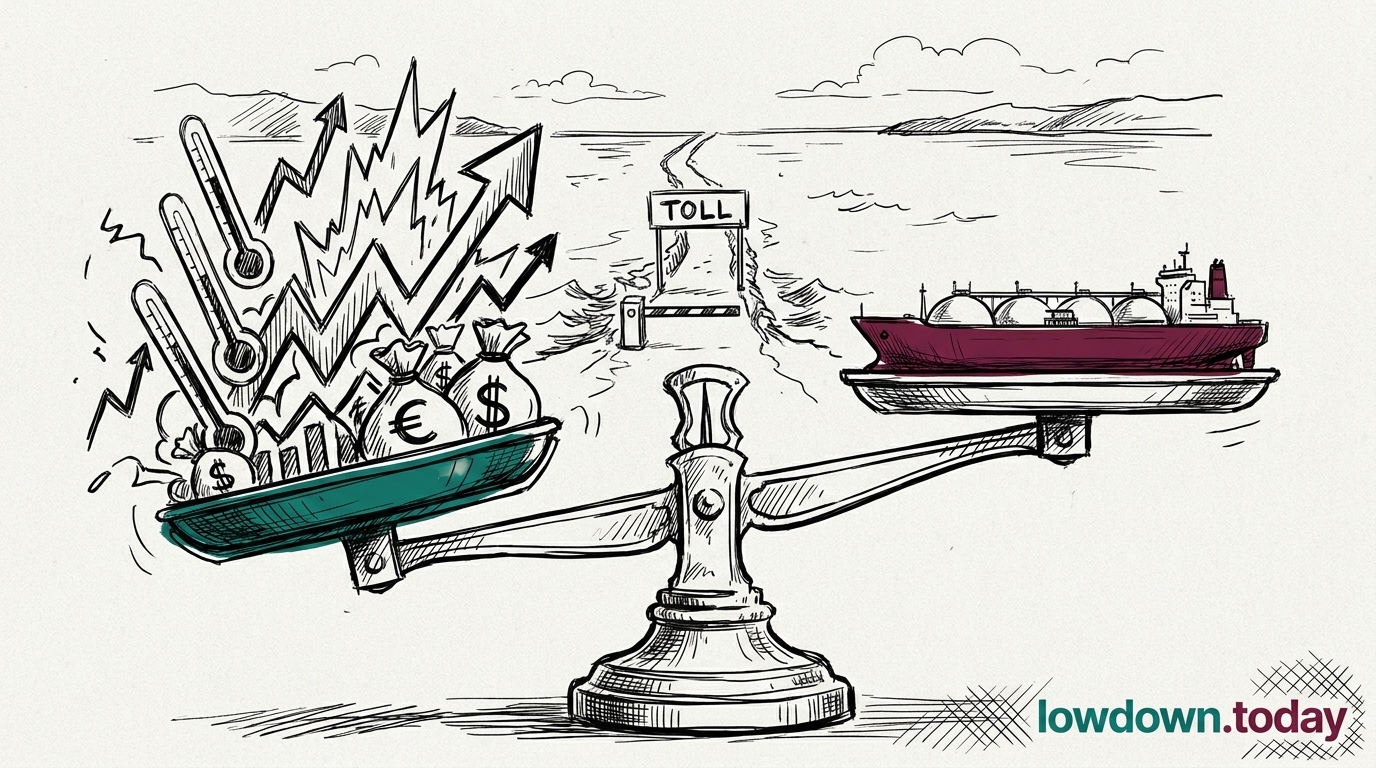
Washington reimposed a blockade on Iranian ports and a 20% Strait of Hormuz cargo toll on 13 July, driving TTF's 9% two-session rally to EUR 54.995/MWh. The posture is again setting Europe's gas benchmark by sentiment rather than by any confirmed change in cargo flows.
EDF
EDF
EDF slipped the Bugey 3, Golfech 2 and Chooz 2 restarts to 19, 22 and 25 July, pushing all three past the 20 July Bugey heat exemption, after river-cooling limits on the Rhone, Garonne and Meuse forced the cuts. The same thermal ceiling has capped the fleet in every major heatwave since 2003, and this cycle is no exception.
German power desk
German power desk
German day-ahead power climbed from EUR 126 to EUR 156/MWh over 14-16 July as the heat dome held, flipping the clean spark spread positive for the first time since 14 July. Gas-for-power demand is now back in competition with mandate storage injection right as the injection margin itself is thinning.
EU carbon and storage regulators
EUA carbon broke EUR 81/tonne on 13 July as the ETS Market Stability Reserve's scheduled withdrawals met fresh fuel-switching demand from France's nuclear curtailment. Brussels' mandatory storage-fill rule kept German and French injection running regardless of the TTF swings, the mechanism working as designed four years after the 2022 shock.
Equinor
Equinor
Equinor returned its Asgard field from maintenance on 11 July, lifting Gassco's exit nominations to 319.8 mcm/day just as TTF round-tripped on Hormuz risk. The restart gave Norway spare pipeline capacity to help Europe absorb the gas rally without drawing down storage, reinforcing its role as the post-2022 swing supplier.
