Skip to content
You can now search across every topic, entity and event.What's new
European Energy Markets
16JUL

EUA carbon holds EUR 78.22 above clawback

3 min read
09:48UTC

EU carbon allowances settled near EUR 78.22/tCO2 on 4 June, extending above the EUR 77.46 clawback that reversed the 11 May ETS benchmark selloff and confirming the cost floor under German CCGT power clearing.

EconomicDeveloping
Key takeaway

EUA holding above the clawback confirms the carbon floor under German CCGT clearing is durable, sustaining the FR-DE power spread.

EUA carbon settled near EUR 78.22/tCO2 on Thursday 4 June 1, extending past the EUR 77.46 level whose recapture reversed the 11 May ETS benchmark revision . The benchmark cut took EUA consensus down roughly 13% in a session; the full recovery and extension tells desks the move was a technical bounce only in reverse. The structural ETS tightening narrative, driven by the Clean Industrial Deal's demand for higher carbon costs, is re-establishing itself as the dominant price signal.

For power desks the carbon input is inseparable from the gas input that broke range a day earlier. Carbon at this level gives the typical German H-class CCGT a clean spark spread of only a few euros per MWh in off-peak hours, barely enough to cover operating costs and insufficient to signal new capacity. Yet this is the unit that set Germany's day-ahead clear above its French neighbour on 3 June: it ran on merit-order necessity, not because the spread invited new generation.

The policy implication runs against EU carbon intent. High allowance prices should incentivise fuel switching away from gas. In practice, with French nuclear providing the bulk of the clean floor and Germany lacking an equivalent dispatchable clean base, the carbon price functions as a tax on German industrials rather than a switching signal: at current gas and carbon levels there is no dispatchable clean alternative to switch into on short notice.


Deep Analysis

In plain English

The EU carbon price settled near EUR 78 per tonne on 4 June 2026, staying above the level that confirmed recovery from a May selloff driven by a regulatory revision to the EU's carbon cap. Carbon allowances are required for every tonne of CO2 that gas power stations emit. At EUR 78, carbon adds roughly EUR 35 per megawatt-hour to the cost of running a German gas power plant , on top of the gas price itself. Together, the two inputs kept German electricity prices above EUR 100 even as France generated power at near-zero cost.

What could happen next?
  • Consequence

    EUA above EUR 77.46 sustains German CCGT marginal costs above EUR 100 for day-ahead power, maintaining the structural condition behind the FR-DE spread record.

  • Risk

    If German industrial output recovers in H2 2026, rising verified emissions absorb surplus allowances faster than the structural-tightening narrative accounts for, potentially accelerating EUA to EUR 85-90.

First Reported In

Update #15 · France EUR 9, Germany EUR 103: heat splits

Trading Economics / Barchart composite· 4 Jun 2026
Read original
Different Perspectives
LNG spreads desk
LNG spreads desk
The JKM-TTF arb flipped to a TTF premium of roughly USD 0.6/MMBtu on 15 July, the first time this cycle Europe has outbid Asia, yet no Atlantic cargo has rerouted west. Until a cargo actually moves, the desk reads the Hormuz premium as unconfirmed and the EUR 55 print as vulnerable to a fast reversal.
United States
United States
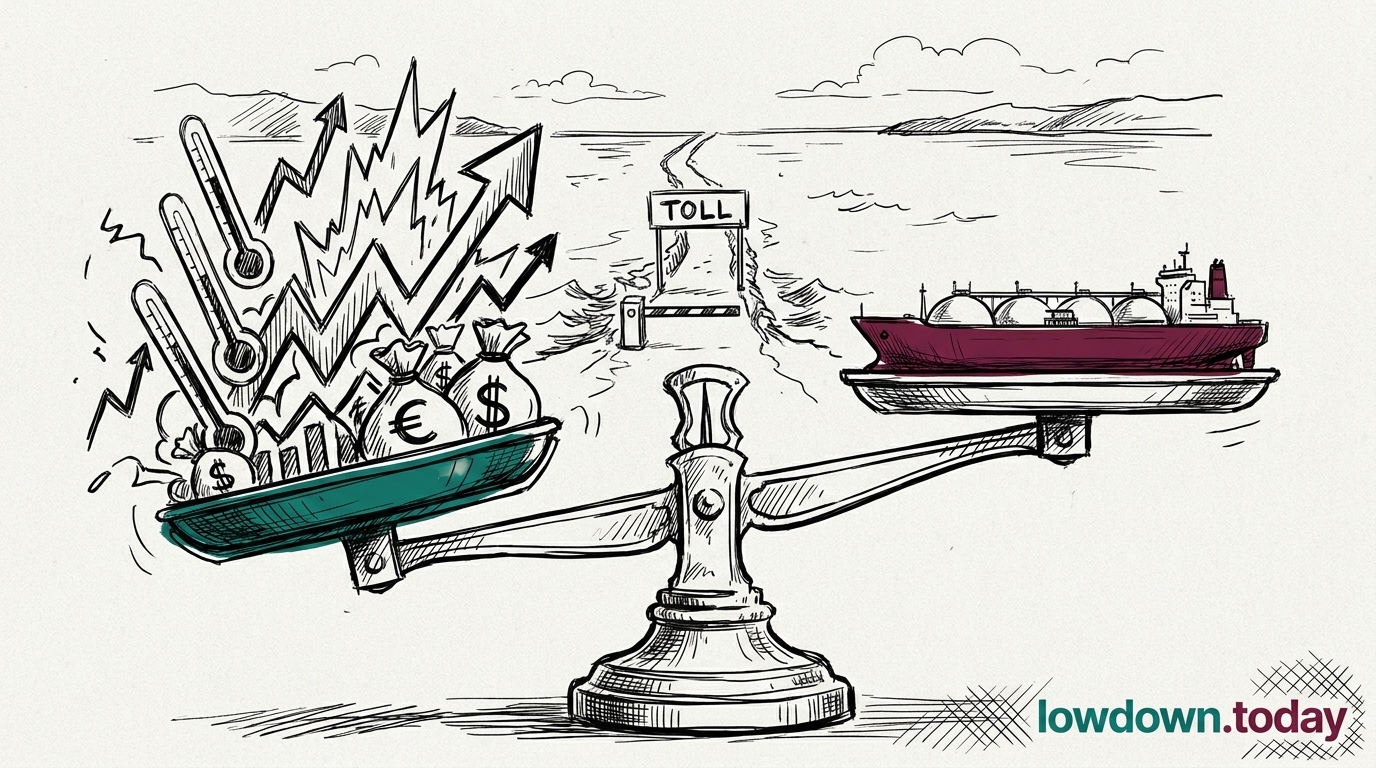
Washington reimposed a blockade on Iranian ports and a 20% Strait of Hormuz cargo toll on 13 July, driving TTF's 9% two-session rally to EUR 54.995/MWh. The posture is again setting Europe's gas benchmark by sentiment rather than by any confirmed change in cargo flows.
EDF
EDF
EDF slipped the Bugey 3, Golfech 2 and Chooz 2 restarts to 19, 22 and 25 July, pushing all three past the 20 July Bugey heat exemption, after river-cooling limits on the Rhone, Garonne and Meuse forced the cuts. The same thermal ceiling has capped the fleet in every major heatwave since 2003, and this cycle is no exception.
German power desk
German power desk
German day-ahead power climbed from EUR 126 to EUR 156/MWh over 14-16 July as the heat dome held, flipping the clean spark spread positive for the first time since 14 July. Gas-for-power demand is now back in competition with mandate storage injection right as the injection margin itself is thinning.
EU carbon and storage regulators
EUA carbon broke EUR 81/tonne on 13 July as the ETS Market Stability Reserve's scheduled withdrawals met fresh fuel-switching demand from France's nuclear curtailment. Brussels' mandatory storage-fill rule kept German and French injection running regardless of the TTF swings, the mechanism working as designed four years after the 2022 shock.
Equinor
Equinor
Equinor returned its Asgard field from maintenance on 11 July, lifting Gassco's exit nominations to 319.8 mcm/day just as TTF round-tripped on Hormuz risk. The restart gave Norway spare pipeline capacity to help Europe absorb the gas rally without drawing down storage, reinforcing its role as the post-2022 swing supplier.
