Skip to content
You can now search across every topic, entity and event.What's new
European Energy Markets
16JUL

Equinor Q1 closes; Hammerfest silence held

4 min read
09:48UTC

Equinor's Q1 2026 earnings call passed on 6 May without any Hammerfest LNG return-date guidance, the most natural disclosure venue between the 22 April maintenance entry and the 15 May threshold left unused.

EconomicDeveloping
Key takeaway

The Q1 call passed without binding management to a Hammerfest return date before 15 May.

Equinor's Q1 2026 results, published 6 May, reported adjusted operating income of USD 9.77 billion, total equity production of 2,313 mboe/day (up 9% year-on-year), a second share buyback tranche of USD 375 million, and a European gas realised price of USD 12.9/mmbtu. The earnings call passed without a Hammerfest LNG return-date update.

Hammerfest LNG is Equinor's liquefaction plant at Melkoeya in northern Norway, the only onshore LNG export terminal in Europe and the flexible-molecule swing in Norway's gas mix. It entered planned maintenance on 22 April . The 4 May NOK 17 billion drilling agreements confirmed routine NCS commitments while the return-date question stayed unanswered.

A quarterly call between the 22 April maintenance entry and update #7's 15 May threshold is the natural moment to communicate any shift in the headline July restart, and Equinor opted not to use it. Historical precedent argues against the July base case anyway: the 2025 Hammerfest cycle entered on the same calendar date, targeted 19 July, and slipped twice into early August on a cooling-compressor fault and air-cooled heat exchanger replacements. A clean July restart prices the lower-probability leg of the empirical distribution.

For positions leaning on July, the Q1 silence reads as confirmation that management is not yet ready to bind itself to a date. The next forced disclosure window is the 15 May threshold itself.


Deep Analysis

In plain English

Hammerfest LNG is a Norwegian gas processing plant at the very top of Norway, in the Arctic. It takes natural gas from under the Barents Sea and converts it into a very cold liquid form, liquefied natural gas, or LNG, so it can be loaded onto ships and sent to European ports. Every year, this plant goes into a maintenance shutdown to be checked and repaired. This year's shutdown started on 22 April. Normally, companies tell investors when they expect the plant to reopen, but Equinor's quarterly results call on 6 May came and went without any such update. That silence matters because the same plant had the same shutdown in 2025 and ran two months late. If it runs late again this year, Europe loses a source of gas precisely during the summer months when countries are supposed to be filling up their storage for winter.

Deep Analysis
Root Causes

Hammerfest LNG's maintenance risk profile concentrates in two systems: the refrigerant compressors (the fault class that caused the 2025 overrun) and the air-cooled heat exchangers. Both are Arctic-environment components subject to thermal cycling stress over winter operating periods.

The maintenance window follows the peak winter operating season, when both systems run hardest. The probability of finding inspection-triggered repair work is structurally higher in the post-winter maintenance window than it would be at a temperate-climate LNG facility.

Equinor's contractual position compounds the incentive to stay silent. Hammerfest LNG supplies predominantly via long-term contracts to Continental European buyers. Early or late return guidance creates a commercial obligation that Equinor is not required to make at a quarterly call; silence preserves contractual flexibility.

The 15 May threshold (set in prior coverage) is the next forced disclosure window in the sense that a prolonged silence past it historically correlates with slippage beyond August.

What could happen next?
  • Risk

    If Equinor issues no Hammerfest return guidance before 15 May, the historical precedent from 2025 and 2020 cycles points to a slippage into August, adding roughly three additional weeks of LNG absence on top of the original 10 July target.

    Short term · 0.68
  • Consequence

    Each week of Hammerfest extension beyond 10 July removes approximately 0.15 bcm from Sodir's monthly production print, compounding the March 2026 baseline decline that already showed -1.6% month-on-month (ID:3034).

    Medium term · 0.85
  • Precedent

    Equinor's Q1 silence establishes the investor relations pattern: no guidance until the company has high confidence in a date. The 15 May threshold is the next test window; if it passes silently, Wood Mackenzie's August scenario becomes the working base case for desk planning.

    Immediate · 0.75
First Reported In

Update #8 · Storage 34.3 as 12 May test nears; Hammerfest silent

Equinor· 8 May 2026
Read original
Different Perspectives
LNG spreads desk
LNG spreads desk
The JKM-TTF arb flipped to a TTF premium of roughly USD 0.6/MMBtu on 15 July, the first time this cycle Europe has outbid Asia, yet no Atlantic cargo has rerouted west. Until a cargo actually moves, the desk reads the Hormuz premium as unconfirmed and the EUR 55 print as vulnerable to a fast reversal.
United States
United States
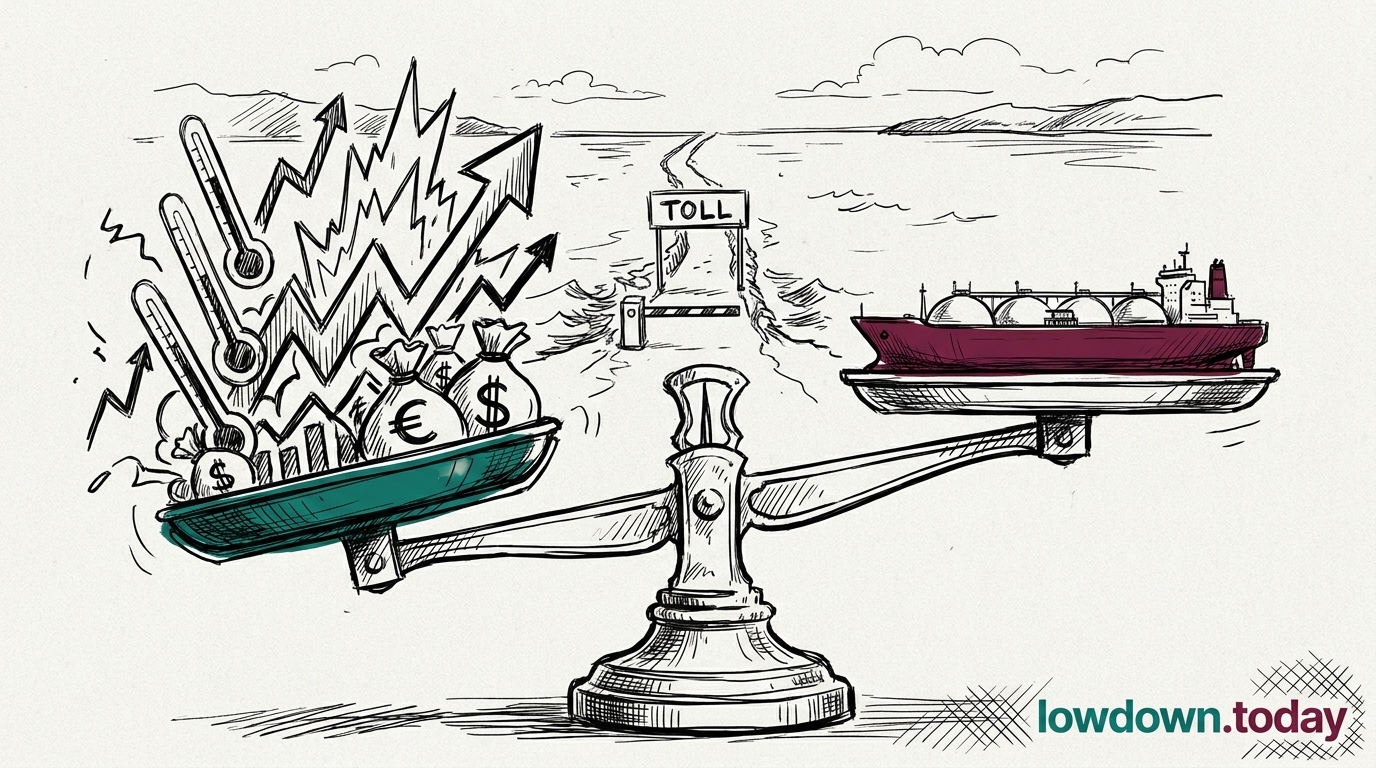
Washington reimposed a blockade on Iranian ports and a 20% Strait of Hormuz cargo toll on 13 July, driving TTF's 9% two-session rally to EUR 54.995/MWh. The posture is again setting Europe's gas benchmark by sentiment rather than by any confirmed change in cargo flows.
EDF
EDF
EDF slipped the Bugey 3, Golfech 2 and Chooz 2 restarts to 19, 22 and 25 July, pushing all three past the 20 July Bugey heat exemption, after river-cooling limits on the Rhone, Garonne and Meuse forced the cuts. The same thermal ceiling has capped the fleet in every major heatwave since 2003, and this cycle is no exception.
German power desk
German power desk
German day-ahead power climbed from EUR 126 to EUR 156/MWh over 14-16 July as the heat dome held, flipping the clean spark spread positive for the first time since 14 July. Gas-for-power demand is now back in competition with mandate storage injection right as the injection margin itself is thinning.
EU carbon and storage regulators
EUA carbon broke EUR 81/tonne on 13 July as the ETS Market Stability Reserve's scheduled withdrawals met fresh fuel-switching demand from France's nuclear curtailment. Brussels' mandatory storage-fill rule kept German and French injection running regardless of the TTF swings, the mechanism working as designed four years after the 2022 shock.
Equinor
Equinor
Equinor returned its Asgard field from maintenance on 11 July, lifting Gassco's exit nominations to 319.8 mcm/day just as TTF round-tripped on Hormuz risk. The restart gave Norway spare pipeline capacity to help Europe absorb the gas rally without drawing down storage, reinforcing its role as the post-2022 swing supplier.



