Skip to content
You can now search across every topic, entity and event.What's new
European Energy Markets
22JUN

Two Hormuz accounts, no published text

3 min read
13:56UTC

Iran says it agreed Hormuz route coordinates with Oman on 5 August. Its own spokesman describes a brand new corridor; Western wires describe the old lanes split in two.

EconomicDeveloping
Key takeaway

Iran and Western wires describe incompatible Hormuz arrangements, and no government has published the agreed route.

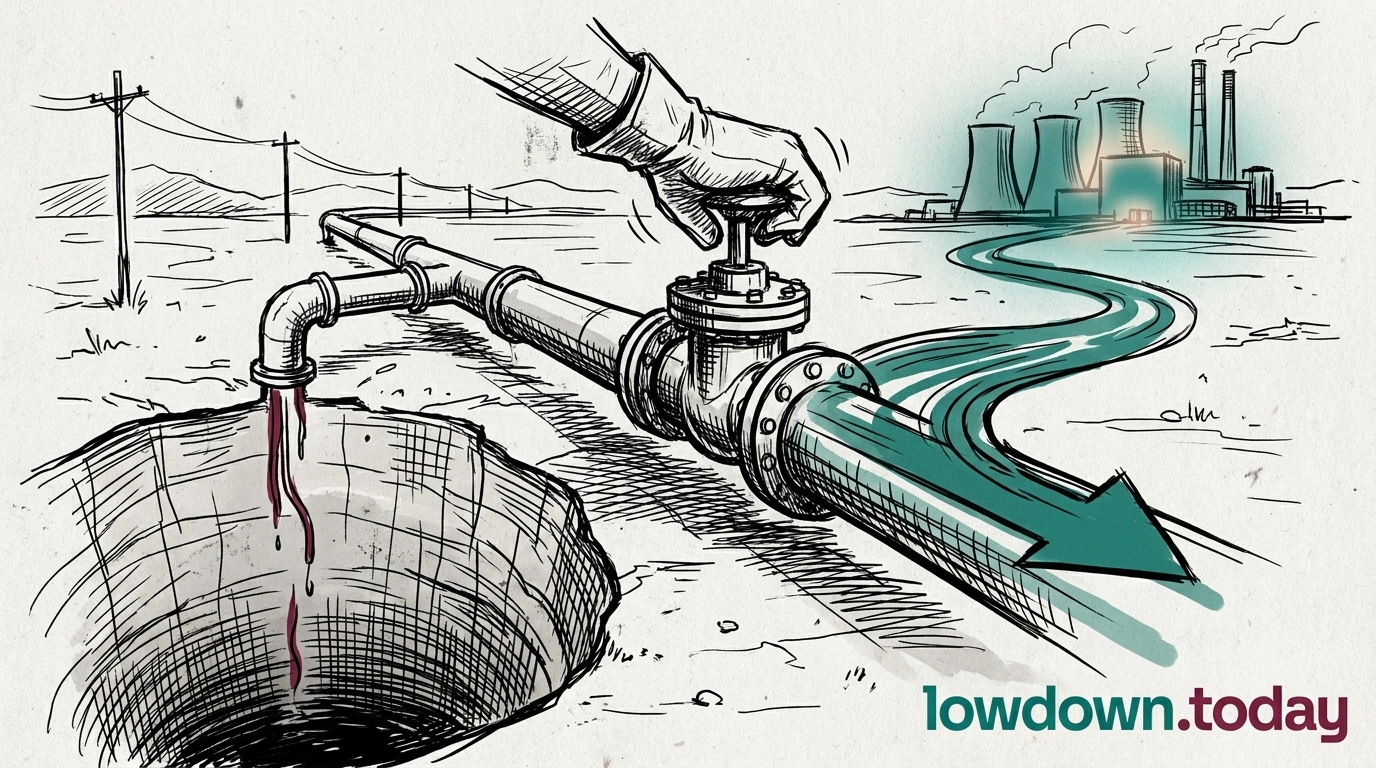
Iran announced on Wednesday 5 August that it had agreed the coordinates of a Strait of Hormuz shipping route with Oman 1. Foreign ministry spokesman Esmaeil Baghaei had set out the shape of it three days earlier, on Sunday 2 August, saying the agreed route would be "neither the current northern route nor the current southern route, but rather a new route to be agreed upon by the two sides" 2. Reporting on the same negotiating window, sourced to Axios, describes the opposite arrangement: the existing lanes divided, inbound traffic through Iranian waters and outbound through Omani 3. Neither government has published a route document.

Hormuz is the only sea exit from the Gulf, and the tankers loading at Saudi, Kuwaiti, Emirati and Iraqi terminals have no alternative to it. Transits have run at a fraction of normal volume since July, after Iranian closure threats and mining emptied the lanes , so how the strait reopens governs when Gulf crude reaches buyers again. One account creates a corridor that does not exist today. The other allocates the corridor that does.

The gap between them is charted in months. A new corridor needs surveying, notices to mariners and mine clearance before a single hull can use it; a lane split needs none of that and could begin on a day's notice. Underwriters write war-risk clauses against named waters, and no clause can name a corridor whose coordinates sit inside an unpublished government announcement.

Baghaei also named the legal basis, Clause 5 of the Iran-US memorandum, under which management of the strait falls to Iran "in consultation with Oman and through dialogue with the region" 4. Consultation gives Muscat no veto over an Iranian routing decision. That reading sits close to what deputy foreign minister Kazem Gharibabadi demanded on 30 July, Iran's own lane plus part of the other , , and a long way from the voluntary-fee model Oman floated two days before that, borrowed from the Malacca Strait and carrying no penalty for a shipowner who declines to pay . Between those two positions lies the difference between a lane Iran polices and a lane Iran merely borders.


Deep Analysis

In plain English

Iran and Oman say they have agreed how ships should move through the Strait of Hormuz, the narrow waterway between Iran and the Arabian peninsula that a large share of the world's oil passes through. But Iran's government describes a new route it controls, while Western reporting describes something closer to splitting the existing route in two. No one has published the actual map or agreement, so it is not yet possible to say which version is accurate, or whether both governments are even describing the same arrangement.

Deep Analysis
Root Causes

Neither government has published the coordinates: Iran's public statements describe a route under its own management rather than a shared lane, while Oman, as facilitator rather than principal, has no standing to release a text neither side has signed.

The absence of a maritime chart or coordinate list also means the agreement cannot yet be tested against the 1982 UN Convention on the Law of the Sea's transit-passage provisions, which Iran never ratified and does not recognise as binding on the strait.

What could happen next?
  • Risk

    If Oman's account and Iran's account remain unreconciled, shipping insurers may treat the corridor as unverified and decline to adjust war-risk premiums until a text is published.

  • Meaning

    A negotiated outcome announced without a text signals both governments prioritised the announcement's political value over its enforceability.

First Reported In

Update #166 · Two Hormuz deals, neither one published

Press TV· 6 Aug 2026
Read original
Different Perspectives
Cross-border power traders
The France-Germany day-ahead spread flipped from a EUR 17.20 German premium on 1 August to a EUR 4.15 French premium on 3 August, the same day French curtailment peaked. They cannot yet attribute the flip to curtailment alone, since a like-for-like overnight comparison shows French nuclear output rising while wind fell and demand returned on the weekday step.
EDF
EDF
River-cooling limits took 7.6 GW, 12 per cent of its fleet, offline on 3 August, the highest curtailment since the heatwave began, with an easing forecast to 4.3 GW on 4 August and 3 GW after. It manages the cut as a recurring seasonal constraint, expecting it to lift with river temperature, not repair.
Gasunie
Gasunie
TTF, the Dutch hub it operates, drifted to roughly EUR 55 to 58 per MWh across the window, staying inside its recent range through both the German spark reversal and the French curtailment. It reads a flat hub price as evidence that neither event this window carried enough weight to move the fuel leg on its own.
German gas-fired generators
Record German solar of 18,761 MW on 2 August pushed the clean spark spread to minus 18.48 EUR/MWh, a loss-making day, before it returned to plus 16.20 on 3 August. They now price dispatch against post-solar residual load rather than wind alone, since the sign flipped inside 48 hours on unchanged fuel and carbon costs.
European Commission (DG Energy)
Its implementing-measures register logged transposition notices from only Portugal and Slovakia against Wednesday's Article 94 deadline for Directive (EU) 2024/1788, with 25 states silent. It expects the register to fill only gradually, since filing routinely lags legislating and any infringement track against non-notifying states runs on a slower clock than the deadline itself.
Spain's LNG terminal operators
Spain's 9,145 GWh terminal inventory is the largest single stock in the EU LNG network, an option value that can reroute cargoes wherever the winter strip pays best rather than a cavern gas obligation tied to a fixed date. That flexibility matters more as Germany's cavern shortfall pushes more of the winter security question onto import infrastructure.



