Skip to content
Briefings are running a touch slower this week while we rebuild the foundations.See roadmap
European Energy Markets
4JUN

REMIT 2.0 hits first 14-day reporting deadline

3 min read
10:45UTC

The REMIT 2.0 recast entered force on Wednesday 29 April. The first 14-day transaction reporting deadline lands around Tuesday 12 May, the recast framework's first compliance test.

EconomicDeveloping
Key takeaway

REMIT 2.0's first 14-day transaction reporting deadline around 12 May sets the recast framework's compliance baseline.

REMIT 2.0 (Regulation on wholesale Energy Market Integrity and Transparency), the recast EU framework, has its first 14-day transaction reporting deadline landing around Tuesday 12 May, the first compliance test of the recast framework that entered force on Wednesday 29 April . ACER (the EU Agency for the Cooperation of Energy Regulators) published four REMIT 2.0 documents on entry day , confirming the recast operative without simultaneity waiver or grace period . The recast had been preceded by an ACER consultation opened on 16 April .

The 14-day reporting cycle introduces an exposure-reporting obligation that was not present in the original REMIT framework, and the framework now binds market participants to disclose net positions on a rolling basis rather than on event-driven triggers. No ACER guidance note or enforcement signal has yet been issued in the days following entry into force, which is the standard pattern: the agency typically lets the first deadline run before issuing operational guidance. The 12 May print is therefore both the first compliance test and the data point against which ACER calibrates whatever follows.

For positioning, the REMIT 2.0 obligations matter alongside the storage-pace question because tighter market integrity rules raise the cost of speculative positioning into a contract that is already pricing the headline rather than the arithmetic. TTF participants whose 14-day exposure prints diverge sharply from physical positions risk supervisory attention from a regulator that has just acquired a new disclosure tool and has not yet shown how aggressively it intends to use it. Whether ACER issues any guidance note or enforcement signal in the week after 12 May is the operative read.


Deep Analysis

In plain English

REMIT 2.0 is a new European Union rule about fairness and transparency in the wholesale energy market, the market where energy companies buy and sell gas and electricity in large quantities. From 29 April 2026, energy traders have to report their net positions in those markets to the EU's energy regulator, ACER, every 14 days. The first of those reports is due around 12 May. This is designed to make it harder for large traders to build up dominant positions that could push up prices for everyone. The regulator has not yet said how strictly it will enforce the new rules.

Deep Analysis
Root Causes

REMIT 2.0's 14-day transaction reporting cycle was accelerated from the originally proposed 21-day window during the trilogue finalisation in January 2026, in direct response to the August 2022 TTF manipulation concerns and the evidence base ACER accumulated during its 2023-2025 Horizonte investigation into TTF position-concentration by three major commodity trading houses.

The structural driver is a regulatory architecture gap: original REMIT was calibrated to a 2011 EU gas market dominated by pipeline supply under long-term contracts.

The 2026 market is a spot-dominated LNG market with algorithmic position-taking and automated roll strategies that generate large intraday net-position swings invisible to a monthly or quarterly reporting cycle. The 14-day window is the minimum cycle at which ACER can observe position-concentration developing before it reaches manipulative scale.

What could happen next?
  • Consequence

    TTF participants whose 14-day net-position disclosures reveal concentration above ACER's (unpublished) threshold could face supervisory inquiries in the week after 12 May, before any formal enforcement action.

    Immediate · 0.6
  • Risk

    MiFID II precedent suggests 30-40% of first-deadline reporters will fail to comply with the technical reporting specifications; ACER's initial enforcement posture, whether it issues warning letters or opens formal investigations, sets the compliance culture for the rest of the season.

    Immediate · 0.62
  • Opportunity

    If ACER uses the 14-day position data to challenge concentrated speculative TTF shorts during the injection season, it could reduce the market's tendency to underprice storage-pace risk relative to the arithmetic, directly relevant to the gap between TTF's settled range and the 0.045 pp/day injection shortfall.

    Medium term · 0.55
First Reported In

Update #7 · Storage pace 0.21 vs 0.257; floor not yet met

Gasunie Transport Services· 4 May 2026
Read original
Different Perspectives
TTF traders / Amsterdam hub desks
TTF broke its 38-session EUR 46-47 band on 2 June to EUR 48.9 on stalled Iran diplomacy and an unconfirmed Troll A restart; Dutch EBN mandates carry storage trajectory while commercial injection books nothing. The 17 June pipeline expiry is the next binary level: Central European hub premium above EUR 2/MWh widens sharply on any physical step-down.
Red Electrica / Spanish grid operators
Spain logged 397 negative-price hours in Q1 2026, eight times the 48 hours of Q1 2025, documenting midday solar surplus now embedding structurally into Continental pricing. Spain is four to six quarters ahead of France and Germany on the solar-penetration curve, making it the clearest forward indicator of where Continental midday clearing is heading.
Equinor
Equinor
Equinor issued no Troll A restart notice through 4 June despite extending the combined outage to 31 May, keeping up to 51 mcm/day of Norwegian supply offline alongside Hammerfest LNG dark since 22 April. The company's silence follows its 2025 Hammerfest pattern, which ran 24 days past target, and each day without a notice sustains the TTF supply premium.
European Commission / GMTF
SWD(2026)147 found EU gas spot and derivatives markets functioning well on 2 June, recommending MiFID-REMIT legislative alignment rather than emergency intervention. The GMTF verdict addressed derivatives-market integrity, not the physical injection mechanism FNB Gas declared broken five days earlier: the Commission's immediate next step is a legislative proposal, not an emergency storage order.
FNB Gas / Bundesnetzagentur
FNB Gas declared the storage-refill mechanism broken on 27 May after zero bookings in January 2026 auctions, and German day-ahead cleared EUR 102.64 on 3 June on a CCGT stack set by TTF near EUR 49 plus EUA near EUR 78. Winter storage fill now depends on state mandates with no commercial self-correction.
EDF / French government
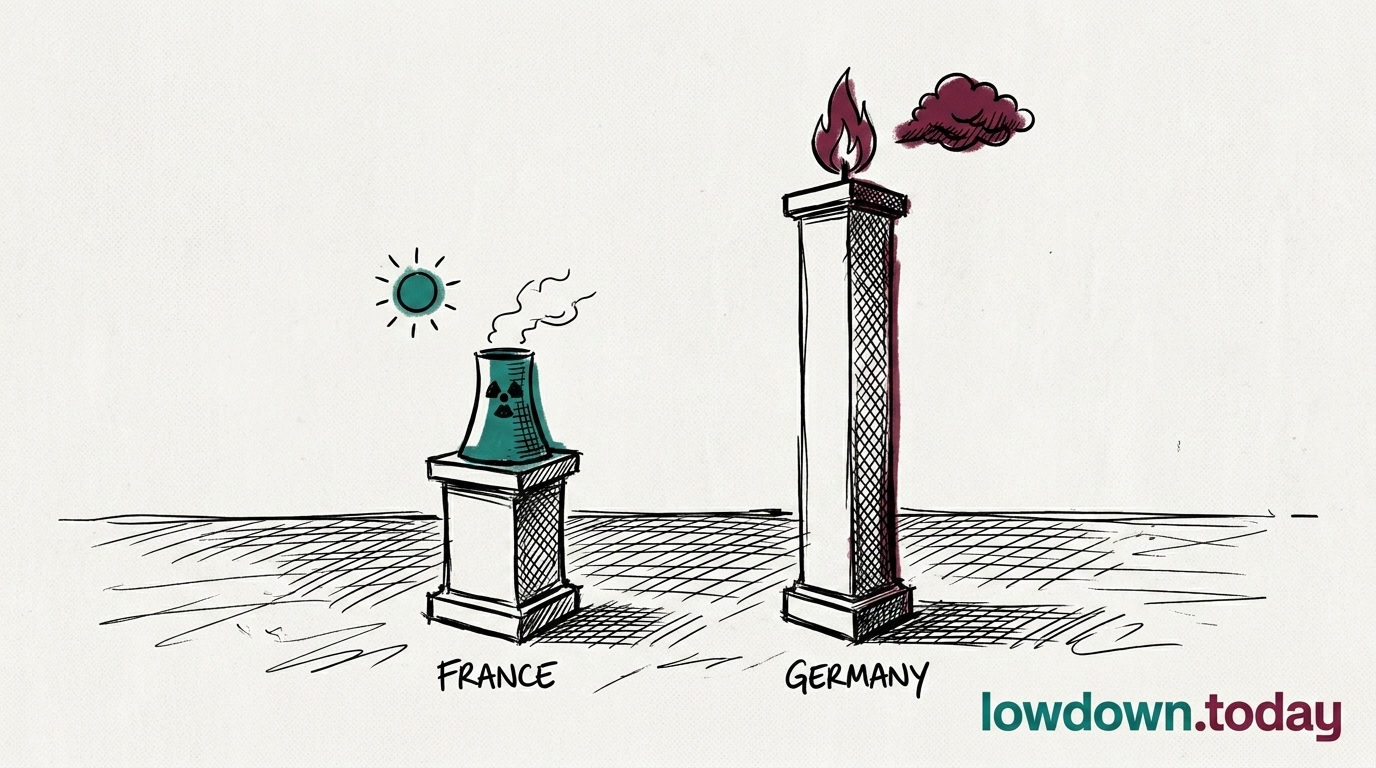
EDF held full-year nuclear guidance at 350-370 TWh after April output of 29.3 TWh, anchoring the surplus that collapsed French day-ahead to EUR 8.96 on 3 June and passed that price to VNU industrials. Flamanville-3's September overhaul removes 1.6 GW at heating-season onset, reversing the nuclear surplus that made VNU pricing competitive.
