Skip to content
You can now search across every topic, entity and event.What's new
European Energy Markets
4JUN

June injections trail last year by 16%

4 min read
10:45UTC

EU storage injected 6.9 bcm in June, down 16% on last year, widening the year-on-year fill deficit to about 9 points as power generation bids for the same prompt cargoes the mandated injectors need.

EconomicDeveloping
Key takeaway

Europe's storage gap is widening on observed data, not narrowing on forecast.

EU storage injected 6.9 bcm in June, down 16% on the same month last year and about 6% below the multi-year pace for the date, on GIE AGSI+ data relayed by TASS 1. AGSI+ is the daily transparency platform run by Gas Infrastructure Europe; it is the reference the whole desk prices off. Fill reached 46.4% on 22 June against 55.4% a year earlier, so the year-on-year deficit widened to roughly 9 percentage points .

The bloc needs 68 bcm more through October to clear the 80% target. At the April-June run-rate of around 9.3 bcm a month, the four remaining injection months deliver about 37 bcm, for a season total near 57 bcm, some 11 bcm short. This is not a forecast that might soften; it is a gap that grew inside the window.

The deficit persisted even as the front-month sat near its floor, because the mandated injectors (EBN, the Dutch state operator, CRE in France and ARERA in Italy) are bidding for the same prompt cargoes that power generation now wants. When the spark turned positive , commercial burn out-competed the only structural injection discipline the bloc has left.

Gazprom now forecasts EU storage may not even reach 70% before the heating season 2. The Russian producer has an interest in talking the deficit up, but its number lands close to the independent reading the curve is already pricing, so the warning carries weight it would not normally earn.


Deep Analysis

In plain English

Europe fills its underground gas tanks over the summer so there is enough gas to heat homes and run factories through winter. The target is 80% full by 1 November. Right now, the tanks are 46.4% full; and this year the filling is going slower than last year by about 16%. Think of it like a road trip where you need 80 litres of fuel at your destination but you have only 37 litres in the tank so far, and you are filling up more slowly than you planned. You need to fill at a faster rate for the rest of the journey, but the petrol stations are mostly sending their supply somewhere else. The somewhere else is Asia, where gas prices are higher than in Europe right now, so cargo ships carrying liquefied natural gas are sailing east rather than west. Europe's filling problem will not fix itself at current prices; prices need to rise enough to make it worthwhile for those ships to change course.

Deep Analysis
Root Causes

Three structural causes converge on the 16% year-on-year injection shortfall. First, the summer-winter TTF strip has been inverted throughout 2026: prompt gas trades above winter delivery, removing any commercial incentive to inject beyond regulatory mandates. Without the strip turning normal (summer cheaper than winter), only state-mandated operators inject at scale.

Second, the LNG replacement for Qatari volumes has not materialised. The JKM-TTF arbitrage, which stood above USD 5/MMBtu in mid-June, continues to pull Atlantic-basin cargoes toward Asia. The OIES 2.1 bcm/month net shortfall figure directly reflects the non-arrival of these cargoes.

Third, the gas storage levy abolition in Germany from 1 January 2026 removed the fiscal mechanism that previously supplemented market-rate injection. Germany is the EU's largest storage holder; its injection shortfall carries disproportionate weight in the bloc-wide figure.

What could happen next?
  • Risk

    At the April-June run-rate, the EU closes the season roughly 11 bcm short of the 80% floor, placing November storage near 65-67%; historically associated with Q1 price spikes above EUR 80/MWh.

    Medium term · Assessed
  • Consequence

    A Gazprom forecast of sub-70% storage, if it prompts early demand-side measures from member states, would raise industrial energy costs and compress output in energy-intensive sectors before winter demand peaks.

    Short term · Assessed
  • Opportunity

    If TTF rises to EUR 58-62/MWh in July, the JKM-TTF spread closes enough to redirect several Atlantic-basin cargoes, potentially adding 3-4 bcm of incremental July injection.

    Short term · Suggested
First Reported In

Update #20 · Spark spread now feeds the winter deficit

TASS· 22 Jun 2026
Read original
Different Perspectives
Marine insurers and AIS trackers covering Hormuz
AIS data shows severe curtailment on 20 July, 479 vessels anchored, 36 dark, 123 still broadcasting inside the strait, not the closure the IRGC claims. War-risk premiums move on the unresolved CENTCOM-IRGC contest itself, since underwriters price the dispute as much as the count.
QatarEnergy
QatarEnergy
Ras Laffan has run at minimum output under force majeure into August since 9 July, a constraint already priced before this week's claim. The 17-20 July move is risk premium stacked on that standing loss, not a new physical loss at the plant.
ACER and the European Commission
ACER opened the REMIT reporting consultation on schedule on 16 July, giving firms to 11 September before a quarter to build systems against Regulation 648/2012. Brussels' separate silence on StromVKG state-aid clearance leaves Berlin's own capacity mechanism without legal authorisation.
EDF and French grid operator RTE
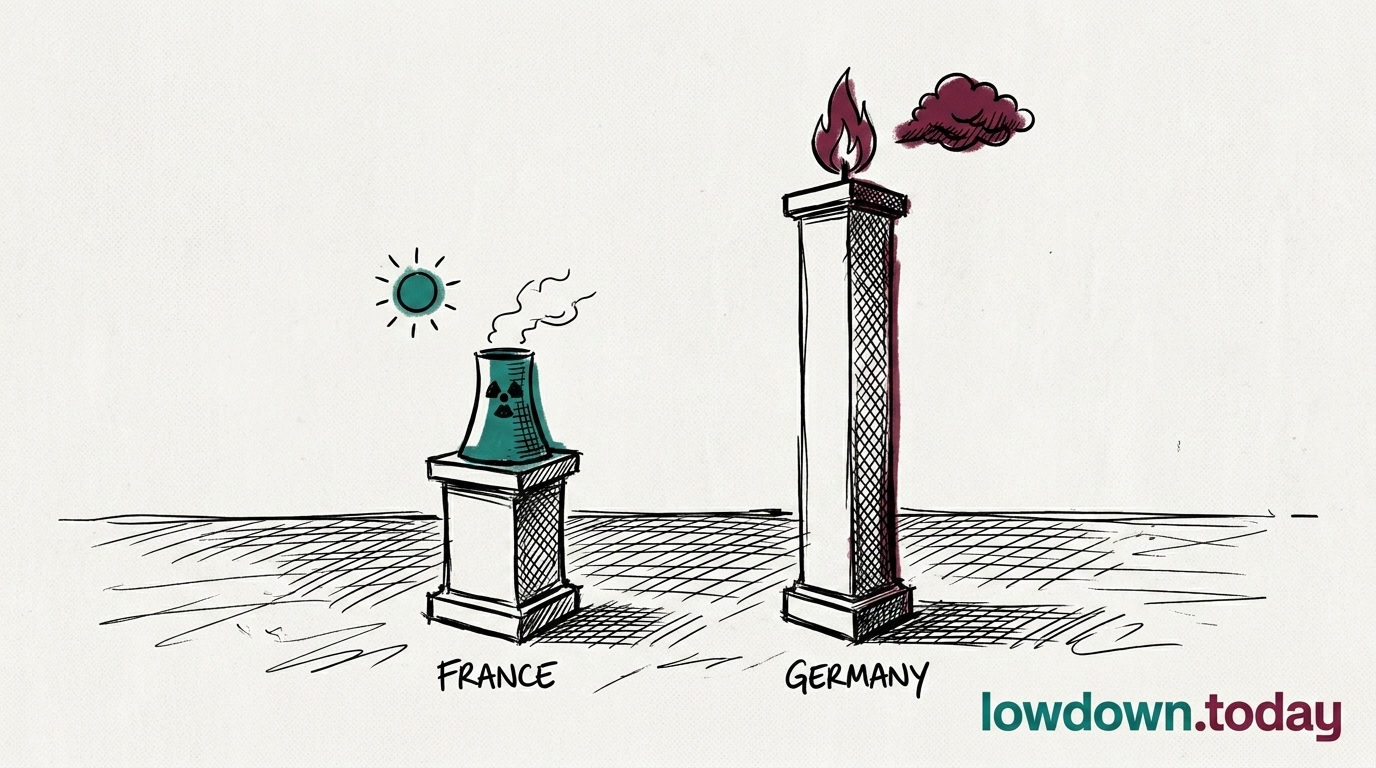
France's discount to Germany rests on an ASNR derogation from the 28C river-cooling limit at Bugey that expires today, not on a nuclear recovery; Chooz, Golfech and Bugey restarts run to 25 July. The cheap leg holds only as long as regulators keep waiving the limit each heatwave.
German CCGT operators and grid balancers
German gas plants went off-merit on 20 July as the clean spark spread inverted to minus EUR 15 to minus EUR 21/MWh, sidelining the flexible capacity storage injection needs. Operators are pricing 2027-28 capacity revenue against Bundesnetzagentur's own admission that Brussels has not cleared the 9 GW StromVKG auctions.
LNG spreads desk
LNG spreads desk
The JKM-TTF arb flipped to a TTF premium of roughly USD 0.6/MMBtu on 15 July, the first time this cycle Europe has outbid Asia, yet no Atlantic cargo has rerouted west. Until a cargo actually moves, the desk reads the Hormuz premium as unconfirmed and the EUR 55 print as vulnerable to a fast reversal.
