Skip to content
Briefings are running a touch slower this week while we rebuild the foundations.See roadmap
Drones: Industry & Defence
13APR

Zelenskyy reveals ten offshore factories

2 min read
13:26UTC

Ukraine's wartime export ban is fracturing. One manufacturer sold 1,000 interceptors for $3.5 million while holding a EUR 300 million state contract.

TechnologyDeveloping
Key takeaway

Grey-market factories signal Ukraine's export ban is fracturing under commercial pressure.

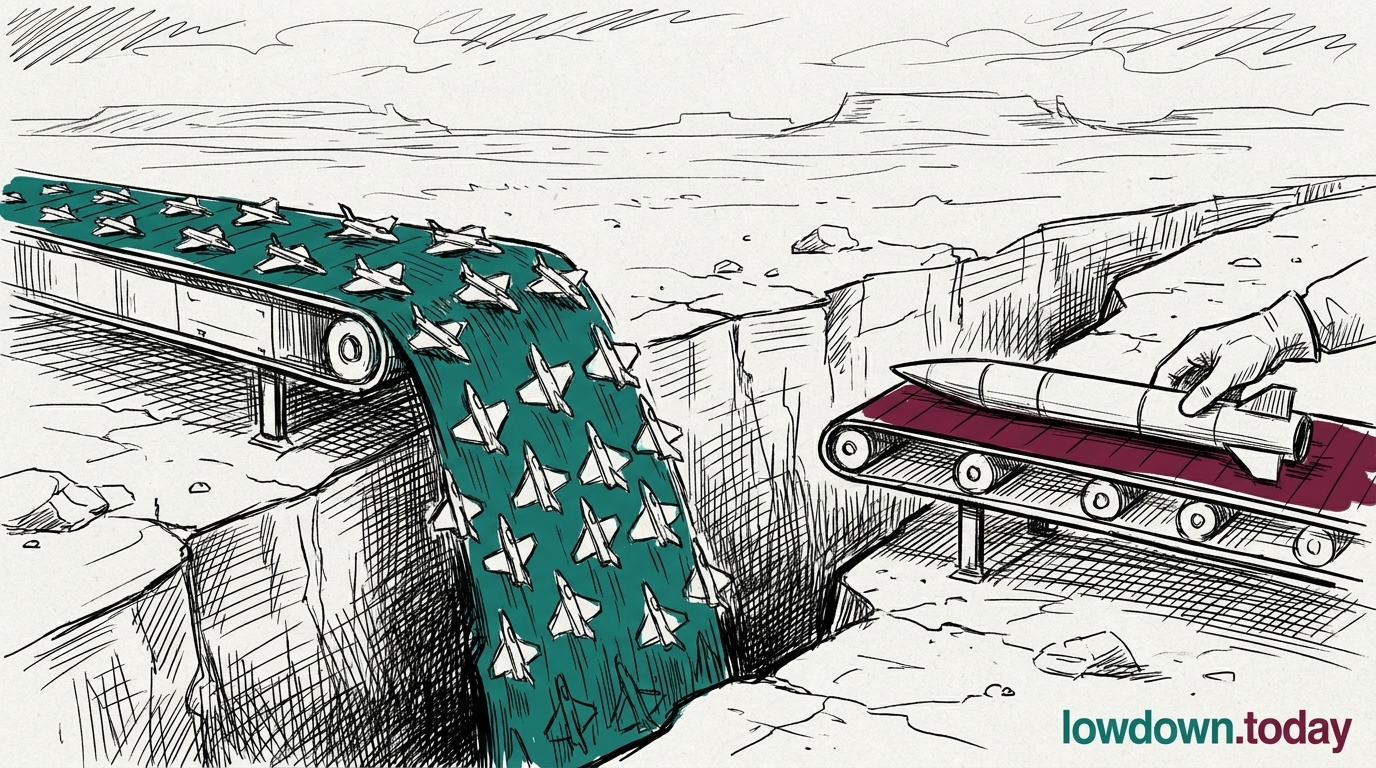
Volodymyr Zelenskyy disclosed on 28 March that approximately 10 drone factories have been built abroad to circumvent Ukraine's wartime export ban.1 One company sold 1,000 interceptor drones to a foreign buyer for $3.5 million while simultaneously holding a EUR 300 million state production contract. At least one European country purchased drones without warheads and then requested Ukrainian operators to accompany them.

The economics explain the leakage. Ukrainian interceptors cost $2,500 to $5,000 per unit.2 A PAC-3 Patriot interceptor costs $13.5 million. That price ratio makes Ukrainian systems irresistible to any buyer facing drone threats, and demand from 11 nations remains blocked by the export ban . Manufacturers with excess capacity and uncertain state payment timelines have rational incentives to seek foreign hard-currency buyers.

Ukraine can technically build 1,000 interceptors per day but is budget-limited to roughly half that. The funding gap, perhaps $5 million to $10 million daily, represents the difference between a cottage industry and a global export platform. Zelenskyy warned the "window of opportunity" is narrowing: private manufacturers are outpacing state coordination.

Deep Analysis

In plain English

Ukraine bans the export of its drones because it is still at war and does not want its most effective weapons reaching enemy hands. But the manufacturers making these drones need cash now, not promises from a government with constrained budgets. So roughly 10 factories have been built outside Ukraine in secret, allowing the drones to be sold to foreign buyers without technically violating the export ban. Zelenskyy revealed this publicly, which is unusual. It signals he sees both the problem (the state is losing control of its most valuable technology) and an opportunity (these exports could become a significant revenue source if formalised).

Deep Analysis
Root Causes

The export ban was enacted in 2022 as a wartime security measure to prevent battlefield-proven designs from reaching adversaries. The problem is that Ukrainian drone manufacturers have matured from cottage workshops into industrial producers, and the state payment infrastructure has not kept pace.

When a manufacturer holds a EUR 300 million state contract but also sells 1,000 units abroad for $3.5 million, the state contract is providing production certainty while the export sale provides cash flow. This is structurally identical to how Soviet-era arms exporters operated in the 1980s: state backing for capacity, grey market for liquidity.

What could happen next?
  • Risk

    Grey-market drone exports undermine Ukraine's ability to control proliferation of its most advanced battlefield technologies, with no guarantee buyers' security practices are adequate.

    Immediate · High
  • Opportunity

    Lifting or restructuring the export ban could generate $2–3 billion annually in hard currency revenue, reducing Ukraine's dependence on Western military aid.

    Short term · Medium
  • Consequence

    The existence of 10 shadow factories signals that Ukrainian drone manufacturers are already operating as a de facto global defence export industry without state oversight.

    Immediate · High
  • Precedent

    If Ukraine formalises exports, it establishes the first wartime-proven small-drone export market, reshaping the global defence procurement landscape for sub-$10,000 strike systems.

    Long term · Medium
First Reported In

Update #3 · Anduril wins $20 billion counter-drone deal

Euromaidan Press· 30 Mar 2026
Read original
Different Perspectives
Chinese drone manufacturers (DJI, Autel)
Autel's Ralls Corp Fifth Amendment filing and DJI's Ninth Circuit quantification of USD 1.56 billion in 2026 losses are parallel constitutional attacks on a classified-evidence exclusion mechanism; neither company can contest the intelligence allegations directly, so both are betting on due-process doctrine to reopen the FCC authorisation route.
Ukraine (SSEC export regulator)
Baltic states bought Lithuanian Merops and Swedish LVKV 90 stopgaps while Ukraine's cheapest combat-proven interceptors at USD 2,100 to USD 2,500 per unit remain legally blocked under EU conflict-aggravation rules; Perennial Autonomy, built on Ukrainian combat data, can now sell via Munich while direct Ukrainian sales to the same buyers remain prohibited.
Helsing
Helsing
HX-2 combat-proven status, a EUR 1.46 billion German framework, an $18 billion valuation, and the OHB space JV together constitute the first credible European counterweight to Anduril's US stack. The critical test is whether European procurement offices can maintain sovereign AI discipline under operational urgency, or default to the US integration speed that drove the Netherlands Lattice decision.
Anduril Industries
Anduril Industries
A USD 61 billion valuation on USD 2.2 billion revenue prices in the assumption that Lattice becomes the default Western counter-drone software layer. The Netherlands adoption and Project NYX inclusion suggest the architecture bet is converting; the S-1 filing window opens when quarterly growth sustains the 27x multiple.
European Union
European Union
The EUR 115 million AGILE programme was designed before Baltic states began emergency national purchases worth ten times the total EU budget; calling for coordination on 26 May after each country had signed contracts is not a procurement policy, it is a statement of concern with no enforcement teeth.
UK Ministry of Defence
Britain has committed GBP 752 million to Ukraine drones, GBP 115 million to Hormuz, APKWS to Gulf combat, and three concurrent procurement programmes, all driven by the same operational pressure. Project NYX and Corvus together set the British Army's drone architecture through 2036; the autumn down-select will reveal whether Washington or London holds the architectural preference.
