Skip to content
You can now search across every topic, entity and event.What's new
Drones: Industry & Defence
20AUG

Army awards Anduril $20 billion Lattice

2 min read
16:38UTC

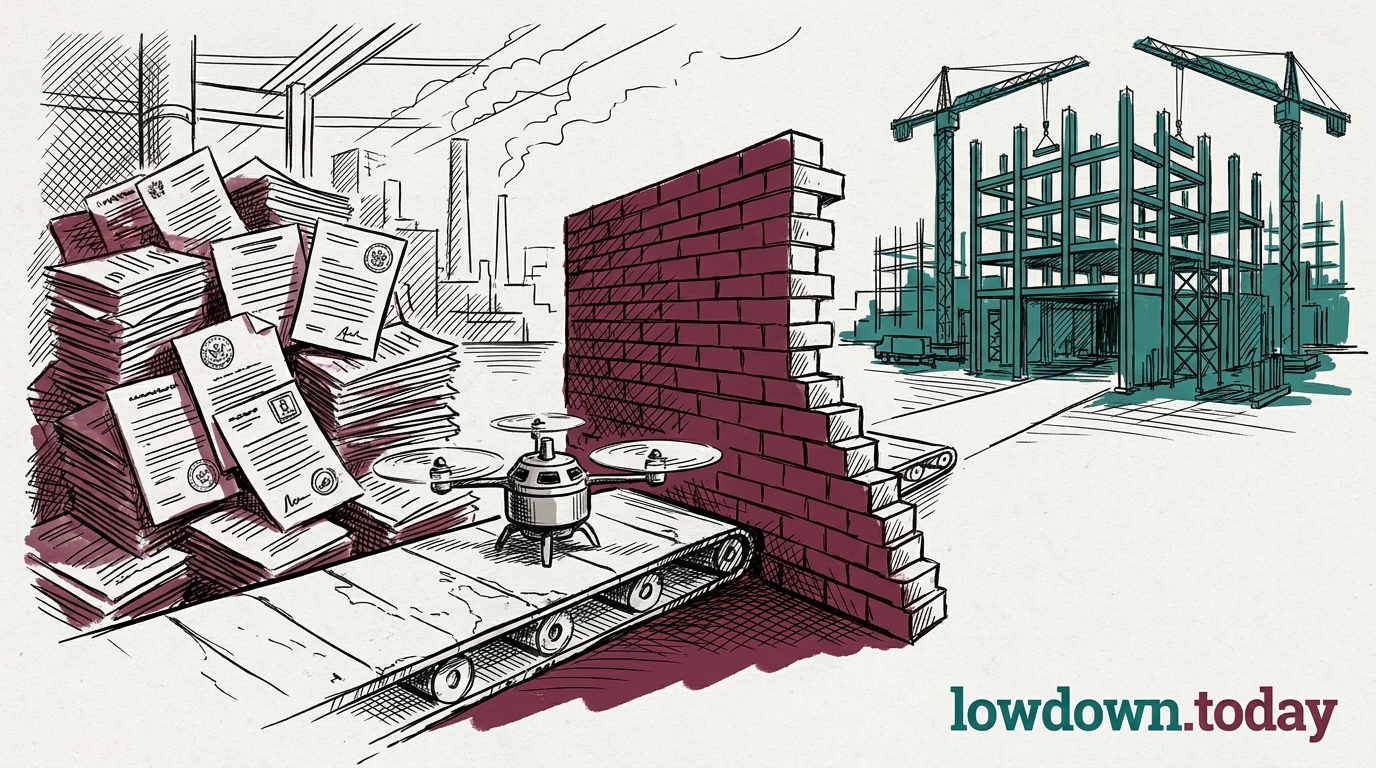
A single enterprise contract consolidates 120 separate procurement actions into one ordering mechanism. Every future Pentagon counter-drone buy can now bypass competitive tendering.

TechnologyDeveloping
Key takeaway

Anduril now holds the default procurement position for all US counter-drone purchases.

Army Contracting Command at Aberdeen Proving Ground awarded Anduril Industries a 10-year, $20 billion enterprise contract vehicle on 14 March, with an optional five-year extension to 2036.1 The vehicle consolidates more than 120 separate procurement actions into a single mechanism. Any federal buyer can now order the Lattice counter-drone platform without a fresh competition.

The $87 million task order for JIATF-401 that surfaced two weeks earlier was not a standalone award. It was the first purchase against this master agreement. Brian Schimpf, Anduril's president, called the arrangement "an ordering guide," a description that frames Lattice less as a product to be evaluated and more as a catalogue to be browsed.

Enterprise vehicles of this scale are common in Pentagon procurement, and ceilings are rarely reached. But the structural effect matters more than the headline figure. Every future Department of Defense counter-UAS requirement can be routed through Anduril without competitive tendering. For rivals, the barrier to displacement has risen by an order of magnitude. The closest analogy is the JEDI cloud contract, where platform selection proved more consequential than any individual task order.

Deep Analysis

In plain English

Imagine the US Army previously had to run a separate tender every time it wanted to buy counter-drone equipment. Each one took 18 months and generated a stack of paperwork. This contract collapses all of that into a single agreement. Now any part of the US military that needs counter-drone equipment can simply place an order with Anduril, much like a corporate purchasing department ordering from a pre-approved supplier catalogue. The upside is speed. The downside is that Anduril now effectively has a monopoly on US military counter-drone procurement for the next decade, which removes the competitive pressure that typically keeps costs in check.

Deep Analysis
Root Causes

The consolidation reflects Pentagon frustration with the acquisition cycle. Counter-UAS threats evolved faster than the 18–24 month procurement timelines that govern competitive re-tendering under standard FAR rules.

Anduril's position was further entrenched by Lattice's dual role: it is simultaneously a command-and-control platform and an interface layer that creates switching costs analogous to enterprise software lock-in. Once a command architecture integrates Lattice, replacing it requires replacing the software stack that manages all connected systems.

What could happen next?
  • Consequence

    Anduril becomes the de facto monopoly provider for US counter-drone procurement for up to 15 years, dramatically raising the barrier for rivals.

    Immediate · High
  • Risk

    Enterprise vehicle concentration creates a single point of failure in US counter-drone capability if Anduril underperforms or faces legal challenges.

    Medium term · Medium
  • Opportunity

    Other US defence firms can position complementary capabilities — sensors, munitions, training — as add-ons within the Lattice ecosystem rather than competing for the platform itself.

    Short term · Medium
  • Precedent

    If the vehicle model succeeds, it will become the template for all major US drone and autonomy procurement, fundamentally reshaping how the Pentagon buys military technology.

    Long term · Medium
First Reported In

Update #3 · Anduril wins $20 billion counter-drone deal

DefenseScoop· 30 Mar 2026
Read original
Different Perspectives
South Korea's Defense Acquisition Program Administration
DAPA folded drone and roadside-bomb jammers into an 18-year, KRW 3.448 trillion K2 tank upgrade approved 11 August, rather than fund counter-drone kit as its own programme. Seoul is treating the threat as permanent enough to write into a platform's lifecycle, not urgent enough to buy ahead of it.
NATO Support and Procurement Agency
NSPA named five pre-qualified counter-drone suppliers under new framework contracts on 27 July, giving allies a purchasing route with no published budget attached. A framework without committed money is an instrument waiting for a spending decision, not a guarantee one is coming.
Ukraine's Ministry of Defence
Ukraine's forces strike with more than 70 AI and computer-vision systems drawn from over 200 domestic producers, the ministry said on 18 August, a supplier base neither Washington's tariff fight nor Beijing's export licence touches. Kyiv is scaling capability faster than either government is writing rules for it.
A European drone-component manufacturer
A European manufacturer selling components into the United States faces the same 100 per cent tariff and 3 September deadline as any other foreign supplier, with the duty-free onshoring carve-out available only to firms building on American soil. That leaves it to absorb the cost, relocate assembly, or cede the US market rather than shop around a rival supply chain.
Chinese drone component exporters
Exporters now need a case-by-case licence for each US-bound dual-use shipment after MOFCOM's 5 August order, with no published review clock. The same week Shenzhen logged nearly 200,000 domestic logistics-drone sorties and Hunan reported record spraying coverage, a home market large enough to absorb what the licence regime slows from leaving the country.
US drone manufacturers
The onshoring carve-out protects Performance Drone Works' $820 million War Department loan, but the same 3 September deadline hits Red Cat Holdings and Unusual Machines, both filing over 500 per cent revenue growth on 6 August, on Chinese-sourced components with no qualified domestic substitute yet.
