Skip to content
Briefings are running a touch slower this week while we rebuild the foundations.See roadmap
Drones: Industry & Defence
7JUN

Lethality Prize feeds Gauntlet II cycle

2 min read
11:27UTC

The Pentagon's Lethality Prize Challenge closes 14 April; winners gain preferred munitions status for the 50,000 to 60,000 drone Phase II procurement.

TechnologyDeveloping
Key takeaway

Lethality Prize winners gain presumptive positioning for the Pentagon's 300,000-drone programme.

The Pentagon's Lethality Prize Challenge closes 14 April, with winners announced by 21 April. Selected companies join the Gauntlet II preferred munitions list and receive weapons system reviews, feeding directly into the 50,000 to 60,000 drone Phase II procurement target .

The structure creates a filtered payload ecosystem. Companies that win preferred status gain not merely a contract but a pre-qualified position for future procurement cycles across the broader 300,000-drone 2027 programme ambition. Companies that miss the window face a barrier even if their product eventually proves superior. This is how default procurement positions are built: early preferment in structures that compound with scale, the same pattern visible in Anduril's Lattice positioning .

The Pentagon is deliberately separating the payload problem from the platform problem. By building a modular munitions ecosystem qualified across multiple airframes, the programme avoids tying lethal capability to a single manufacturer's hardware. The approach distributes industrial participation more broadly than sole-source platform awards allow.

AeroVironment, which is also preparing an entrant for the delayed EHEL directed-energy competition, could use the Lethality Prize as a parallel entry point for kinetic payload systems. Winning both kinetic and directed-energy qualification would position the company across both counter-drone paradigms simultaneously.

Deep Analysis

In plain English

The Pentagon is building up to 300,000 attack drones by 2027. The Lethality Prize is a competition closing 14 April to decide which explosives and warheads those drones will carry. The idea is to separate the drone (the vehicle) from the payload (the weapon it carries), so different companies can specialise in one or the other. Winners of the Lethality Prize get put on a preferred suppliers list for 50,000-60,000 drones in the next procurement phase. For smaller companies that make munitions but not full drones, this is their main route into the Pentagon's drone programme.

What could happen next?
  • Opportunity

    Companies that win Lethality Prize preferred status before 14 April gain presumptive positioning for a 300,000-drone programme by 2027; the window for entry closes with this competition and does not reopen until Gauntlet III.

  • Consequence

    A separated platform-payload architecture distributes Pentagon drone programme revenue across a wider set of suppliers than a vertically-integrated approach, reducing the concentration risk that Anduril's sole-source positions represent in the counter-UAS domain.

First Reported In

Update #5 · Gulf drone war rewrites procurement

Defense Daily· 13 Apr 2026
Read original
Different Perspectives
Denmark (host nation)
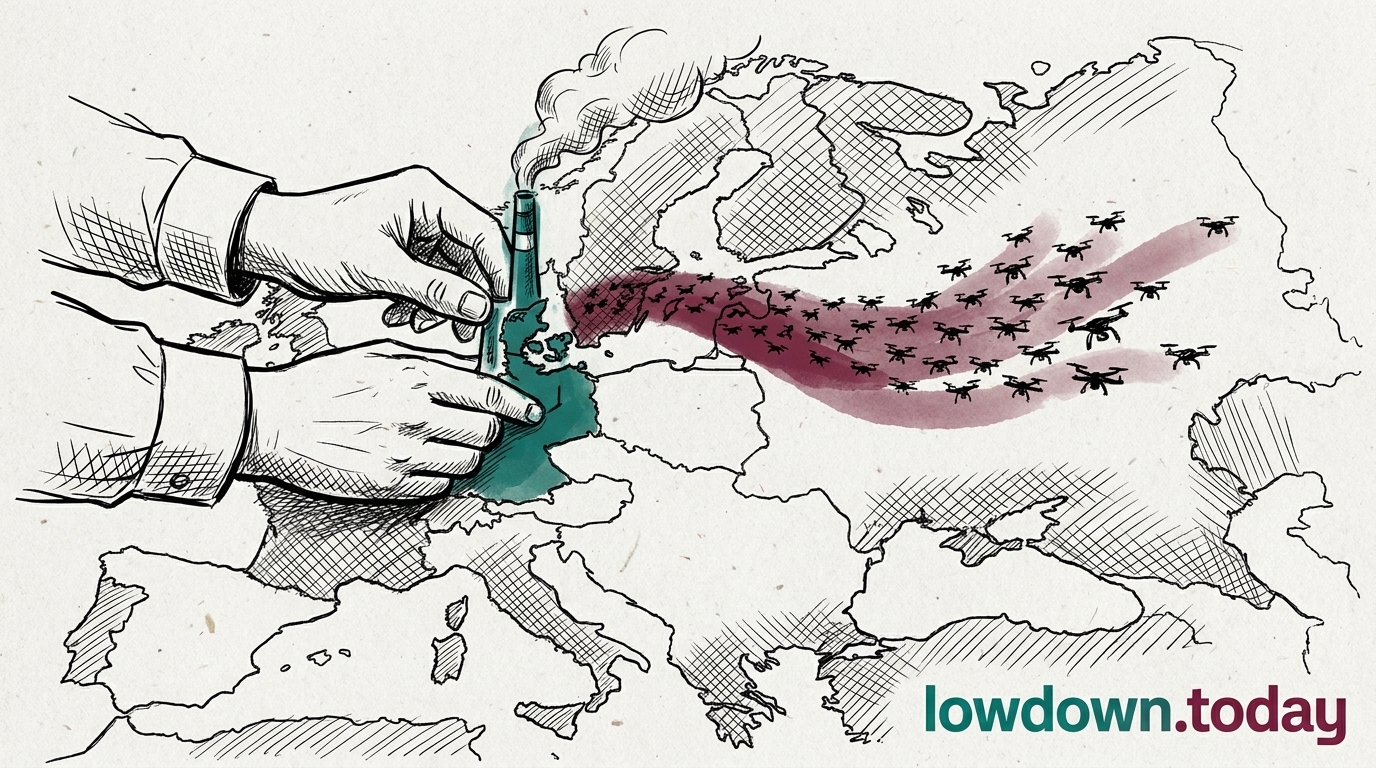
Denmark accepted Fire Point's Skrydstrup plant after committing to bilateral defence co-production at the B9 Nordic summit in May; the facility sits beside a Danish F-35 base, sharing security perimeters. NATO has published no legal guidance on whether hosting Ukrainian weapons production converts Denmark into a co-belligerent, leaving the host-state obligation unresolved.
Russian Ministry of Defence
Russia's 117% YoY drone-output rise in April, accelerating from a 68% full-year 2025 baseline, validates the FPV mass-production doctrine and hands Moscow a cleaner targeting argument for the Skrydstrup plant than any hidden production line offered; a Ukrainian weapons facility on NATO sovereign territory is a legitimate military target under the laws of armed conflict.
Baltic NATO states (Latvia, Estonia, Lithuania)
Latvia deployed mobile drone-intercept teams on 29 May using domestic Origin Robotics and Eraser interceptors, the first kinetic Baltic border response to Russia's 117% output surge. The Baltic states are the primary target market for Ukraine's ten EU export offices, giving them direct commercial access to combat-tested interceptors their own manufacturers have not yet matched.
Pentagon / Joint Interagency Task Force 401
Two Ukrainian entrants in Drone Dominance Phase 2 and Red Cat's SEC-filed STE partnership bring combat-iterated Ukrainian designs into US procurement without triggering Foreign Military Sale approvals; the programme's performance-scoring methodology does not require US-origin hardware. Northrop holding the Common UAS Payload standard means a heritage prime captures interface revenue regardless of which startup airframe wins.
Ukrainian defence industry (Fire Point / Spetstechnoexport)
Fire Point's Skrydstrup construction start and Spetstechnoexport's Red Cat partnership execute Zelensky's 13 May Bucharest proposal: converting wartime production surplus into a state export apparatus, independent of US approval chains. For Ukraine, embedded manufacturing on NATO soil protects propellant supply from Russian strikes while generating hard currency the war effort needs.
Chinese drone manufacturers (DJI, Autel)
Autel's Ralls Corp Fifth Amendment filing and DJI's Ninth Circuit quantification of USD 1.56 billion in 2026 losses are parallel constitutional attacks on a classified-evidence exclusion mechanism; neither company can contest the intelligence allegations directly, so both are betting on due-process doctrine to reopen the FCC authorisation route.
