Skip to content
Briefings are running a touch slower this week while we rebuild the foundations.See roadmap
Drones: Industry & Defence
7JUN

Australia commits A$7bn to counter-drones over decade

4 min read
11:27UTC

Defence Industry Minister Pat Conroy on 21 April announced Australia will invest up to A$7 billion over a decade in counter-drone capability, with first ASCA Mission Syracuse contracts going to AIM Defence and SYPAQ Systems.

TechnologyDeveloping
Key takeaway

Australia is the third major non-US counter-drone market; first ASCA contracts seeded SMEs over the listed national champion.

On Tuesday 21 April, Defence Industry Minister Pat Conroy announced the Albanese Government will invest up to A$7 billion over the next decade in counter-drone capabilities, embedded in a wider A$22 billion drone, counter-drone and autonomous-systems envelope inside the 2026 Integrated Investment Program (IIP) released five days earlier 1. The A$22 billion total is a 69% increase on the A$13 billion committed in the 2024 IIP. First contracts ran through Advanced Strategic Capabilities Accelerator (ASCA) Mission Syracuse: AIM Defence received A$21.3 million for the Fractl high-powered laser; SYPAQ Systems received A$10.4 million for the Corvo Strike loitering interceptor drone, designed to chase and destroy Shahed-class airframes.

Australia is now the third major non-US C-UAS market after the UK's £4 billion commitment and the EU's €115 million Accelerated Government Innovation for Lethality and Effectiveness (AGILE) plan . Both Australian systems will integrate into the Australian Defence Force's Land 156 battle management network, which is the procurement gate any future ADF C-UAS bidder will have to clear. Australia's 2024 to 2026 defence reviews placed sovereign capability above off-the-shelf imports for prioritised technology areas, of which counter-drone is now one.

A$31.7 million across two SMEs is the seed phase, not the steady state. Comparable national programmes have run a three to five year window between seed awards and consolidation contracts at the £100 million-plus scale. Australia's A$7 billion divided across that horizon implies a small number of A$500 million to A$1 billion programmes of record by 2030, with AIM Defence's Fractl laser and SYPAQ's Corvo Strike both candidates if they survive the operational evaluation phase. The A$22 billion envelope provides the allocation pool for follow-on awards.

DroneShield, the country's only publicly listed counter-drone champion, headquartered in Sydney and approaching A$300 million annual revenue , received no first-tranche award. That can be read two ways: ASCA Mission Syracuse is deliberately spreading early funding to smaller firms to seed the supplier base, or DroneShield's product mix sits outside the laser-and-loitering-interceptor focus of the first round. The 29 May AGM will surface management's reading.

Deep Analysis

In plain English

Australia announced it will spend A$7 billion over the next ten years on systems to detect and destroy enemy drones. This follows a broader A$22 billion commitment to drones, counter-drones and autonomous systems; nearly 70% more than it committed just two years earlier. The first two contracts went to small Australian companies: one makes a laser that can shoot down drones, the other makes a drone designed to chase and destroy enemy unmanned aircraft. The money is part of a strategy to build Australian companies that can supply their own military, rather than relying entirely on imports from the United States.

Deep Analysis
Root Causes

Two strategic shocks drove the 69% IIP increase. Australia's 2023 and 2024 defence reviews both assessed that the ADF lacked credible area-denial capability against a sustained drone campaign in the approaches to northern Australia. The reviews named the Shahed-class loitering munition as the specific threat template, noting that ADF inventories of kinetic interceptors would be exhausted within hours of a serious sustained attack.

ASCA was created in 2023 precisely because the ADF's previous approach; buying mature US systems through Foreign Military Sales; was too slow and too dependent on US production priorities. ASCA Mission Syracuse is designed to build an indigenous supply chain so that in a contingency, Australia is not competing with the US Army and Marine Corps for the same munitions on the same FMS queue.

What could happen next?
  • Consequence

    ASCA Mission Syracuse second-round awards, likely Q3 2026, will reveal whether the programme consolidates around a small number of integration primes or continues seeding the wider SME base. AIM Defence and SYPAQ will be the benchmark against which new bidders are measured.

    Short term · 0.77
  • Opportunity

    The Land 156 integration requirement creates a natural consolidation gateway. Companies that achieve Land 156 certification in the seed phase hold a competitive moat against later entrants, who face a 12 to 18 month certification cycle to qualify.

    Medium term · 0.71
  • Risk

    DroneShield's exclusion from the first tranche may reflect a deliberate ASCA policy to avoid consolidating around a single listed champion before the technology landscape is understood. If subsequent rounds continue to exclude DroneShield, the company's path to the A$7 billion envelope narrows.

    Medium term · 0.6
  • Precedent

    Australia becoming the third major non-US C-UAS procurement market, after the UK and EU, establishes a Five Eyes counter-UAS industrial base with genuine non-US sovereign capabilities. This model will be cited in Canadian and New Zealand defence reviews.

    Long term · 0.73
First Reported In

Update #7 · DAWG jumps 24,000% as Anduril sweeps board

Australian Defence Ministers· 30 Apr 2026
Read original
Causes and effects
This Event
Australia commits A$7bn to counter-drones over decade
Australia becomes the third major non-US C-UAS market after the UK and the EU, and the only one with an indigenous publicly listed champion approaching A$300 million annual revenue.
Different Perspectives
Denmark (host nation)
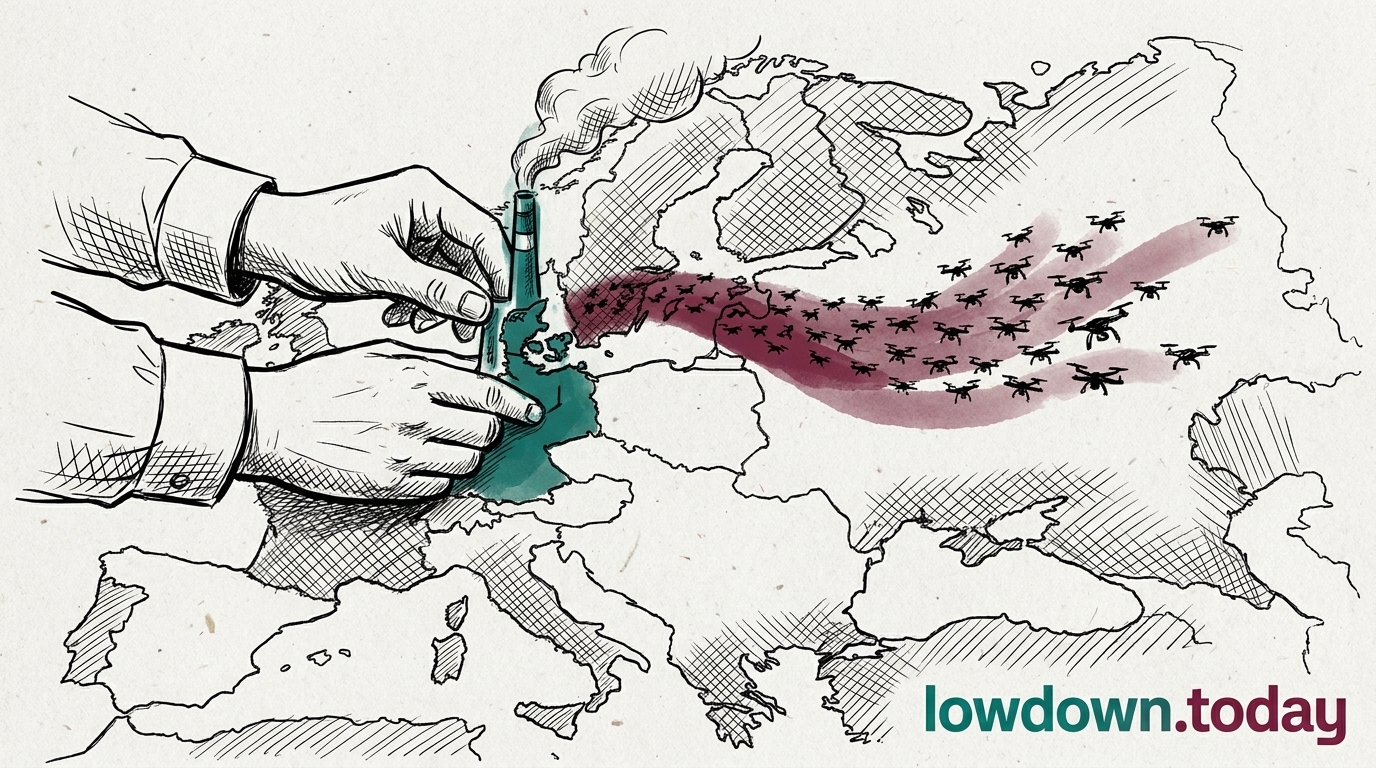
Denmark accepted Fire Point's Skrydstrup plant after committing to bilateral defence co-production at the B9 Nordic summit in May; the facility sits beside a Danish F-35 base, sharing security perimeters. NATO has published no legal guidance on whether hosting Ukrainian weapons production converts Denmark into a co-belligerent, leaving the host-state obligation unresolved.
Russian Ministry of Defence
Russia's 117% YoY drone-output rise in April, accelerating from a 68% full-year 2025 baseline, validates the FPV mass-production doctrine and hands Moscow a cleaner targeting argument for the Skrydstrup plant than any hidden production line offered; a Ukrainian weapons facility on NATO sovereign territory is a legitimate military target under the laws of armed conflict.
Baltic NATO states (Latvia, Estonia, Lithuania)
Latvia deployed mobile drone-intercept teams on 29 May using domestic Origin Robotics and Eraser interceptors, the first kinetic Baltic border response to Russia's 117% output surge. The Baltic states are the primary target market for Ukraine's ten EU export offices, giving them direct commercial access to combat-tested interceptors their own manufacturers have not yet matched.
Pentagon / Joint Interagency Task Force 401
Two Ukrainian entrants in Drone Dominance Phase 2 and Red Cat's SEC-filed STE partnership bring combat-iterated Ukrainian designs into US procurement without triggering Foreign Military Sale approvals; the programme's performance-scoring methodology does not require US-origin hardware. Northrop holding the Common UAS Payload standard means a heritage prime captures interface revenue regardless of which startup airframe wins.
Ukrainian defence industry (Fire Point / Spetstechnoexport)
Fire Point's Skrydstrup construction start and Spetstechnoexport's Red Cat partnership execute Zelensky's 13 May Bucharest proposal: converting wartime production surplus into a state export apparatus, independent of US approval chains. For Ukraine, embedded manufacturing on NATO soil protects propellant supply from Russian strikes while generating hard currency the war effort needs.
Chinese drone manufacturers (DJI, Autel)
Autel's Ralls Corp Fifth Amendment filing and DJI's Ninth Circuit quantification of USD 1.56 billion in 2026 losses are parallel constitutional attacks on a classified-evidence exclusion mechanism; neither company can contest the intelligence allegations directly, so both are betting on due-process doctrine to reopen the FCC authorisation route.
