Skip to content
You can now search across every topic, entity and event.What's new
Autonomous Systems: Land & Sea
12AUG

Eleven nations seek Ukraine's drone tech

4 min read
14:17UTC

Ukraine's wartime export ban blocks sales of the world's cheapest battle-tested interceptor drones to eleven allied nations — pushing demand toward US-manufactured alternatives at five to seven times the price.

TechnologyDeveloping
Key takeaway

Ukraine's export ban routes battlefield IP value to American manufacturers, inadvertently subsidising US industrial competitiveness.

Eleven nations have requested access to Ukrainian interceptor drones, and none can buy them. Ukraine's wartime export ban — enacted after Russia's 2022 invasion to prevent technology leakage to adversaries — blocks all sales of the country's most combat-proven systems.

The hardware in demand includes Wild Hornets' Sting, a 3D-printed interceptor capable of 213 mph with a 400g explosive charge, priced at $2,100–$2,500 per unit 1. SkyFall's interceptor — the same platform referenced in — is also subject to the ban. Wild Hornets spokesman Alex Roslin confirmed the company is "ready to export if called on to do so" but cannot under current law 2. The requesting nations have not been publicly identified, though Gulf states facing active Iranian drone threats are the most probable buyers given both the threat environment and Ukraine's deployment of 201 drone warfare specialists to the region.

The ban produces a specific market distortion. Demand that would flow to Ukrainian manufacturers at $2,100–$2,500 per interceptor instead reaches buyers through American intermediaries at multiples of the price. The Merops interceptor — developed by Project Eagle, the defence venture backed by former Google CEO Eric Schmidt — drew directly on Ukrainian combat data and costs $14,000–$15,000 per unit at current production volumes 3. That is a five-to-seven-fold markup over the Ukrainian-built alternative performing the same mission. At the Pentagon's projected scale pricing of $3,000–$5,000, the gap narrows but does not close against a Ukrainian system already in volume production.

Whether Kyiv lifts the ban depends on a calculus between wartime operational security — the original rationale, rooted in preventing Russian acquisition of Ukrainian drone designs through third-country re-export — and the economic and diplomatic leverage that direct arms exports to eleven allied nations would provide 4. The longer the ban holds, the more deeply entrenched the US intermediary model becomes. Ukrainian firms retain their combat data advantage but cede manufacturing margin to American producers who package that knowledge into exportable hardware.

Deep Analysis

In plain English

Eleven countries want to buy combat-tested Ukrainian interceptor drones — developed and refined through years of real fighting. Ukraine's law, passed when Russia invaded in 2022, bans selling military drones abroad. So those countries cannot buy from Ukraine directly. Instead, they end up buying similar drones made in America — like the Merops interceptor — which were designed using battlefield lessons learned in Ukraine. Ukraine provides the knowledge but receives no payment for it. America provides the factory and collects the revenue. The arrangement benefits US defence manufacturers but leaves Ukraine without the export earnings its companies could otherwise generate from some of the world's most battle-proven technology.

Deep Analysis
Synthesis

The technology transfer paradox reveals a structural economic imbalance in Ukraine's alliance relationships. Ukrainian engineers and soldiers bear the innovation cost — through casualties, field testing, and iterative development under live fire. American manufacturers and investors capture the commercial value through products like Merops.

As Ukraine's post-war reconstruction financing requirements become clearer, the absence of export revenue from its most commercially valuable asset will become a domestic political issue, not merely an external strategic one. The twelve-nation demand signal — eleven requesting access plus the US already manufacturing derivatives — effectively establishes a latent export market for Ukrainian drone IP. Whether Ukraine can convert this into formal licensing revenue rather than continued informal IP transfer will shape its post-war industrial strategy.

Root Causes

The 2022 export ban was a wartime emergency measure designed for a specific threat: preventing Russian acquisition of Ukrainian drone technology. It was not designed for the scenario in which Ukraine becomes a net technology exporter to allied states. The policy has no sunset clause or partner-state exemption mechanism, making it structurally rigid at the precise moment maximum flexibility is required.

Escalation

Demand pressure from eleven named nations, combined with the Iran conflict's validation of interceptor drone effectiveness, will intensify lobbying within Ukraine to modify the ban. The most likely path is selective export authorisation for trusted partners structured as bilateral agreements — similar to Israel's model for UAV technology transfer. Full ban removal is unlikely while active operations against Russia continue, as hardware exports create exploitation risk if intercepted or reverse-engineered.

What could happen next?
  • Consequence

    Eleven nations unable to buy Ukrainian drones directly will accelerate procurement of Merops-style US alternatives, deepening American commercial dominance in low-cost interceptor markets.

    Short term · Assessed
  • Risk

    Ukraine foregoes both export revenue and geopolitical leverage by maintaining the ban as global demand for its combat-tested systems intensifies.

    Medium term · Assessed
  • Opportunity

    If Ukraine introduces partner-state export exemptions, Ukrainian firms like Wild Hornets and SkyFall could recapture significant market share from US intermediaries at substantially lower price points.

    Medium term · Suggested
  • Precedent

    The Merops model establishes a replicable template for channelling allied combat IP into US manufacturing without formal licensing or revenue-sharing requirements.

    Long term · Suggested
First Reported In

Update #2 · UK startup tops Pentagon's drone gauntlet

Washington Times· 19 Mar 2026
Read original
Causes and effects
This Event
Eleven nations seek Ukraine's drone tech
The export ban creates a structural market distortion in which Ukrainian combat IP flows through American intermediaries at substantial markups, shaping the global counter-drone supply chain around US manufacturing rather than the lowest-cost, most operationally proven producers.
Different Perspectives
Conservative opposition
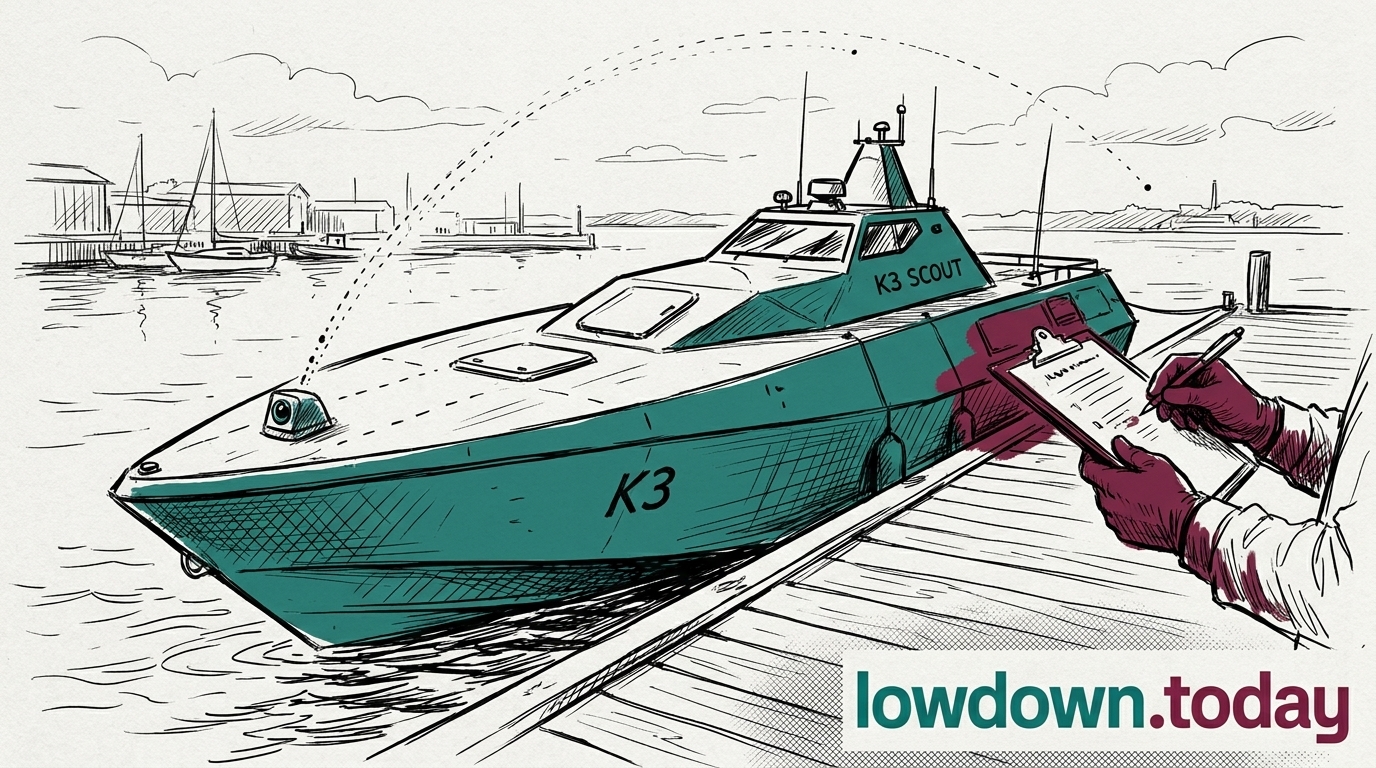
The Conservative opposition called on the Government on 9 August to 'urgently audit' equipment for hidden Chinese components, after the Telegraph's K3 SCOUT report. No named MP has been quoted on the record; the call came at party level, alongside the Ministry of Defence's own 10 August statement that no data had been compromised.
Netherlands Ministry of Defence
The Netherlands Ministry of Defence authorised Dutch Naval Design on 4 August to design 12-metre anti-submarine warfare uncrewed vessels for the Dutch-Belgian frigate programme, and to buy an adapted Compact FLASH dipping sonar from Thales Underwater Systems France. The order commits money and a named supplier while Britain's own certification body remains at the market-engagement stage.
Kraken Technology Group
Kraken Technology Group is a UK maritime-defence company based in Portsmouth that builds the K3 SCOUT, and crossed a $1bn valuation in July on a single-sourced $175m raise. The camera components reached the fleet under a third party's written security assurance, which the Platform Authority, which does not yet exist, was never positioned to check.
Navy Commercial
Navy Commercial
Navy Commercial at Whale Island published two notices on 5 August: 074032-2026, asking industry how to build a Platform Authority to certify uncrewed vessels, and 074351-2026, a GBP10m multi-role USV testbed for the Defence Chief Technology Officer. Responses on the Platform Authority close 19 August, ten days after the cameras were found transmitting to China.
Ministry of Defence
Ministry of Defence
The Ministry of Defence said on 10 August that a routine cyber vulnerability assessment found the camera fault, and a thorough investigation found no evidence that MoD data or systems had been accessed, compromised or transmitted externally. It stripped the cameras of internet connectivity but did not say whether it acted against the supplier.
Thales
Thales
Thales converted its 6 July engaging accord with Exail into a definitive combination agreement on 30-31 July, but the tender offer for Exail's remaining shares now closes by early 2028, later than July's timetable implied. Thales integrates its new undersea prime while still bidding against Kongsberg and DRASS's 2027 target for the AUKUS Pillar II contest.
