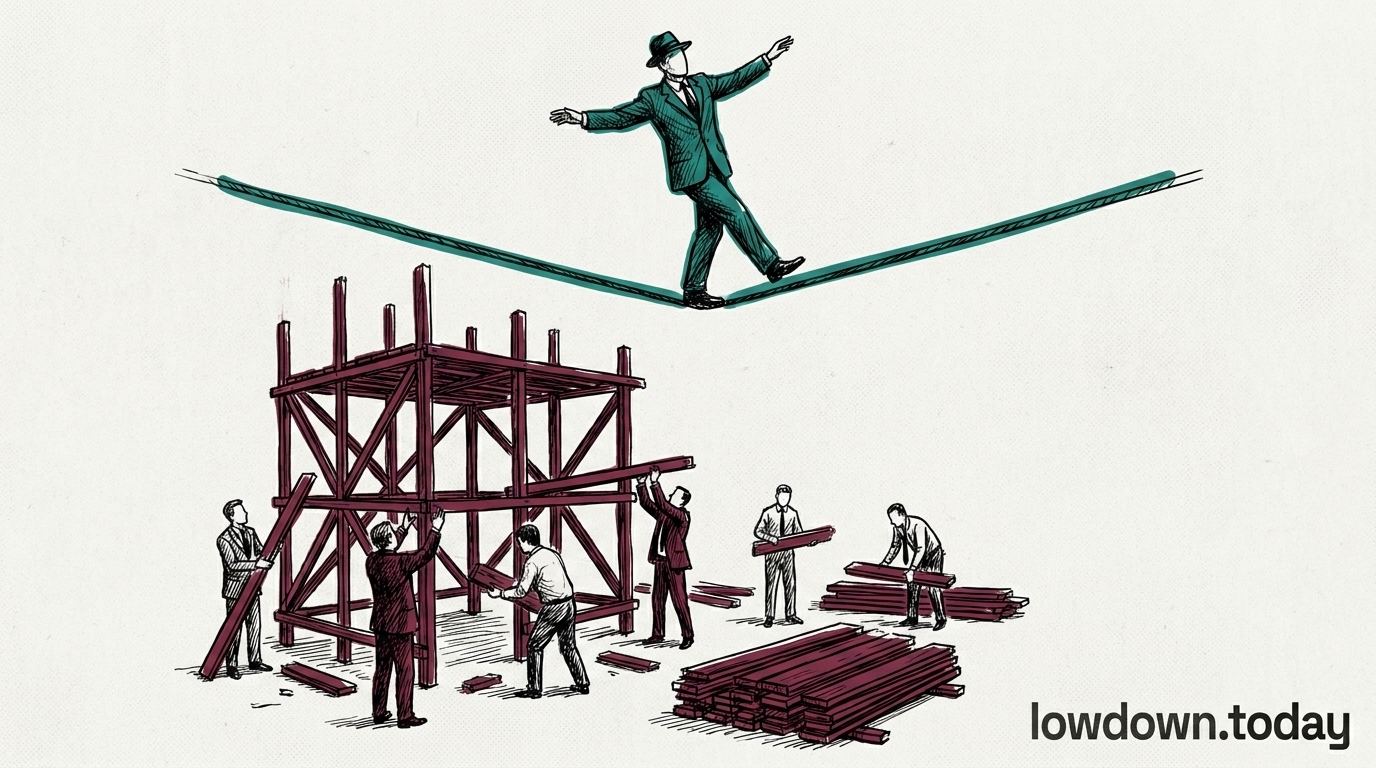
The Stanford Digital Economy Lab published "We Must Act Now" on Monday 13 July, signed by more than 200 economists and AI researchers including 16 Nobel laureates.1 Erik Brynjolfsson, who directs the lab, organised it with Ajay Agrawal, Anton Korinek and Tom Cunningham. The argument: AI capability is advancing "far faster than our understanding of the economic implications", and where earlier technologies granted decades of adjustment, this one "may give us only a few years".
Treat it as what it is. Nobody peer-reviewed this, there is no method to inspect and no result anyone could fail to replicate. A reader who wants a finding should look elsewhere; a signed statement is a piece of professional testimony, and it stands or falls on the signatures.
Daron Acemoglu signed. His 2024 working paper for the National Bureau of Economic Research, "The Simple Macroeconomics of AI", puts AI's contribution to total factor productivity, the extra output an economy squeezes from the same labour and capital, at no more than 0.66% cumulatively across ten years, and under 0.53% on his more conservative assumptions.2 That is close to a rounding error in a national accounts table, and it sits at the sceptical floor of a literature whose ceiling, set by Goldman Sachs Research, runs orders of magnitude above it. Michael Spence signed too.
So the statement gathers economists who do not agree about the size of the effect, and gets them to agree about the clock instead. Acemoglu can hold that AI will barely register in the productivity statistics and still hold that the labour transition arrives faster than any government is built to handle, because those are separate claims, and the aggregate is what only the first one measures. The lab has been building the measurement side for months: it launched its AI Economic Indicators dashboard six weeks ago, assembling the private data that public statistics do not collect. Having looked at what they could see, they went and found 200 signatures instead.





