Skip to content
You can now search across every topic, entity and event.What's new
AI: Jobs, Power & Money
13JUN

Big Five to spend $650bn on AI in 2026

3 min read
11:22UTC

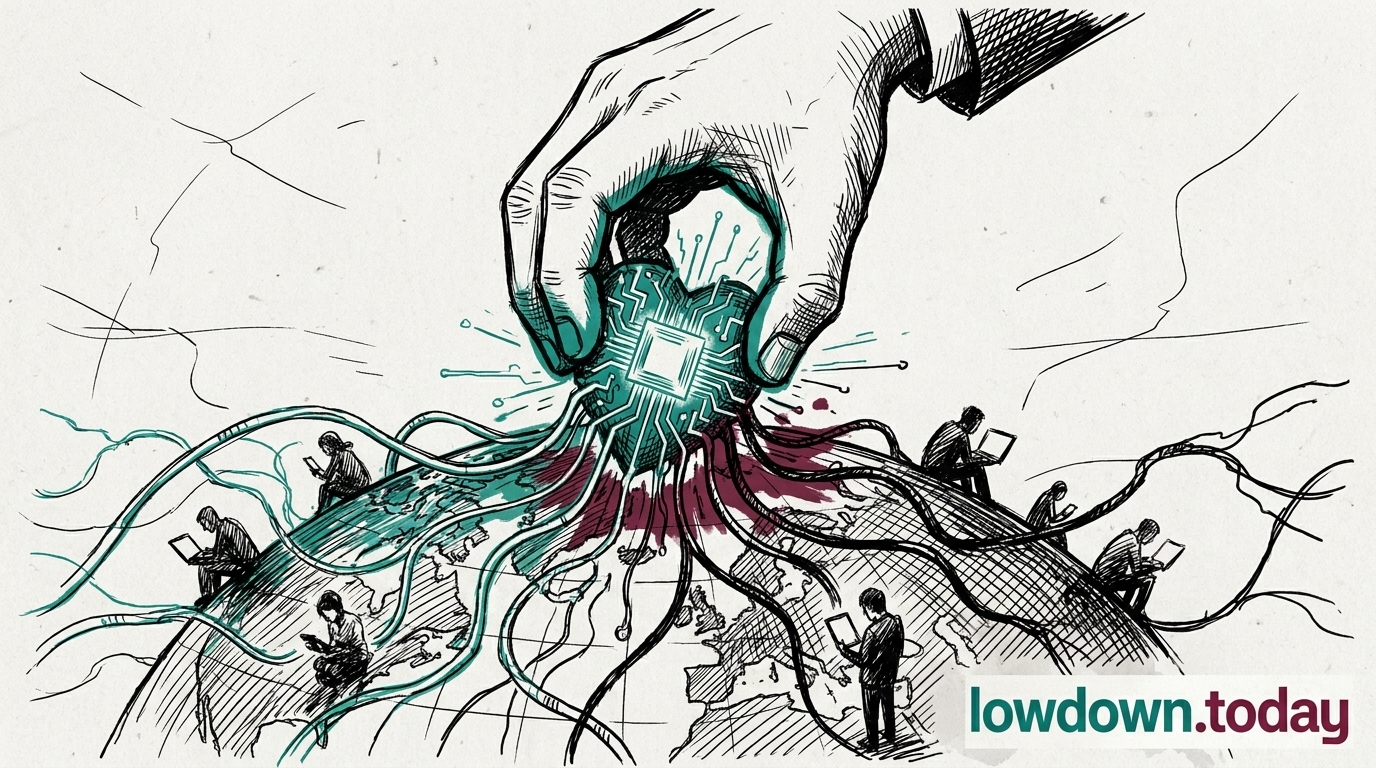
The five largest US technology companies plan to nearly double AI infrastructure spending in 2026, converting payroll budgets into data-centre capacity at a pace that locks in years of automation pressure.

EconomicAssessed
Key takeaway

Private AI capex now rivals the entire US interstate highway system's historical cost — in a single year.

The five largest US technology companies plan to spend $650–690 billion on AI infrastructure in 2026, nearly doubling their combined outlay from the previous year, according to a Bridgewater Associates estimate 1.

The capital flows into data centres, GPU procurement, and power infrastructure. Meta's capex guidance and Oracle's planned workforce-to-infrastructure conversion are two expressions of a sector-wide pattern: labour budgets becoming infrastructure budgets at accelerating rates 2.

The scale creates its own momentum. Data centres take two to four years to plan, permit, and build. They consume electricity at densities far exceeding traditional computing, adding grid constraints to the capital lock-in. Once tens of billions are sunk into physical infrastructure, the economic incentive to automate enough work to justify the investment intensifies. The capital demands utilisation, which means finding more tasks to transfer from workers to machines. The current wave of layoffs is the front end of a capital cycle that will generate sustained pressure on labour costs through the rest of the decade.


Deep Analysis

In plain English

Five companies are collectively planning to spend more on computer infrastructure in 2026 than the entire US government spends on defence procurement. This money flows primarily to specialised chips (GPUs), the vast warehouses housing them (data centres), and the electricity to run them. It does not flow to hiring more workers — these same companies are simultaneously cutting headcount. The bet is that AI will make each remaining worker so much more productive that the economics work out. Whether that bet is correct determines whether this is the largest productive investment in private-sector history or the largest capacity overbuild.

Deep Analysis
Synthesis

This $650–690B figure represents a privately funded reorientation of the US capital stock at a speed with no peacetime precedent. Gains accrue to a narrow set of capital owners — GPU manufacturers (primarily Nvidia at 75%+ gross margins), construction firms, and energy utilities — while the labour market contracts. This is capital deepening at wartime mobilisation speed, but without the corresponding employment surge that wartime investment historically produced.

Root Causes

The body frames this as AI-driven, but a structural factor it omits is that hyperscaler cloud revenue is itself growing rapidly, creating internal compute demand that is partly independent of AI product revenue. AWS, Azure, and Google Cloud are building infrastructure for paying cloud customers; AI is an accelerant layered onto an existing secular trend rather than the sole cause.

Escalation

The spending commitment is largely locked in for 2026 through multi-year data-centre construction contracts and GPU supply agreements. Even if AI revenue disappoints, the capex will be spent — creating a sunk-cost dynamic that may extend the investment cycle beyond rational return thresholds.

What could happen next?
1 risk2 consequence1 precedent1 meaning
  • Risk

    If AI revenue fails to materialise at projected scale, sunk construction and GPU contracts create a capacity overbuild with no viable exit mechanism.

    Medium term · Suggested
  • Consequence

    Nvidia captures the dominant share of capex at 75%+ margins, concentrating wealth gains more narrowly than any comparable historical infrastructure boom.

    Short term · Assessed
  • Precedent

    Hyperscaler monopoly over AI infrastructure may invite utility-style regulation analogous to interventions that followed railway and telecom concentration.

    Long term · Suggested
  • Consequence

    Residential electricity bills in data-centre-heavy regions face upward pressure as utility load growth is passed through to consumers.

    Short term · Suggested
  • Meaning

    Capital deepening at this pace without employment growth inverts the historical relationship between investment booms and job creation.

    Medium term · Assessed
First Reported In

Update #1 · Meta cuts 20% while Big Tech spends $650bn

Bloomberg· 17 Mar 2026
Read original
Different Perspectives
India IT services and global capability centre workforce
India's in-house GCCs added roughly 200,000 net staff in fiscal 2026, nearly double the 110,000 added by the IT services firms feeding the same companies. The shift moves work toward captive centres while squeezing entry-level hiring at the outsourcing firms, reshaping where Indian tech careers begin as US clients cut staff at home.
EU workers and European labour institutions
The 93-4 committee vote locked the diluted Omnibus literacy clause before plenary: EU workers in AI-augmented but non-high-risk workplaces have no statutory right to demand an explanation until December 2027. The European Trade Union Confederation called the shift from 'ensure' to 'support' a legal threshold collapse, not a drafting compromise.
UK workforce and labour market
UK 16-to-24 unemployment reached 16.2% in the latest ONS reading, above the 15.2% pandemic peak and the highest since 2015. Britain is among the most AI-exposed labour markets this desk tracks, yet the Office for National Statistics still publishes no AI-attribution layer, so young workers face the displacement without official data naming its cause.
Anthropic and frontier AI labs subject to US jurisdiction
Anthropic complied with the directive but publicly disputed its application, citing that OpenAI's GPT-5.5 carried the identical jailbreak vulnerability and remained on sale. For any US-domiciled frontier lab, the action demonstrates that regulatory compliance and political alignment are now distinct variables: Anthropic backed the pro-regulation PAC and was the first lab Washington reached.
US national-security and export-control apparatus
The Lutnick directive treats runtime inference access by a foreign national as legally equivalent to exporting Claude Fable 5 and Mythos 5 to that person's home country. It established that a deployed consumer AI product can be withdrawn globally by regulatory letter, with no appeal period and no customer notice.
European workers and regulators
NBER working paper w34995 found European workers use generative AI at 32% versus 43% of US workers, a gap driven by management practice rather than regulation. The EU AI Act's high-risk employment deadline stays at December 2027, leaving European workers facing the same displacement curve two to four years behind the US.



