Skip to content
Welcome, thoughtbot's Giant Robots listeners!Start here
AI: Jobs, Power & Money
1JUN

We left the UK row of the table empty

3 min read
09:18UTC

The IMF's tables, statistical appendix and DataMapper interface returned access errors across five URLs on two attempts, so this briefing publishes a G7 debt comparison with no British figure in it.

EconomicDeveloping
Key takeaway

A blank cell with a stated reason beats a plausible figure measuring the wrong thing.

The International Monetary Fund April 2026 World Economic Outlook puts general government gross debt at 204.4% of GDP in Japan, 138.4% in Italy, 125.8% in the United States, 118.4% in France, 110.7% in Canada and 64.6% in Germany⁠1. Germany is the only G7 member below 100%. Those six figures reach us through a secondary compilation of the IMF database rather than the IMF's own tables, which is a weaker provenance than every other cell in this briefing.

We left the British row blank on purpose. The IMF's tables, statistical appendix and DataMapper interface returned access errors across five separate URLs on two independent attempts this run, so we do not hold a UK figure on that standardised basis. The temptation is to reach for the 94.9% net debt figure the Office for National Statistics publishes and drop it in. That would be wrong twice over: public sector net debt is a different measure on a different definition, and general government gross debt already puts the UK above 100% on the IMF's convention. Two numbers in the same column measuring different things is the exact error this register was built to avoid, and a blank cell with a stated reason is more useful to a reader than a plausible wrong one.

Two British positions do stand out against that peer group, pointing in opposite directions. The average maturity of the gilt stock was 13.9 years at the end of December 2025, longer than the G7 average⁠2. Long maturities mean only a fraction of the debt has to be refinanced in any one year, so a buyers' strike would hurt Britain slowly rather than overnight, which is a genuine and underrated buffer. Against that, the UK carries the highest share of index-linked debt in the G7, the feature that blocks the inflation route out.

This briefing attempts no per-ledger international comparison, and later runs will not either. Section 114 notices, Office for Students returns and Regulator of Social Housing gradings have no foreign equivalents to compare against. The next run will try the IMF statistical appendix again; until then the cell stays empty.


Deep Analysis

In plain English

When comparing how much different countries owe, economists use a standardised measure called general government gross debt, tracked by the International Monetary Fund (IMF) so that every country is measured the same way. This is different from the UK's own headline figure, public sector net debt, which uses a different definition and cannot simply be swapped in. This week, the IMF's own website blocked every attempt to retrieve the UK's specific figure on that standardised basis, so this briefing reports Japan, Italy, the United States, France, Canada and Germany's figures but leaves the UK's blank rather than guess or substitute a different measure that would compare apples to oranges.

Deep Analysis
Root Causes

The IMF's World Economic Outlook database is the standardised source most cross-country debt comparisons rely on precisely because it applies one consistent methodology (general government gross debt) across member states, unlike each country's own domestic debt measure.

When that single source becomes technically unreachable, there is no equally authoritative substitute; a domestic figure like the UK's own PSND measure cannot simply be substituted, because it is not calculated on the same basis.

The access failure itself traces to standard web infrastructure (Akamai/edgesuite bot protection) applied to the IMF's domain, the kind of protection large institutional websites commonly deploy against automated scraping, which becomes a research obstacle specifically for anyone trying to fetch data programmatically rather than reading it manually in a browser.

What could happen next?
  • Risk

    Readers or other outlets substituting the ONS's 94.9% net-debt figure into an international gross-debt comparison table would be making a genuine category error, understating where the UK actually sits against G7 peers on the IMF's own convention.

First Reported In

Update #1 · The distress moved from banks to councils

Mappr· 27 Jul 2026
Read original →
Causes and effects
This Event
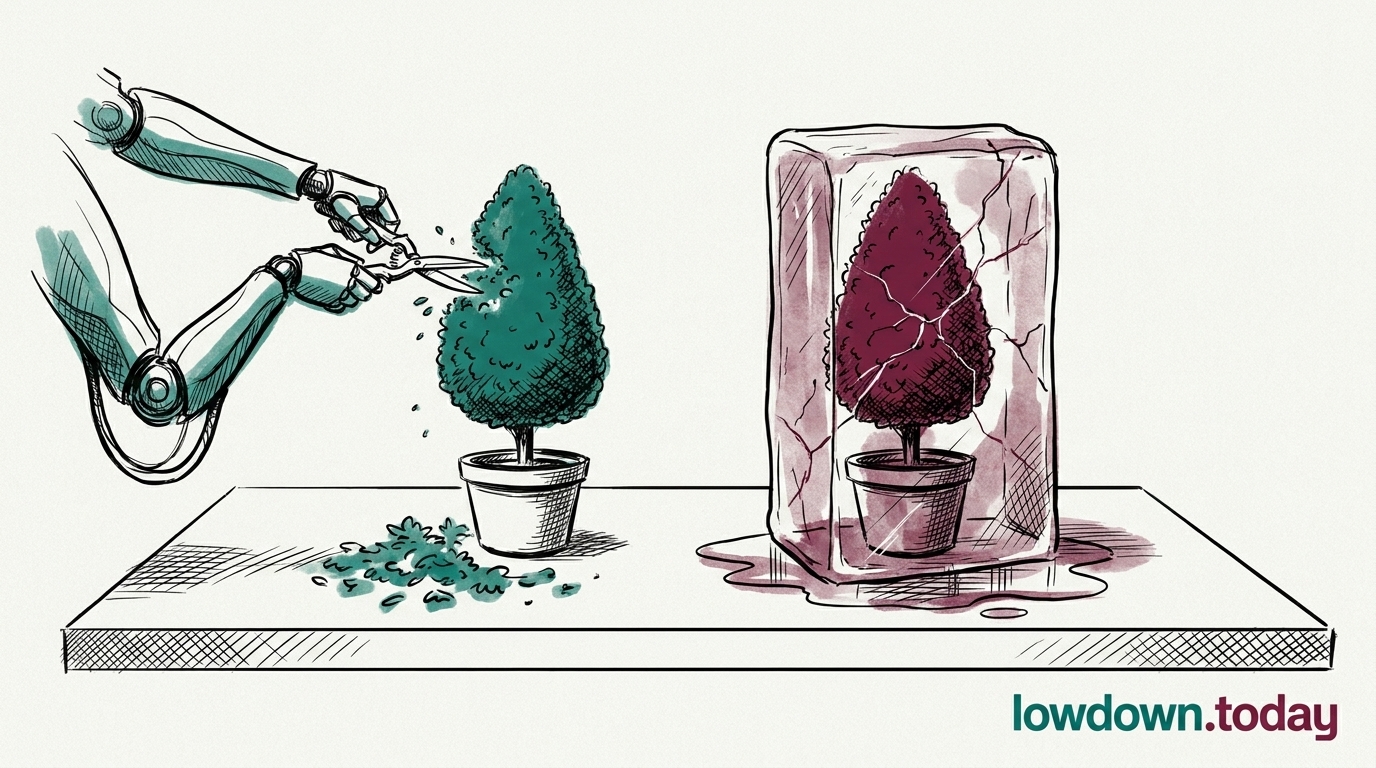
We left the UK row of the table empty
The obvious fix would be to drop Britain's 94.9% into the gap, and it would be a category error dressed up as completeness.
Different Perspectives
Competition and Consumer Commission of Singapore
The regulator found on 27 November that businesses can still choose and switch between cloud providers and AI models. It named dominant firms blocking rival AI agents as a risk, but answered with eight voluntary principles rather than rules.
La Poste
La Poste
France's state-owned postal group signed its first AI accord with four union confederations on 19 November, setting up a joint committee to oversee AI use. The announcement gives the unions a say, but no job security and no training hours for its 227,000 staff.
Nascent Information Technology Employees Senate (NITES)
The IT workers' union asked India's central government on 26 November for a mandatory national policy on AI layoffs, with every automated job cut logged in public. It expects to meet Labour Ministry officials; no government response has been reported.
China State Council
China State Council
Beijing's cabinet told local governments to pace AI in labour-intensive industries and to screen large AI projects for job losses. It keeps backing AI but wants the replacement of workers slowed, and it set no numeric targets.
SAP
SAP
SAP answered Bloomberg's report of at least 10,000 planned job cuts by telling CNBC that nothing is settled. In Germany a cut on that scale goes through works councils, and its 2024 round of about 10,000 ended mostly in voluntary departures.
Nvidia's board of directors
The board reinstated Jensen Huang on 22 November after input from senior levels of the US government, while its committee of independent directors keeps investigating. Its confidence rests, by its own account, on Washington's input, and the company says it will keep cooperating with government inquiries.

Written with AI from Lowdown's published reporting. Not individually reviewed by an editor. Editorial standards.
