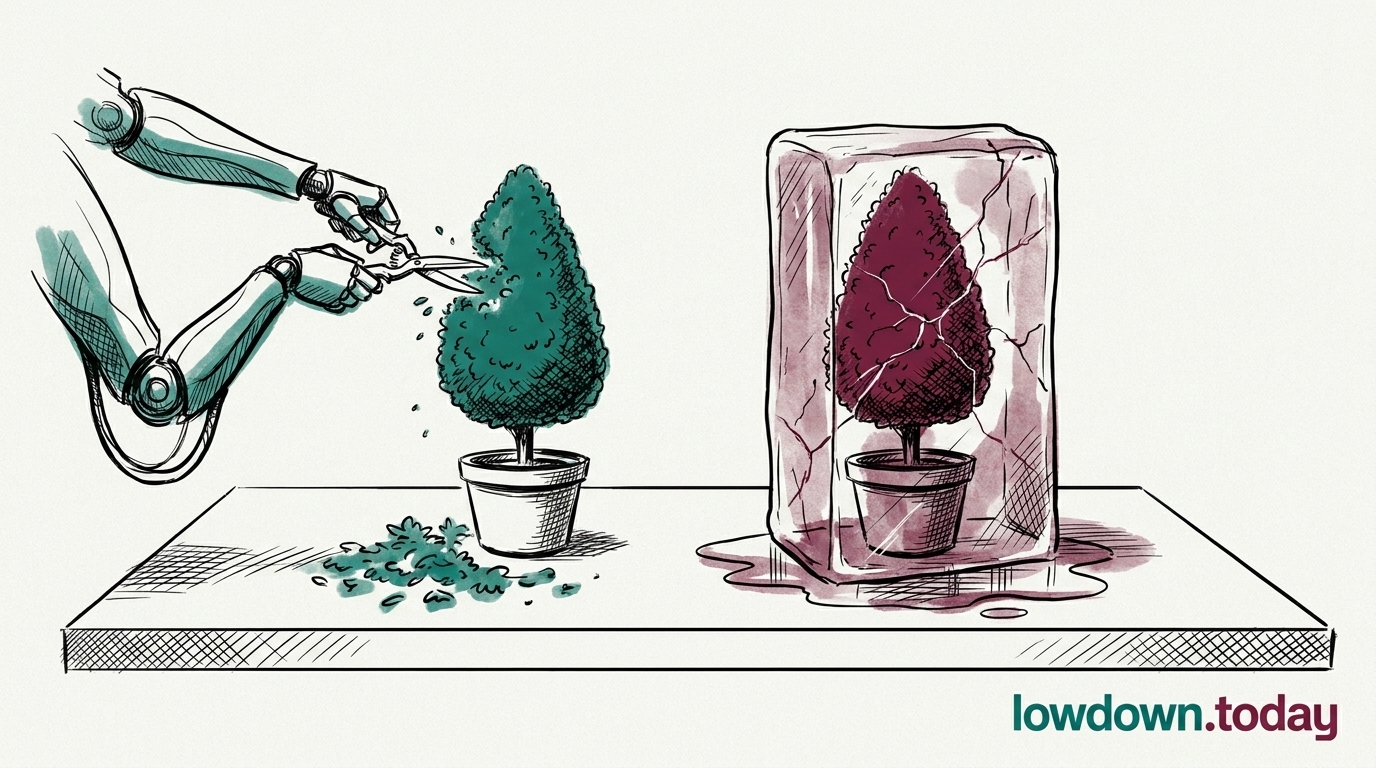
The Federal Reserve Bank of New York published an occupation-level study of job-posting data on 14 May 2026 reporting minimal evidence that artificial intelligence (AI) has directly cut labour demand since ChatGPT shipped in December 2022.1 The paper, by NY Fed economists on the bank's Liberty Street Economics blog, found the relative fall in postings for AI-exposed roles began before that launch, and that junior and senior roles declined at similar rates.2
That reading sits directly against the Stanford Digital Economy Lab, which 30 days earlier read the aggregate hiring rate and attributed roughly one million prevented US hires a year to AI, a figure 34 times the declared layoff count. Stanford concentrated the damage on the under-25s; the NY Fed found no such age cliff. A worker entering the market is now told by two credible institutions, a month apart, both that the entry-level cliff is real and that it does not exist.
Each team reached its answer by choosing a different dataset, not by disputing the underlying numbers. Stanford reads JOLTS (the Job Openings and Labor Turnover Survey, a monthly federal count of openings, hires and separations) and infers AI causation from a collapsing hiring rate. The NY Fed reads occupation-level postings and finds the decline predates the technology, which removes the timing evidence Stanford's causal story rests on. Less than 10% of workers sit in high-exposure occupations and 40% sit in jobs with no measured exposure at all, so most of the workforce is nowhere near the frontier the headlines describe.3
There is no official answer to arbitrate between them. The Bureau of Labor Statistics (BLS) has published nothing on the question, and the Federal Reserve Board has already shown three federal surveys putting AI adoption at 18%, 41% and 78% for the same period. A government that cannot agree how many firms use AI has now been handed two opposite readings of whether it is costing jobs. Every layoff below has to be weighed against that vacuum.





