Skip to content
Briefings are running a touch slower this week while we rebuild the foundations.See roadmap
2026 FIFA World Cup
29MAY

Serie A hands Malago a 20-point brief

3 min read
15:10UTC

On 20 April, Giovanni Malagò will be summoned to the Serie A Lega to receive a programme the league has drawn up itself.

SportDeveloping
Key takeaway

Serie A has swapped endorsing a candidate for writing a platform that any winner will inherit.

On 20 April, tomorrow, Giovanni Malagò will be summoned to the Serie A Lega to receive a 20-point programme the league has drawn up itself 1. Eighteen of 20 Serie A clubs back him; Lazio under Claudio Lotito and Hellas Verona are the only dissenters.

Malagò is the sitting president of CONI, the Italian National Olympic Committee, which gives him cross-bench access in Rome most federation administrators do not have. The 20-point document is the instrument Serie A has chosen to formalise what a Malagò presidency would legislate for. That sequence inverts the usual Italian federation politics. Clubs are normally institutional veto players; drafting their own programme signals they are treating the 22 June Federal Council vote as a legislative reform vehicle rather than a personnel contest.

The choice reads against the arithmetic. Serie A's own bloc is 18% of the FIGC electoral college , and former FIGC president Giancarlo Abete commands the amateur leagues' 34% from the Lega Nazionale Dilettanti. A document 34% cannot credibly oppose without explaining why is a better instrument than a candidate the 34% can outvote. That is what the Serie A board has put on the table; the signing ceremony on 20 April turns it from a draft into Malagò's public platform, whether or not Abete's bloc carries the vote in June.


Deep Analysis

In plain English

The FIGC is Italy's football governing body : equivalent to what the FA is in England. Its president position is elected by a council of clubs, leagues, players and coaches. The current president, Gabriele Gravina, is leaving after Italy were eliminated from the World Cup qualifying. Normally, a candidate campaigns on their own platform and tries to build support. What happened on 20 April is the reverse: the top 18 of 20 Serie A clubs wrote a 20-point reform programme themselves, then summoned their chosen candidate, Giovanni Malagò (who runs Italy's Olympic Committee), to receive it. He is being handed the platform rather than writing it : making the clubs, not the candidate, the political principals in this election.

Deep Analysis
Root Causes

Italian clubs' collective €5.5bn debt and €730m+ annual losses create the structural pressure that makes the 20-point programme politically viable. Serie A ranks 49th of 50 European leagues for under-21 playing time (1.9%), and 67.9% of playing minutes are held by foreign players. These figures, from Gravina's April parliamentary report, mean club owners face a structural competitiveness crisis that federation presidential platforms have historically ignored.

The decision to write the programme themselves, rather than endorse Malagò's proposals, reflects clubs' learned scepticism: the three legislative items (Growth Decree reinstatement, gambling advertising repeal, betting levy) have circulated in Italian football reform proposals since 2019 without parliamentary progress. Clubs are not backing a candidate's ideas; they are presenting a bill of demands and selecting the candidate they judge most capable of delivering it.

First Reported In

Update #8 · Three clocks running against kickoff

Sport Mediaset· 19 Apr 2026
Read original
Causes and effects
This Event
Serie A hands Malago a 20-point brief
Italian top-flight clubs have inverted the usual candidacy process: league writes the demands, the candidate is the vehicle, with only Lazio and Hellas Verona dissenting.
Different Perspectives
Argentina / Lionel Scaloni
Scaloni confirmed Messi for a record sixth World Cup on 28 May, choosing the 38-year-old captain's institutional authority over 18-year-old Franco Mastantuono's development potential. Commercial as well as sporting considerations weigh on any Messi decision, and Argentina's AFA was never likely to backstop an exclusion on pure sporting logic.
DFB / Rudi Völler
DFB / Rudi Völler
Völler issued informal guidance to Germany's squad on around 27 May to keep politics and sport separate, stopping short of the formal ban that produced Qatar 2022's OneLove armband collision. The approach gives the federation documented deniability while preserving each player's legal freedom to act independently.
England Football Association / Thomas Tuchel
Tuchel cut Alexander-Arnold, Foden and Palmer on system grounds, the clearest signal yet that the FA has genuinely ceded selection authority to the coaching staff. England travel without Palmer, one of the Premier League's sharpest creators, accepting a narrower build-up vocabulary against low-block opponents in exchange for off-ball discipline.
Football Supporters Europe / Euroconsumers
The fan coalition's Article 102 TFEU complaint, filed in March and unacknowledged past the April deadline, was confirmed for assessment by the European Commission on 28 May. Brussels logging the file gives the complainants a live regulatory record FIFA must preserve, building on the European Super League judgment that exposed FIFA and UEFA rules to EU competition scrutiny.
New York and New Jersey Attorneys General / UNITE HERE Local 11
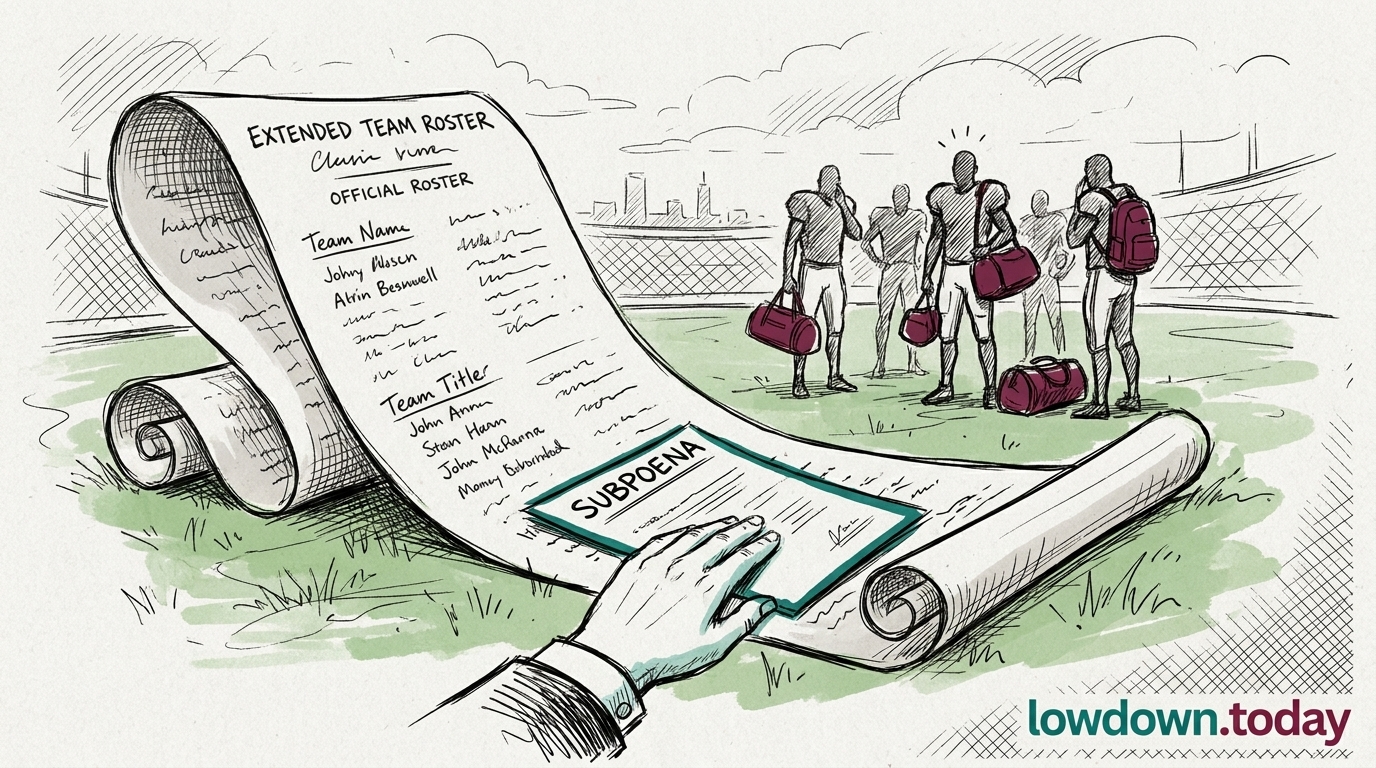
On 28 May, Letitia James and Jennifer Davenport subpoenaed FIFA under their broad state authority to pursue an entity trading in their states, regardless of FIFA's Swiss registration; that same week UNITE HERE Local 11 moved its campaign to California privacy law, filing with the CPPA over FIFA accreditation data shared with DHS and ICE without worker consent.
FFIRI / Mehdi Taj
FFIRI / Mehdi Taj
Taj framed Tijuana as resolving entry friction while simultaneously demanding multiple-entry US visas, because single-entry papers would strand the squad in Mexico after the first match-day crossing. Both are needed: the camp solves accommodation, the visa solves the border crossings Iran's three group matches require, the first before 15 June.


