Skip to content
Briefings are running a touch slower this week while we rebuild the foundations.See roadmap
2026 FIFA World Cup
29MAY

Host committees skip human rights plans

3 min read
15:10UTC

Three months before kickoff, most US host committees have not produced the human rights assessments FIFA's own framework demands — and FIFA itself has dropped anti-discrimination messaging.

SportAssessed
Key takeaway

FIFA created human rights rules under Qatar pressure, then stopped enforcing them for the United States.

Human Rights Watch published "Keep the World in the World Cup" on 12 March, reporting that most of the 16 US host committees have not released the Human Rights Action Plans required under FIFA's hosting framework 1. The report also documented FIFA's decision to cancel anti-discrimination messaging for the tournament — a programme that had been a visible fixture at previous World Cups.

FIFA adopted its human rights policy in 2017 after sustained pressure over labour deaths in Qatar's stadium construction programme and restrictions on civil liberties in Russia before the 2018 tournament. The policy drew on the UN Guiding Principles on Business and Human Rights, authored by Harvard professor John Ruggie, who advised FIFA on the framework before his death in 2021. Host cities are required to produce action plans identifying risks to workers, fans, journalists, and local populations, with mitigation measures and public accountability mechanisms.

With the tournament opening on 11 June, the compliance gap is measurable. Most host committees have produced no public documentation of the assessments they committed to. The cancellation of anti-discrimination messaging is a separate decision by FIFA itself — not the host committees — and removes visible institutional backing for the non-discrimination pledges central to the 2017 policy. Taken together, the two failures suggest the human rights framework functions as a reputational shield during the bidding phase and loses binding force once commercial operations begin.

The 2026 context makes the gap more consequential than in previous cycles. The primary host nation's government has enacted a travel ban barring fans from four qualified nations, expanded immigration enforcement operations, and presided over a rollback of LGBTQ+ protections at federal and state level — precisely the policy areas the action plans were designed to assess and mitigate. Human Rights Watch's report does not accuse FIFA of bad faith; it asks a narrower question: whether a framework the organisation built, promoted, and claimed as a reform legacy has any enforcement mechanism at all.


Deep Analysis

In plain English

When FIFA awarded the 2022 World Cup to Qatar, international criticism of Qatar's treatment of migrant workers forced FIFA to create formal human rights requirements. Host countries and their city committees must publish plans explaining how they will protect people's rights during the tournament. Human Rights Watch found that most US host committees have not published these plans — and separately, FIFA has cancelled the anti-discrimination messaging it normally runs at tournaments. In short, rules FIFA created under public pressure are now going unenforced for a politically connected host.

Deep Analysis
Synthesis

The combination of host committee non-compliance, FIFA's cancellation of anti-discrimination messaging, and the Infantino ethics complaint indicates that FIFA's human rights architecture is being systematically dismantled through inaction rather than formal repeal — a technique that avoids the reputational cost of visibly reversing policy while achieving the same effect.

Root Causes

FIFA's Human Rights Policy lacks an enforcement mechanism with real consequences — it relies on host committee self-reporting and voluntary compliance. The cancellation of anti-discrimination messaging suggests a deliberate policy decision at FIFA executive level, potentially linked to the US political environment or sponsor preferences. Without an independent monitoring body authorised to sanction host committees, the framework is structurally performative.

Escalation

The FairSquare ethics complaint against Infantino (event 23) and this HRW report together create a compound accountability pressure point. If the ethics complaint advances to a formal FIFA investigation before the Congress on 30 April, FIFA may simultaneously have to defend both Infantino's conduct and the host committees' non-compliance — a reputational double-exposure that its communications operation is not currently structured to manage.

What could happen next?
  • Risk

    FIFA sponsors subject to EU mandatory ESG reporting could face shareholder pressure to reconsider or condition their World Cup associations if non-compliance with human rights plans becomes publicly documented.

    Short term · Suggested
  • Consequence

    The absence of Human Rights Action Plans leaves FIFA legally exposed if a rights incident occurs at a US venue and affected parties demonstrate no protective framework existed.

    Immediate · Assessed
  • Precedent

    If FIFA's human rights requirements go unenforced for a G7 host, the policy's credibility as a genuine condition of future World Cup bids is permanently damaged.

    Long term · Assessed
  • Meaning

    FIFA's cancellation of anti-discrimination messaging, read alongside event 23, indicates the organisation is actively aligning its public communications with the political preferences of the current US administration.

    Immediate · Suggested
First Reported In

Update #1 · Iran splits on World Cup boycott

Human Rights Watch· 22 Mar 2026
Read original
Causes and effects
This Event
Host committees skip human rights plans
Concrete compliance failure in FIFA's post-Qatar human rights framework, with most US host committees producing none of the required action plans while FIFA simultaneously cancels anti-discrimination messaging.
Different Perspectives
Argentina / Lionel Scaloni
Scaloni confirmed Messi for a record sixth World Cup on 28 May, choosing the 38-year-old captain's institutional authority over 18-year-old Franco Mastantuono's development potential. Commercial as well as sporting considerations weigh on any Messi decision, and Argentina's AFA was never likely to backstop an exclusion on pure sporting logic.
DFB / Rudi Völler
DFB / Rudi Völler
Völler issued informal guidance to Germany's squad on around 27 May to keep politics and sport separate, stopping short of the formal ban that produced Qatar 2022's OneLove armband collision. The approach gives the federation documented deniability while preserving each player's legal freedom to act independently.
England Football Association / Thomas Tuchel
Tuchel cut Alexander-Arnold, Foden and Palmer on system grounds, the clearest signal yet that the FA has genuinely ceded selection authority to the coaching staff. England travel without Palmer, one of the Premier League's sharpest creators, accepting a narrower build-up vocabulary against low-block opponents in exchange for off-ball discipline.
Football Supporters Europe / Euroconsumers
The fan coalition's Article 102 TFEU complaint, filed in March and unacknowledged past the April deadline, was confirmed for assessment by the European Commission on 28 May. Brussels logging the file gives the complainants a live regulatory record FIFA must preserve, building on the European Super League judgment that exposed FIFA and UEFA rules to EU competition scrutiny.
New York and New Jersey Attorneys General / UNITE HERE Local 11
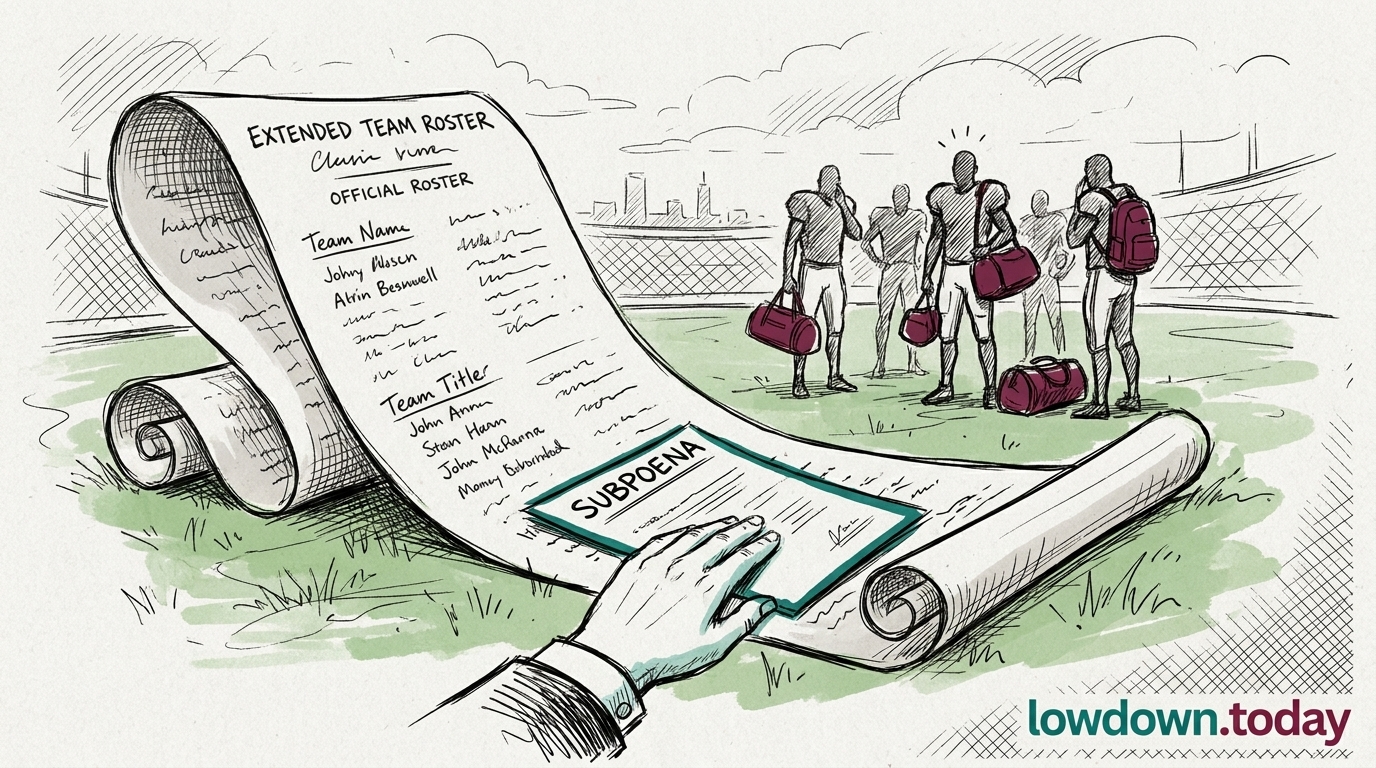
On 28 May, Letitia James and Jennifer Davenport subpoenaed FIFA under their broad state authority to pursue an entity trading in their states, regardless of FIFA's Swiss registration; that same week UNITE HERE Local 11 moved its campaign to California privacy law, filing with the CPPA over FIFA accreditation data shared with DHS and ICE without worker consent.
FFIRI / Mehdi Taj
FFIRI / Mehdi Taj
Taj framed Tijuana as resolving entry friction while simultaneously demanding multiple-entry US visas, because single-entry papers would strand the squad in Mexico after the first match-day crossing. Both are needed: the camp solves accommodation, the visa solves the border crossings Iran's three group matches require, the first before 15 June.


