Skip to content
Briefings are running a touch slower this week while we rebuild the foundations.See roadmap
2026 FIFA World Cup
29MAY

HRW logs 167,000 ICE arrests across US host cities

4 min read
15:10UTC

Lowdown Editorial Desk

SportDeveloping
Key takeaway

HRW gives the enforcement risk an arrest figure and a 11 May deadline for host-city plans.

Human Rights Watch published 'World Cup: 2 Months Out, FIFA and Host Cities Sideline Rights' on 10 April, the most detailed audit of the 11 US host cities to date 1. The headline finding is a count: at least 167,000 people arrested by Immigration and Customs Enforcement (ICE), the federal immigration enforcement agency, in and around the 11 US host cities between 20 January 2025 and 10 March 2026. Houston accounted for 26,483 arrests, Dallas 22,388, and the Atlanta area 13,985. FIFA has published no enforcement protocol covering any of those three cities.

The enforcement footprint is institutional, not ad hoc. Dallas and Houston have signed 287(g) agreements, the federal-local immigration enforcement partnership programme that deputises municipal police to act as ICE agents. Marietta Police Department, outside Atlanta, joined the scheme in March, extending the same authority into a third host metropolitan area. HRW counts 12 of 16 host cities with no published human rights plan; the four that exist (Atlanta, Dallas, Houston, Vancouver) contain no explicit LGBTQ+ protections in either Texan city.

This report sits on top of a documentary chain HRW had built over the previous month. Its March audit on missing host-city plans flagged the absence; Amnesty International's 31 March 'Humanity Must Win' report introduced a medium-to-high risk classification for fans from the four nations facing US travel bans; Vancouver's police chief had already drawn the operational line between Canadian and US enforcement postures . The April audit fills that documented chain with a number. Todd Lyons, acting director of ICE, told Congress in March that his agency would be a 'key part' of tournament security, which is the institutional position the 167,000 figure now contextualises.

HRW's specific demand is a deadline: all 16 host committees must publish action plans by 11 May, exactly one month before the opener at SoFi Stadium. The deadline is a forcing function. Either committees publish protocols that satisfy a human-rights organisation, or they do not, and that decision becomes part of the public record at the moment the international press corps arrives in the United States.


Deep Analysis

In plain English

Human Rights Watch, a global organisation that monitors governments' treatment of people, published a major report on the 11 US cities that will host World Cup matches. They found that immigration enforcement officers made at least 167,000 arrests in those city areas in the 14 months since January 2025. They also found that 12 of the 16 host venues have no written plan for how they will protect fans' human rights during the tournament. HRW is demanding all 16 publish a plan by 11 May. The worry is that foreign fans, particularly from countries whose citizens are already nervous about entering the US, might be put off attending. The World Cup is meant to welcome the world. An immigration enforcement climate that makes fans feel unsafe to travel is a problem both for the tournament's atmosphere and for the host cities' economies.

Deep Analysis
Root Causes

The core structural tension is that US host-city police departments have limited authority over federal immigration enforcement. Even cities with sanctuary policies, Dallas and Houston do not have them, cannot legally prevent ICE from operating in their jurisdictions. FIFA's Host City Agreements contain human rights language, but that language has never been tested against a domestic enforcement agency of a host government.

HRW's 12-of-16 finding on absent action plans reflects a design failure: FIFA assigned human rights obligations to host cities without specifying mandatory deliverables or enforcement consequences. The 11 May deadline HRW has set carries no FIFA sanction for non-compliance.

What could happen next?
  • Risk

    Without published human rights action plans before the tournament opens, individual ICE field-office decisions near venues will set de facto policy, with no accountability mechanism.

    Short term · 0.8
  • Consequence

    The 11 May HRW deadline, if missed by most host cities, will generate a second negative media cycle precisely when ticket-holding international fans are finalising travel plans.

    Short term · 0.75
  • Precedent

    FIFA's failure to enforce the human rights provisions in Host City Agreements will be cited in pre-bid assessments for 2030 and 2034, hardening the argument for binding enforcement clauses.

    Long term · 0.6
First Reported In

Update #7 · 57 Days to Go: Iran said yes in Antalya

Human Rights Watch· 15 Apr 2026
Read original
Different Perspectives
Argentina / Lionel Scaloni
Scaloni confirmed Messi for a record sixth World Cup on 28 May, choosing the 38-year-old captain's institutional authority over 18-year-old Franco Mastantuono's development potential. Commercial as well as sporting considerations weigh on any Messi decision, and Argentina's AFA was never likely to backstop an exclusion on pure sporting logic.
DFB / Rudi Völler
DFB / Rudi Völler
Völler issued informal guidance to Germany's squad on around 27 May to keep politics and sport separate, stopping short of the formal ban that produced Qatar 2022's OneLove armband collision. The approach gives the federation documented deniability while preserving each player's legal freedom to act independently.
England Football Association / Thomas Tuchel
Tuchel cut Alexander-Arnold, Foden and Palmer on system grounds, the clearest signal yet that the FA has genuinely ceded selection authority to the coaching staff. England travel without Palmer, one of the Premier League's sharpest creators, accepting a narrower build-up vocabulary against low-block opponents in exchange for off-ball discipline.
Football Supporters Europe / Euroconsumers
The fan coalition's Article 102 TFEU complaint, filed in March and unacknowledged past the April deadline, was confirmed for assessment by the European Commission on 28 May. Brussels logging the file gives the complainants a live regulatory record FIFA must preserve, building on the European Super League judgment that exposed FIFA and UEFA rules to EU competition scrutiny.
New York and New Jersey Attorneys General / UNITE HERE Local 11
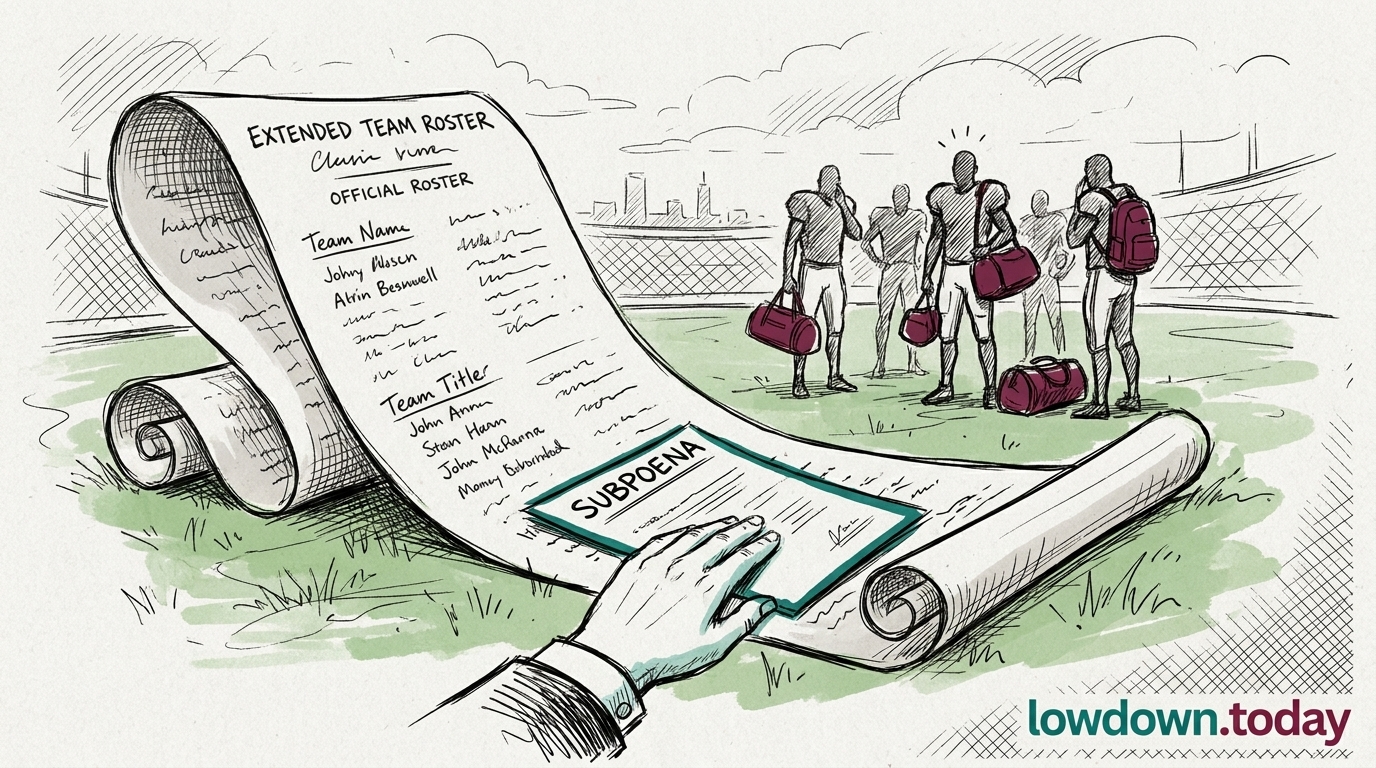
On 28 May, Letitia James and Jennifer Davenport subpoenaed FIFA under their broad state authority to pursue an entity trading in their states, regardless of FIFA's Swiss registration; that same week UNITE HERE Local 11 moved its campaign to California privacy law, filing with the CPPA over FIFA accreditation data shared with DHS and ICE without worker consent.
FFIRI / Mehdi Taj
FFIRI / Mehdi Taj
Taj framed Tijuana as resolving entry friction while simultaneously demanding multiple-entry US visas, because single-entry papers would strand the squad in Mexico after the first match-day crossing. Both are needed: the camp solves accommodation, the visa solves the border crossings Iran's three group matches require, the first before 15 June.


