Story Object Model
CRDT-shaped sync object carrying story context across broadcast newsroom tools and regions.
Last refreshed: 28 July 2026 · Appears in 1 active topic
Will the Story Object Model become broadcast journalism's universal context layer?
Timeline for Story Object Model
Revealed as a CRDT-based data structure synchronising news context across Local and Regional altitudes
Media's AI Pivot: SMART Stories shows its CRDT workingBackground
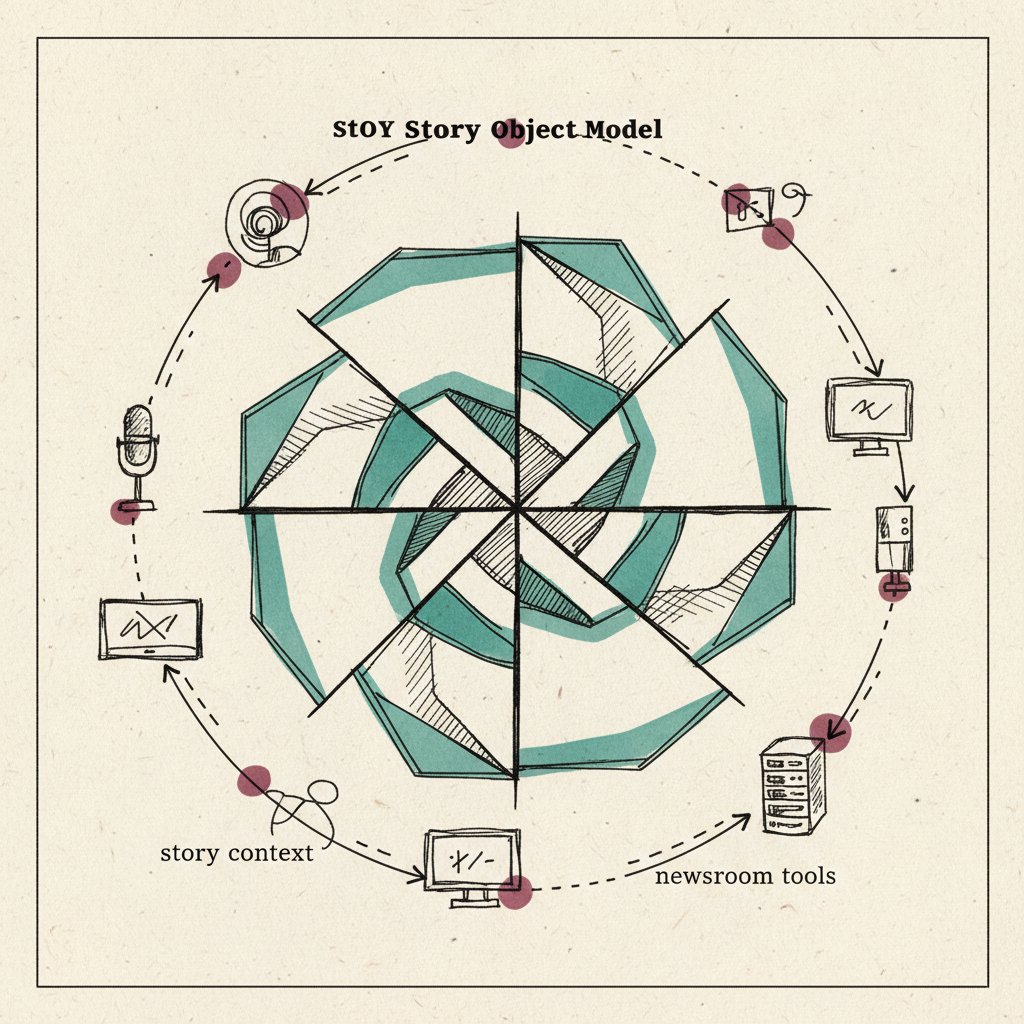
The Story Object Model (SOM) is the central technical deliverable of the SMART STORIES consortium, announced by AP, NBCUniversal, ITN, and the BBC on 30 April 2026 as an IBC2026 Accelerator project. The SOM is not a database or a file format but a sync object: a machine-readable package of story context that travels with a news story from gathering through to distribution, carrying enough semantic state that AI agents at every stage can reason about what they are handling without re-interrogating every upstream source. Its CRDT-shaped architecture means edits from multiple newsrooms converge without conflict.
The EVS whiteboard revealed at mpts.london on 14 May 2026 shows the SOM operating across three runtime regions: LIVE (inbound feeds, router, Cerebrum reasoning agent, ViaMap and Social IPs sub-skills), NEARLIVE (Moments Lab AI metadata records, Local SOM, Regional SOM with bidirectional sync), and DISTRO (Skills-driven output adapters for web, search, and trace channels). Each newsroom holds a Local SOM that syncs upward to a Regional SOM and laterally to peer locals. The pub/sub transport implied by Trint's live-context flagging suggests SOM carries a bus layer, not merely a passive document.
The SOM is positioned as the successor to MOS (Media Object Server) and JSON-over-APIs in the broadcast industry's three-era narrative: Hardware (RS-422, timecode) solved sync; Data (MOS, APIs) solved transport; SOM is meant to solve shared meaning. A live proof-of-concept is due at IBC2026 in Amsterdam, 11-14 September 2026. No public specification or GitHub repository exists as of May 2026.