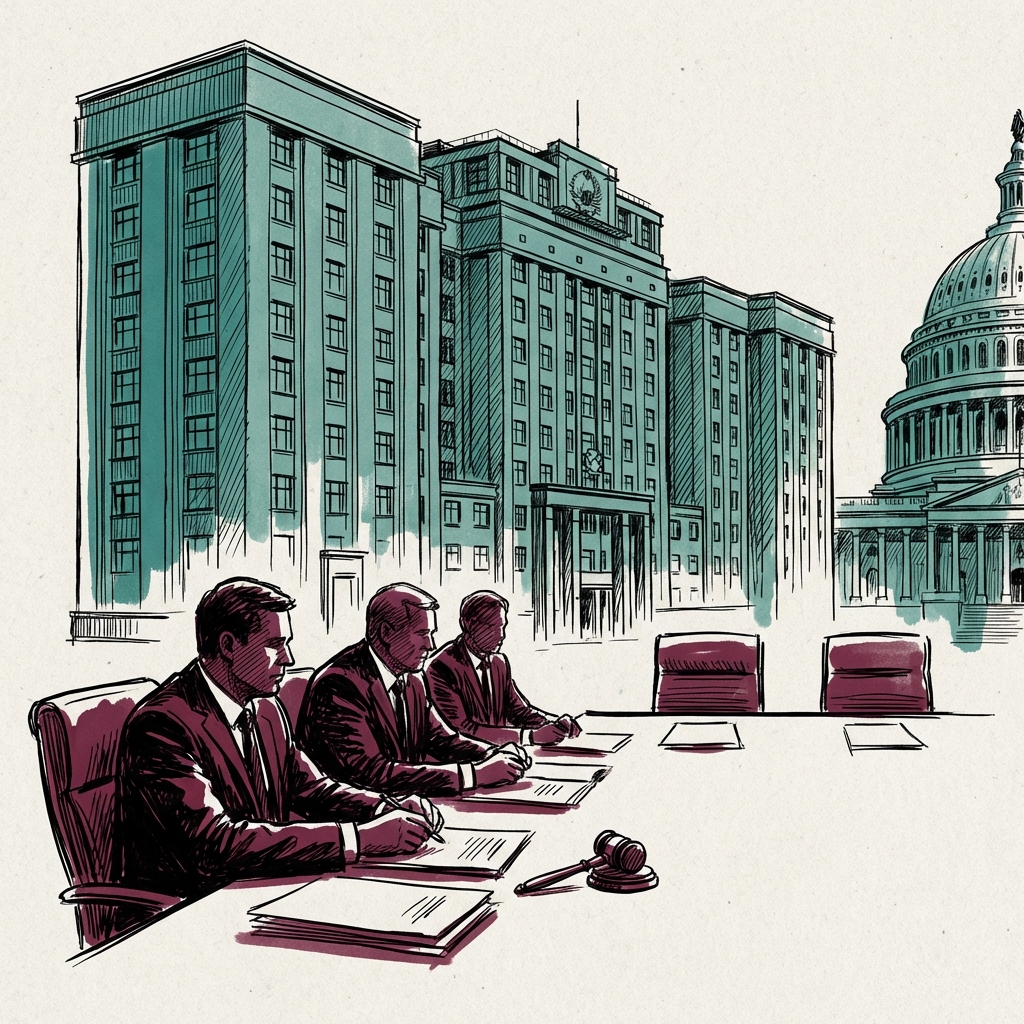
State Duma
Lower house of Russian parliament; delegation visited US Congress under sanctions.
Last refreshed: 2 July 2026 · Appears in 1 active topic
Why are Russian officials discussing a new mobilisation wave right after the September Duma vote?
Timeline for State Duma
Held elections the mobilisation wave has been timed around
Russia-Ukraine War 2026: Russia eyes a quiet October call-upNWF liquid share heads for $12.5bn
Russia-Ukraine War 2026Passed first reading 413-0-0 of extraterritorial military deployment bill
Russia-Ukraine War 2026: Duma passes extraterritorial deployment bill 413-0Mentioned in: Sanctioned Russian MPs visit Congress
Russia-Ukraine War 2026Background
The State Duma is the lower house of Russia's Federal Assembly, its 450 deputies elected on a mixed proportional and constituency basis. Since 2022 it has functioned as a rubber-stamp legislature, authorising wartime measures without meaningful debate or opposition. The chamber faces its own election on 18-20 September 2026; Duma chairman and United Russia leader Dmitry Medvedev named the party's top-five candidate list on 28 June, headed by Foreign Minister Sergei Lavrov.
Its Foreign Affairs Committee, chaired by Vyacheslav Nikonov, is the chamber's main channel for signalling Kremlin positions abroad. A Nikonov-led delegation visited the US Congress on 26 March 2026 at the invitation of Rep Anna Paulina Luna (R-FL) with State Department authorisation, the first such contact since the full-scale invasion; all delegates were under EU sanctions. On 14 April the Duma passed, 413-0-0, the first reading of a bill authorising Putin to deploy Russian forces abroad to protect citizens from foreign courts.
Domestically the Duma has enabled the war economy through mobilisation law, press censorship, and property confiscation from war critics. A Communist Party deputy invoked '1917' in early May after ministers projected the National Wealth Fund's liquid share falling to $12.5 billion by year-end, roughly a quarter of its February value. A Meduza investigation reported officials are discussing a fresh mobilisation wave for after the September election, with voluntary contract signings down roughly 50% year-on-year.