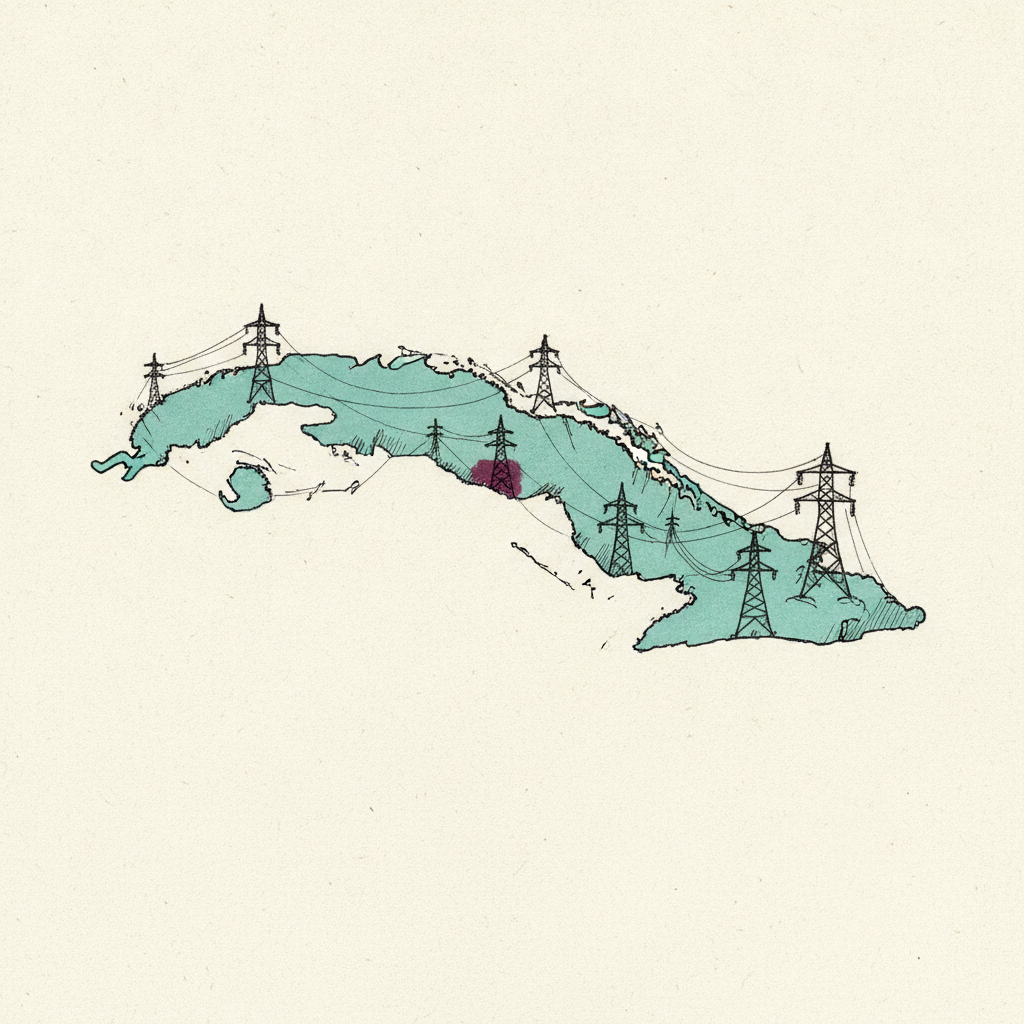
Sistema Eléctrico Nacional
Cuba's National Electric System; collapsed entirely five times in 2026, including three times within eight days in July.
Cuba's national grid collapsed entirely for the fifth time in 2026 on 14 July, when the Felton plant tripped and widened the deficit to 2,020 MW, only four days after a transmission-line failure caused the fourth collapse.
Last refreshed: 17 July 2026 · Appears in 1 active topic
Cuba's grid has collapsed entirely five times in 2026; is the system now failing faster than it can recover?
Timeline for Sistema Eléctrico Nacional
Collapsed a second time within the window after the Felton trip
Cuba Dispatch: Felton trips, and the grid falls againDisconnected entirely after the 220kV line failure
Cuba Dispatch: One 220kV line took the island darkSuffered its fourth total collapse of 2026
Cuba Dispatch: Nuevitas failure blacks out all CubaBackground
The Sistema Eléctrico Nacional (SEN) is Cuba's national electric grid, operated by the state utility Unión Eléctrica (UNE). Its ageing thermal fleet, starved of fuel by the loss of Venezuelan and Russian crude imports and by US sanctions on Cuba's oil sector, has Left the system running with no reserve margin: when any single unit or transmission line fails, the whole grid can collapse rather than just the affected region.
That fragility produced a distinct pattern in 2026: a partial disconnection of the eastern provinces on 14 May under UNE's load-shedding hierarchy, which prioritises Havana, followed by five separate total national collapses through the year. Each restoration buys only weeks or months before the next failure, because the fleet behind the grid is decades old and the fuel supply chain that feeds it remains structurally broken.
Cuba's grid keeps failing entirely
The Sistema Eléctrico Nacional suffered its fifth total collapse of 2026 on 14 July, when the Felton unit 1 thermal plant tripped at 11:05 and widened the generation deficit to 2,020 MW. That followed a fourth collapse four days earlier: the 220kV transmission link connecting Santa Clara to Sancti Spíritus failed at 15:55 on 10 July, cutting the system's generation to 935 MW against 3,100 MW of demand and leaving only 12.6% of Havana with power once the grid came back.
A third total collapse had already struck on 6 July after Unit 6 failed at Nuevitas, leaving Matanzas dark for up to 87 hours. Three collapses in eight days marks a real cadence shift from roughly one every few weeks; UNE reported a 2,126 MW peak deficit on 15 July and forecast 2,240 MW the next day, citing a lack of generation capacity.
How many times has Cuba's national grid collapsed in 2026?
What is the Sistema Eléctrico Nacional?
What is Cuba's current electricity deficit?