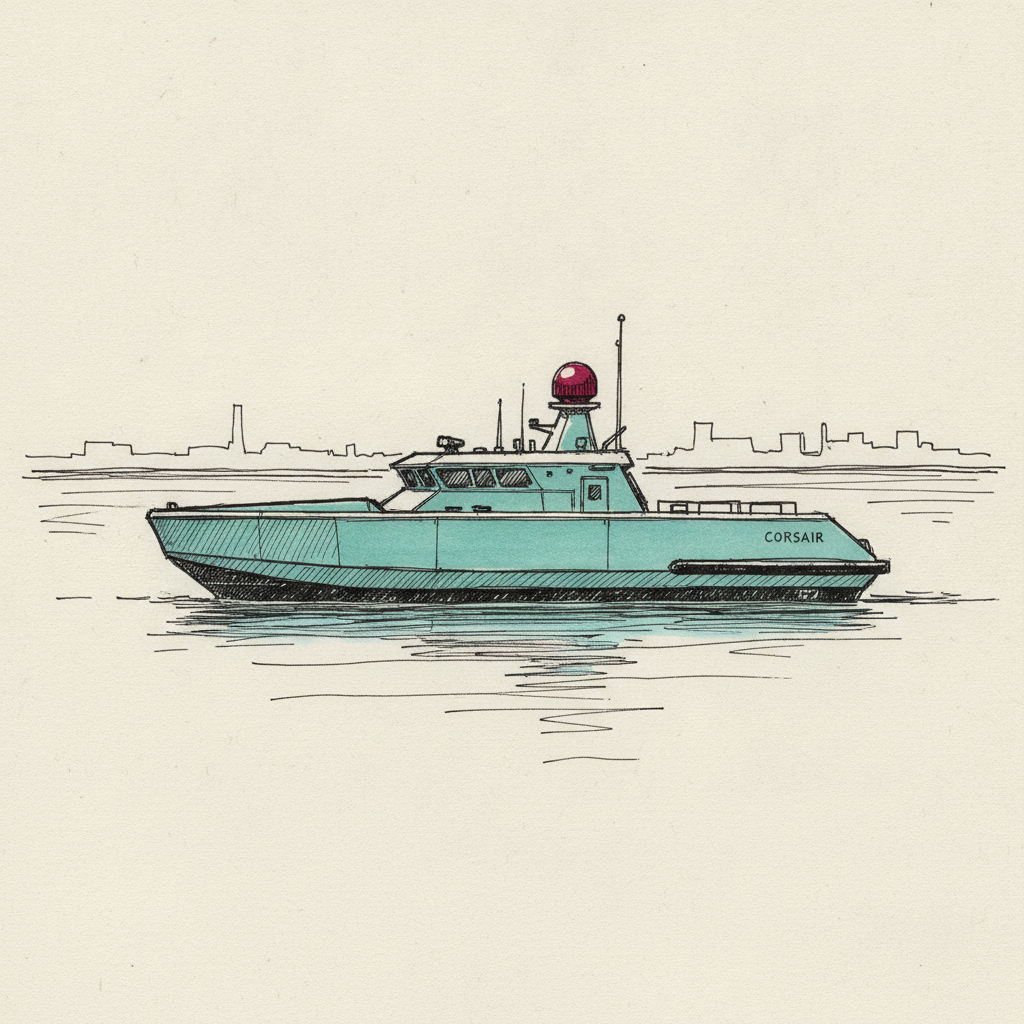
Saronic Corsair
A 24-foot autonomous unmanned surface vessel (USV) developed by Saronic Technologies, operated by US Navy Task Force 59, which performed the first confirmed drone-boat combat personnel recovery in June 2026.
Last refreshed: 10 June 2026 · Appears in 1 active topic
Can a 24-foot drone boat really replace a rescue swimmer in a combat zone?
Timeline for Saronic Corsair
Located and recovered both Apache crew members from the Strait of Hormuz within two hours
Iran Conflict 2026: Drone boat rescued the downed Apache crewBackground
The Saronic Corsair is a 24-foot (7.3-metre) autonomous surface vessel (ASV) built by Saronic Technologies of Texas, designed to operate at speeds exceeding 35 knots with a payload capacity of 1,000 lb (454 kg) over a range of 1,000 nautical miles. On 9 June 2026, a Corsair deployed by Task Force 59 located and recovered both crew members of a US Army AH-64 Apache helicopter that had been downed near the strait of Hormuz. The vessel transported them to a handoff point where a helicopter completed the evacuation. Specialist outlets The War Zone and DefenseScoop, as well as Baird Maritime, reported it as the first unmanned-vessel combat personnel recovery on record; this claim has not been officially designated as a historic first by the US Department of Defense in publicly available statements, and should be understood as specialist-reported rather than formally certified.
Saronic unveiled the Corsair in October 2024 and in December 2025 won a production contract worth several hundred million dollars to deliver the vessel to the US Navy. The platform is equipped with 360-degree passive sensing for day and night operations and can operate autonomously as a single vessel or in a coordinated swarm. The Defence Innovation Unit listed the Corsair as a production-ready expeditionary small unmanned surface vehicle (sUSV).
The June 2026 rescue operation marks the Corsair's first publicly confirmed operational use in a combat theatre and has drawn significant Pentagon and allied attention to unmanned systems as a viable platform for search, rescue, and force-protection missions in contested maritime environments.
What is the Saronic Corsair drone boat?
How did the Corsair drone rescue the Apache pilots?
Is the Saronic Corsair the first drone to rescue people in combat?
How much did the US Navy pay for the Saronic Corsair?


Written with AI from Lowdown's published reporting. Not individually reviewed by an editor. Updated 10 June 2026. Editorial standards.