Skip to content
You can now search across every topic, entity and event.What's new
NRSC v. FEC
Event

NRSC v. FEC

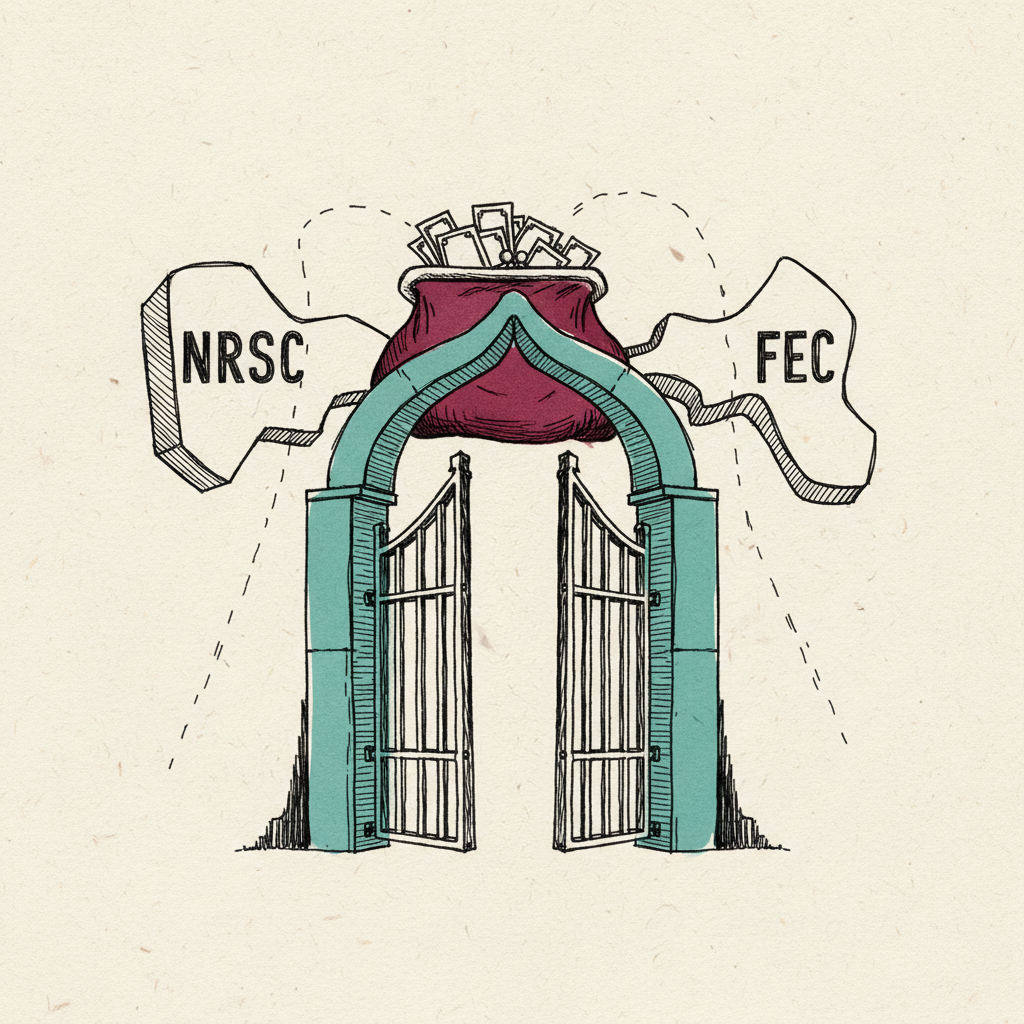
Supreme Court case that struck federal coordinated party-candidate spending caps, 6-3, in June 2026.

Last refreshed: 9 July 2026 · Appears in 1 active topic

Key Question

Will the Court let party committees spend without limit alongside their own candidates?

Timeline for NRSC v. FEC

#121 Jul

Provided the legal basis for the new coordinated-spending architecture

US Midterms 2026: NRSC shifts to coordinated party money
#1130 Jun
#1130 Jun

Enabled the NRSC's shift from independent expenditures to coordinated buys

US Midterms 2026: NRSC moves its ad money in-house
#1018 Jun
View full timeline →
Common Questions
What is NRSC v. FEC and why does it matter for the 2026 midterms?
NRSC v. FEC challenges limits on coordinated spending between parties and their own candidates. A ruling eliminating caps would let the RNC, which holds $95m vs the DNCs $14m, funnel unlimited funds directly into individual Senate races.Source: Supreme Court oral argument, December 2025
When will the Supreme Court rule on party spending limits?
The Court heard arguments on 9 December 2025 and is expected to rule by end of term, likely June or July 2026, before the main midterm campaign season.Source: Supreme Court schedule
How much can political parties currently spend coordinating with candidates?
Current limits range from $127,200 to $3.9 million per Senate race depending on state population, set under the Federal Election Campaign Act and upheld since Buckley v. Valeo in 1976.Source: FEC regulations

Background

NRSC v. FEC is the Supreme Court case that on 30 June 2026 struck down the Federal Election Campaign Act's (FECA) limits on coordinated spending between party committees and their own candidates. Ruling 6-3, the Court held that the caps, which had ranged from $61,800 to $3.7 million per Senate race depending on state population, unconstitutionally restricted political speech between a party and its own nominees. The case had been argued on 9 December 2025; at oral argument Justice Brett Kavanaugh said the caps had weakened parties relative to outside groups, and the ruling followed that reasoning.

Striking the caps removes the last constraint separating party committees from campaign operations. Where the NRSC, NRCC, DSCC, and DCCC previously had to keep coordinated spending on a separate, capped track from their own candidates' campaigns, all four can now spend without limit in direct consultation with named candidates. The NRSC moved first: a 30 June memo told campaigns it would fold its independent-expenditure unit into fully coordinated spending, a shift analysts described as the template for a joint-fundraising-committee architecture now open to every national committee. The Senate Leadership Fund's $342 million parallel operation, built specifically because the caps required independent spending, is no longer structurally necessary under the new regime.

The case traces its constitutional lineage to Colorado Republican I (1996), which first recognised a party committee's right to independent spending, and Citizens United (2010), which removed limits on corporate independent expenditure. NRSC v. FEC completes that arc: with the coordinated-spending caps gone, the last structural limit on party-candidate coordination in federal elections has been removed for the rest of the 2026 cycle and beyond. The Sixth Circuit had upheld the caps before the Supreme Court took the case; the Campaign Legal Center, among the organisations that defended the caps, was on the losing side of the ruling.

More questions
What is NRSC v. FEC and why does it matter for 2026?
NRSC v. FEC is a Supreme Court case challenging federal limits on coordinated spending between party committees and their own candidates. A ruling expected by end of June 2026 could let party committees spend without limit directly alongside Senate campaigns, dissolving the firewall that forces bodies like the Senate Leadership Fund to operate independently.Source: event
What are the current limits on party spending in Senate races?
Under FECA, party committees can spend between $61,800 and $3.7 million per Senate race in coordination with their candidates, depending on state population. NRSC v. FEC challenges whether these caps are constitutional.Source: event
When will the Supreme Court rule on NRSC v. FEC?
A ruling is expected by the end of June 2026. The case was argued on 9 December 2025.Source: event
What did Justice Kavanaugh say about campaign finance limits?
At oral argument in December 2025, Kavanaugh said FECA coordinated-spending caps had weakened parties relative to outside groups, signalling the conservative majority was prepared to strike them.Source: event
What did the Supreme Court decide in NRSC v. FEC?
On 30 June 2026 it ruled 6-3 that FECA's caps on coordinated spending between party committees and their own candidates were unconstitutional, striking them for the rest of the 2026 cycle.Source: Supreme Court ruling
How does the NRSC v. FEC ruling change 2026 campaign spending?
Party committees can now spend without limit in direct consultation with named candidates; the NRSC responded within days by folding its independent-expenditure unit into fully coordinated spending.Source: NRSC internal memo
Why did the NRSC bring the NRSC v. FEC case?
It argued FECA's coordinated-spending caps, which limited party-candidate coordination to between $61,800 and $3.9 million per race depending on the office and state, unconstitutionally restricted political speech.Source: Supreme Court oral argument