Implementing Decision (EU) 2026/335
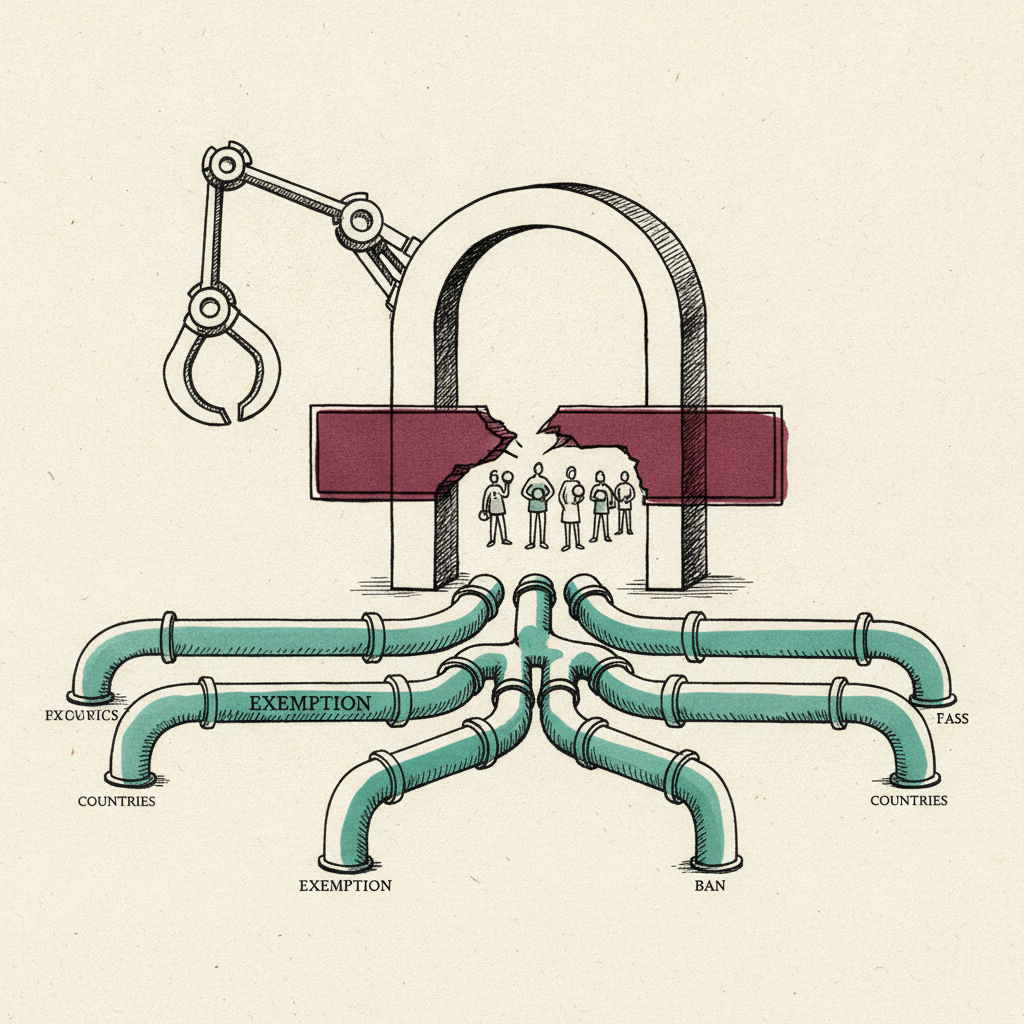
EU implementing decision exempting six gas-supplying countries from prior-authorisation under the pipeline ban.
Last refreshed: 15 June 2026 · Appears in 1 active topic
Which countries are exempt from the EU's prior-authorisation requirement for gas imports?
Timeline for Implementing Decision (EU) 2026/335
Exempted Algeria, Nigeria, Norway, Qatar, UK and USA from prior-authorisation requirement
European Energy Markets: The ban's own text makes it porous- Why are Norway, Qatar and the USA exempt from the EU's pipeline gas import rules?
- Implementing Decision 2026/335 exempts these six origins; Algeria, Nigeria, Norway, Qatar, the UK and the USA; from the prior-authorisation requirement under Regulation 2026/261. They are the EU's main alternative gas suppliers, so the exemption avoids creating administrative friction on substitute supply.Source: EUR-Lex
- What is the prior-authorisation requirement for EU gas imports?
- Under Regulation 2026/261, importers bringing in short-term pipeline gas from non-exempt origins must file a declaration one month before customs entry and clear an administrative check. The six origins in Implementing Decision 2026/335 are exempt from this step.Source: EUR-Lex
- Does the EU ban on Russian gas have any loopholes?
- Several. Long-term contracts are exempt until September 2027. The six origins in Implementing Decision 2026/335 face no prior-authorisation. The Kipi entry point on the Greek-Turkish border lacks the origin documentation to enforce the rebuttable presumption on BOTAS-blended gas entering the EU.Source: event
Background
Implementing Decision (EU) 2026/335 is a Commission implementing act adopted on 9 February 2026 that exempts six gas-supplying origins from the prior-authorisation requirement established under Regulation (EU) 2026/261. The six exempt origins are Algeria, Nigeria, Norway, Qatar, the United Kingdom and the United States. The prior-authorisation mechanism requires a short-term importer to file a declaration one month before customs entry and clear an administrative check; the exemption removes that requirement for supply from these origins.
The six origins represent the EU's key alternative pipeline and LNG supply routes: Norwegian pipeline gas via the North Sea, Algerian gas via trans-Mediterranean pipelines, US and Qatari LNG, UK North Sea reexports, and Nigerian LNG. By exempting them from prior authorisation, the decision ensures that alternative non-Russian supply faces no administrative delay at the point of entry, reducing the risk that the bureaucratic mechanism designed to filter Russian short-term gas would inadvertently impede substitute molecules. The decision is the operational complement to the regulation's transitional exemption for long-term contracts.
The decision is significant because it defines the enforcement architecture of the pipeline ban in practice. Supply from origins not on the exempt list; primarily Russian pipeline gas on short-term contracts; remains subject to prior authorisation, which functions as a bureaucratic chokepoint rather than a hard prohibition. The decision's design leaves Russian short-term supply legally possible via a one-month administrative process rather than prohibited outright, which contributes to the market's reading of the regulation as procedural.
