Skip to content
Briefings are running a touch slower this week while we rebuild the foundations.See roadmap
General License V
LegislationUS

General License V

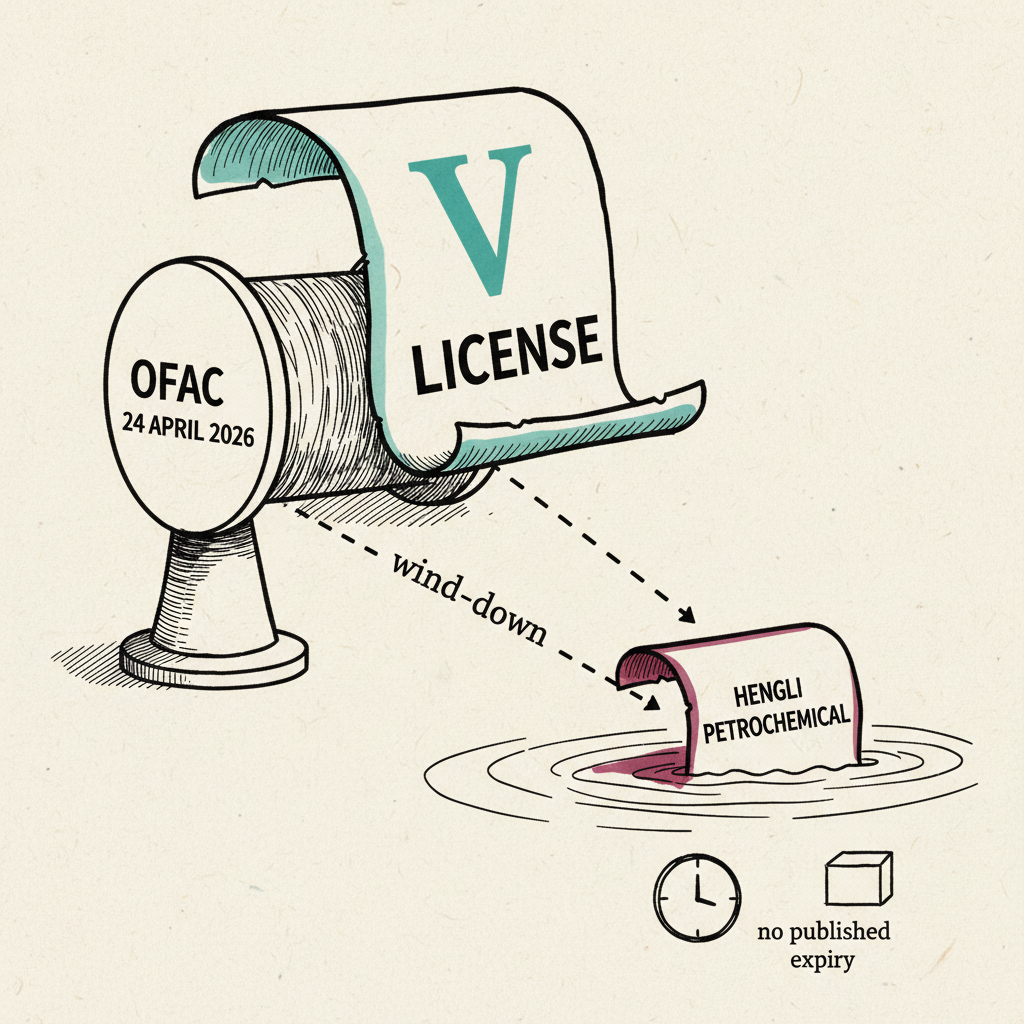
OFAC 30-day wind-down instrument for Hengli Petrochemical; expires 24 May, triggering secondary sanctions on any bank clearing Hengli dollar payments.

Last refreshed: 21 May 2026 · Appears in 1 active topic

Key Question

Does the Sunday 24 May expiry produce observable secondary-sanctions enforcement against any Chinese bank?

Timeline for General License V

View full timeline →
Common Questions
What is General License V and who does it affect?
General License V is an OFAC authorisation issued 24 April 2026 that permits Hengli Petrochemical and its counterparties to complete and wind down existing transactions following the Hengli designation. It expires 24 May 2026.Source: OFAC
When does General License V expire for Hengli?
General License V expires on 24 May 2026, giving Hengli 30 days from the 24 April designation to complete its wind-down. Hengli pre-positioned three months of crude inventory and restructured its Singapore trading Arm within this window.Source: OFAC
What is a general licence in OFAC sanctions?
An OFAC general licence is a blanket authorisation permitting specific activities that would otherwise violate US sanctions. Unlike specific licences granted case-by-case, general licences apply to any qualifying transaction, giving counterparties time to wind down legally-initiated business with newly-sanctioned entities.Source: OFAC licensing guidance
Does General License V mean Hengli can still buy Iranian oil?
GL-V permits only wind-down transactions — completing, unwinding, or closing existing dealings. Hengli cannot initiate new Iranian crude purchases under GL-V. After 24 May, no such transactions are permitted without a new OFAC authorisation.Source: OFAC
What is General License V and why does it have no deadline?
General License V is an OFAC authorisation issued 24 April 2026 allowing Hengli Petrochemical to wind down Iranian crude transactions after its designation. The absence of a published deadline is unusual and means compliance teams cannot calculate when permitted activity converts to a violation.Source: event
Why was Hengli Petrochemical sanctioned by the US?
OFAC designated Hengli Petrochemical (Dalian) on 24 April 2026 for purchasing Iranian crude oil. Hengli was the largest single-entity Chinese designation of the 2026 conflict, processing an estimated 400,000 Barrels Per Day of Iranian crude.Source: OFAC
How do OFAC general licences work in sanctions cases?
OFAC general licences create targeted exemptions within broader sanctions regimes. They are used to give counterparties time to wind down legally-initiated business with newly-sanctioned entities, avoiding immediate supply chain disruption. GL-V is a standard 30-day wind-down example.Source: OFAC
What is OFAC General Licence V?
General Licence V is a US Treasury OFAC authorisation issued 24 April 2026 allowing Hengli Petrochemical (Dalian) and its counterparties to wind down existing transactions following Hengli's designation under Iran sanctions. It expires 24 May 2026.Source: OFAC
When does OFAC General Licence V expire?
General Licence V expires on 24 May 2026, giving Hengli Petrochemical 30 days from its 24 April designation to complete its wind-down. After that date, no such transactions are permitted without a new OFAC authorisation.Source: OFAC
Who is sanctioned under OFAC General Licence V?
GL-V covers Hengli Petrochemical (Dalian) Refinery Co. Ltd and its majority-owned subsidiaries. The MOFCOM Blocking Rules response also named four additional refiners: Shandong Shouguang Luqing, Shandong Jincheng, Hebei Xinhai Chemical, and Shandong Shengxing.Source: OFAC / MOFCOM
Why did China retaliate after OFAC sanctioned Hengli?
Eight days after GL-V designated Hengli, China's MOFCOM activated its 2021 Blocking Rules for the first time on 2 May 2026, naming five Chinese refineries barred from complying with US sanctions. Article 9 creates a private right of action against any Chinese firm that complies with OFAC designations.Source: MOFCOM
How does OFAC General Licence V fit into the Iran sanctions series?
GL-V is the only signed Iran instrument of the 2026 conflict at the time of issue. It follows GL-U (the Iranian crude waiver that lapsed 19 April 2026) and precedes GL-W (a broader wind-down instrument issued 1 May 2026). Together they trace the escalation from waiver to targeted designation.Source: OFAC
When does OFAC General Licence V expire for Hengli?
General Licence V expires on 24 May 2026, giving Hengli 30 days from its 24 April designation to complete its wind-down. After that date, any dollar transaction with Hengli triggers secondary sanctions on the clearing bank.Source: OFAC
What happens to banks that process Hengli payments after 24 May 2026?
Any non-US bank that clears a US-dollar payment for Hengli after General Licence V expires loses its access to the US correspondent banking system. The trigger is automatic under OFAC's secondary-sanctions framework and requires no additional designation action.Source: OFAC
Why did Hengli's Singapore office start laying off staff?
Hengli Petroleum Singapore began redundancies ahead of the 24 May 2026 General Licence V expiry, signalling the refinery's acceptance that its dollar-clearing infrastructure is closing. MOFCOM Announcement No. 21 instructs the firm to ignore OFAC, but the layoffs indicate corporate-level recognition that enforcement will bite.Source: Manifold Times

Background

General Licence V is an OFAC authorisation issued on 24 April 2026 simultaneously with the designation of Hengli Petrochemical (Dalian) Refinery Co. LtdChina's second-largest independent teapot refinery at roughly 400,000 Barrels Per Day — under sanctions bulletin sb0472. It permits Hengli and counterparties to complete, unwind, and wind down existing transactions that would otherwise be blocked by the new designation, with a 30-day wind-down expiry of 24 May 2026 . The licence was the only signed Iran instrument issued during the entire conflict at that date. Hengli denied any Iran trade on 26 April; China's Washington embassy called the designation 'illegal unilateral sanctions'. Hengli responded by pre-positioning three months of crude inventory and cutting its Singapore trading Arm's stake from 100% to 5%, transferring the remainder to a Chinese local government entity to insulate physical refining operations from OFAC reach within the GL-V window .

General Licences are a standard OFAC tool — blanket authorisations permitting specific activities that would otherwise violate US sanctions — issued under Executive Order 13902 (targeting Iran's construction, mining, manufacturing, and textiles sectors) and EO 13846 (reimposing nuclear-related sanctions). GL-V sits in a series of Iran-related instruments: it follows GL-U (the Iranian crude waiver for vessels loaded before 20 March, which lapsed 19 April 2026 with no renewal) and precedes GL-W (a wind-down instrument for newly blocked Iran-related persons issued 1 May 2026). Unlike GL-U, which covered a broad fleet of 325 tankers, GL-V is entity-specific, targeting a single Chinese corporate group and its majority-owned subsidiaries.

The GL-V designation is the first OFAC instrument to name Chinese refiners by designation — historically a threshold OFAC had avoided to prevent direct US-China economic escalation. Eight days after GL-V's issuance, China's MOFCOM activated its 2021 Blocking Rules for the first time on 2 May 2026, naming five Chinese refineries (Hengli Petrochemical (Dalian), Shandong Shouguang Luqing, Shandong Jincheng, Hebei Xinhai Chemical, and Shandong Shengxing) as legally barred from complying with OFAC's designations . With three days to expiry on 21 May 2026, Hengli Petroleum Singapore had begun laying off staff — the refinery's own operational signal that the dollar door is closing regardless of MOFCOM's blocking instructions. From Monday 25 May, any bank that clears a US-dollar Hengli payment loses US correspondent access; the secondary-sanctions trigger is automatic and requires no further OFAC action beyond the existing clock . The 24 May expiry is the first hard-dated OFAC-MOFCOM enforcement moment of the Iran war and the only Iran-relevant US instrument with a written timetable after 82 days of unsigned conflict management.
