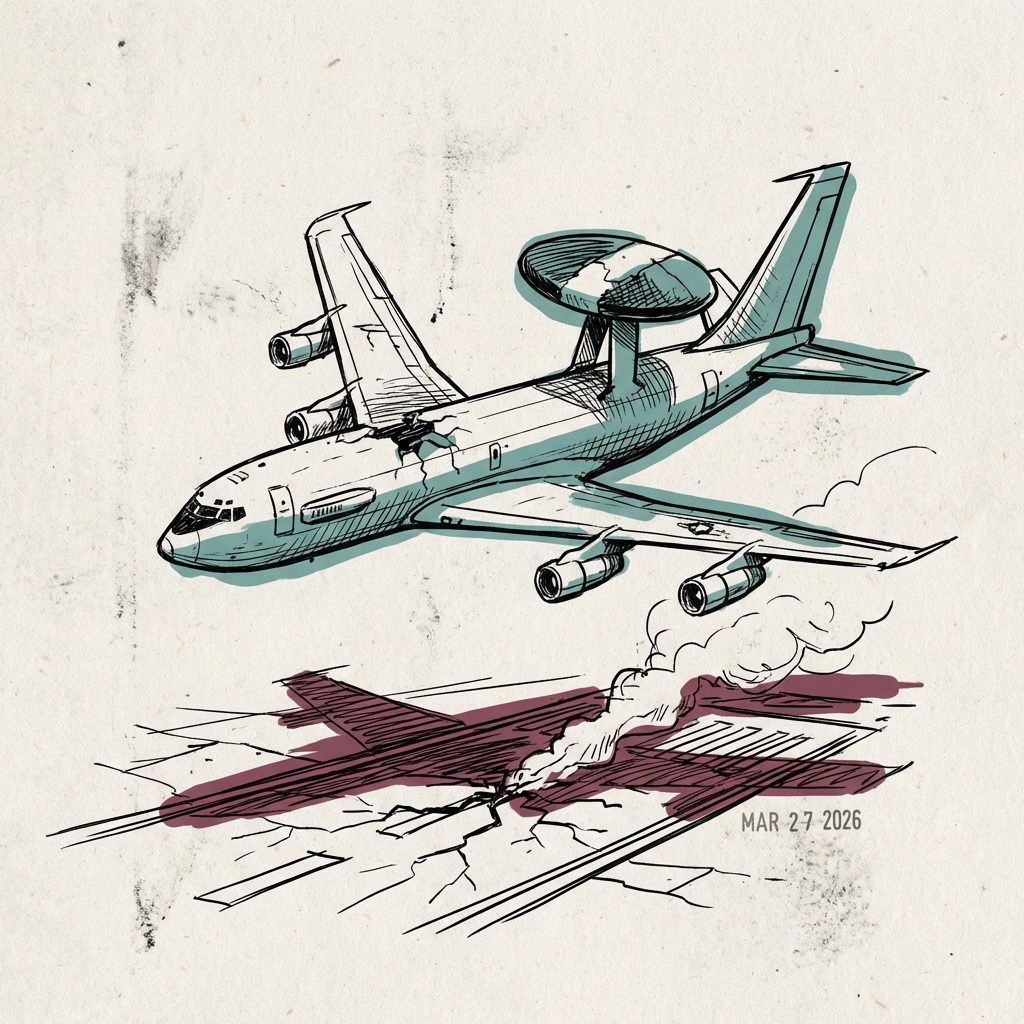
E-3 Sentry
US Air Force AWACS aircraft; one destroyed at Prince Sultan base on 27 March 2026.
Last refreshed: 28 July 2026
What replaced the E-3 Sentry destroyed at Prince Sultan Air Base?
Timeline for E-3 Sentry
Mentioned in: Pentagon Sent Congress Stale Casualty Data
Iran Conflict 2026Mentioned in: Iran Suspends All IAEA Access; Nuclear Programme Goes Dark
Iran Conflict 2026Pre-IOC Electronic Warfare Aircraft Deployed to Patch AWACS Gap
Iran Conflict 2026Mentioned in: Iran hits Prince Sultan base; 12 US hurt
Iran Conflict 2026Background
The Boeing E-3 Sentry is the US Air Force's primary Airborne Warning and Control System (AWACS) aircraft, providing over-the-horizon radar surveillance, battle management, and command and control for joint air operations. Powered by four turbofan engines and carrying a distinctive rotating radar dome, a single E-3 can track hundreds of aircraft simultaneously across a radius exceeding 300 miles. On 27 March 2026, an Iranian Ballistic missile strike on Prince Sultan Air Base in Saudi Arabia destroyed one E-3 Sentry, the first combat loss of an AWACS aircraft in US history.
The destruction of the Prince Sultan E-3 created an immediate battle management gap over the theatre, forcing CENTCOM to accelerate the deployment of the EA-37B Compass Call electronic warfare aircraft as a partial substitute. The EA-37B had not yet reached Initial Operational Capability at the time of deployment. Two aircraft (AXIS41, AXIS43) departed RAF Mildenhall on 2 April, underscoring the urgency.
The E-3 fleet is ageing: the aircraft entered service in 1977 and the Air Force has been transitioning to the Boeing E-7A Wedgetail as its replacement, though that programme has faced repeated delays. The loss at Prince Sultan exposed the vulnerability of large, slow, high-value airborne assets to modern ballistic missiles and has accelerated internal Pentagon debate over how to distribute battle management capability across more survivable, dispersed platforms.