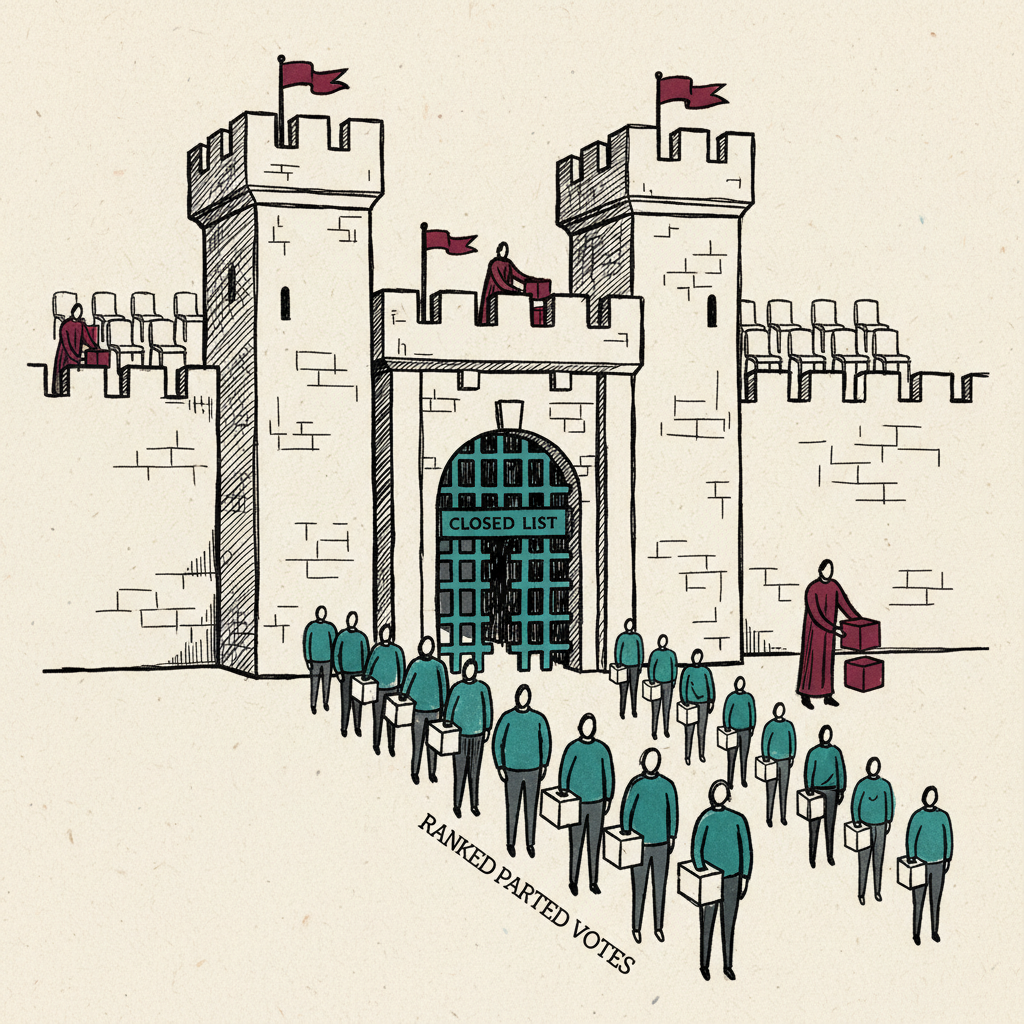
Closed-list proportional representation
Electoral system used in Wales from 2026: parties ranked by votes, seats filled from fixed party lists.
Last refreshed: 10 April 2026 · Appears in 1 active topic
Why does Wales now use closed-list PR and what does it mean for voters?
Timeline for Closed-list proportional representation
Mentioned in: Six Reform Wales Candidates Gone, Three From One Seat
UK Local Elections 2026Mentioned in: Wales Hardening Into Two Blocs, Researchers Find
UK Local Elections 2026- How does the new Welsh voting system work in 2026?
- Voters cast a single vote for a party. Seats are allocated proportionally by vote share, and candidates are elected in the order pre-set by each party. Voters cannot choose between candidates from the same party.Source: Senedd Cymru (Members and Elections) Act 2024
- What is the difference between closed-list and open-list PR?
- In closed-list PR, the party fixes the order of candidates before the election and voters cannot alter it. In open-list PR, voters can express a preference between candidates from the same party.Source: Electoral context, 2026
- Why did Wales change its voting system for the Senedd?
- The Senedd Cymru (Members and Elections) Act 2024 replaced the mixed-member system with closed-list PR and expanded the chamber from 60 to 96 members, aiming for more proportional outcomes.Source: Senedd Cymru (Members and Elections) Act 2024
- Does closed-list PR give more power to party machines?
- Yes. Party leadership controls the candidate ranking, so high list placements are effectively SAFE seats. Voters have no mechanism to promote or demote individual candidates.Source: Electoral analysis, 2026
Background
Closed-list proportional representation is the electoral system introduced for Welsh Senedd elections from 2026, replacing the mixed-member proportional system used since devolution began in 1999. Under the new system, voters cast a single ballot for a party rather than for an individual candidate. Seats are allocated to parties in proportion to the votes they receive, and the order in which candidates take those seats is determined entirely by each party internal ranked list -- voters have no influence over which individuals within a party are elected. The 7 May 2026 Senedd election is the first ever conducted under this system.
The switch was legislated by the Senedd Reform (Wales) Act 2024 (Senedd Cymru (Members and Elections) Act 2024). The reform also increased the number of Senedd members from 60 to 96 and changed constituency boundaries. Proponents argued the old mixed-member system was confusing for voters and that the new system would deliver more proportional outcomes and greater party diversity. Critics -- primarily within Labour and the Conservative parties -- argued the closed-list mechanism removes voter influence over individual candidates and entrenches party machine power over selection.
The distinction between closed and open list PR matters politically. In an open-list system, voters can express a preference between candidates from the same party, altering the internal order. In closed-list, the party ranks its candidates before the election and voters cannot reorder them. This gives party leadership significant control over who enters the Senedd: high list placements are effectively SAFE seats, low placements are paper candidacies. The 2026 Welsh Senedd election is being watched as the United Kingdom first large-scale test of closed-list PR at a legislative level.