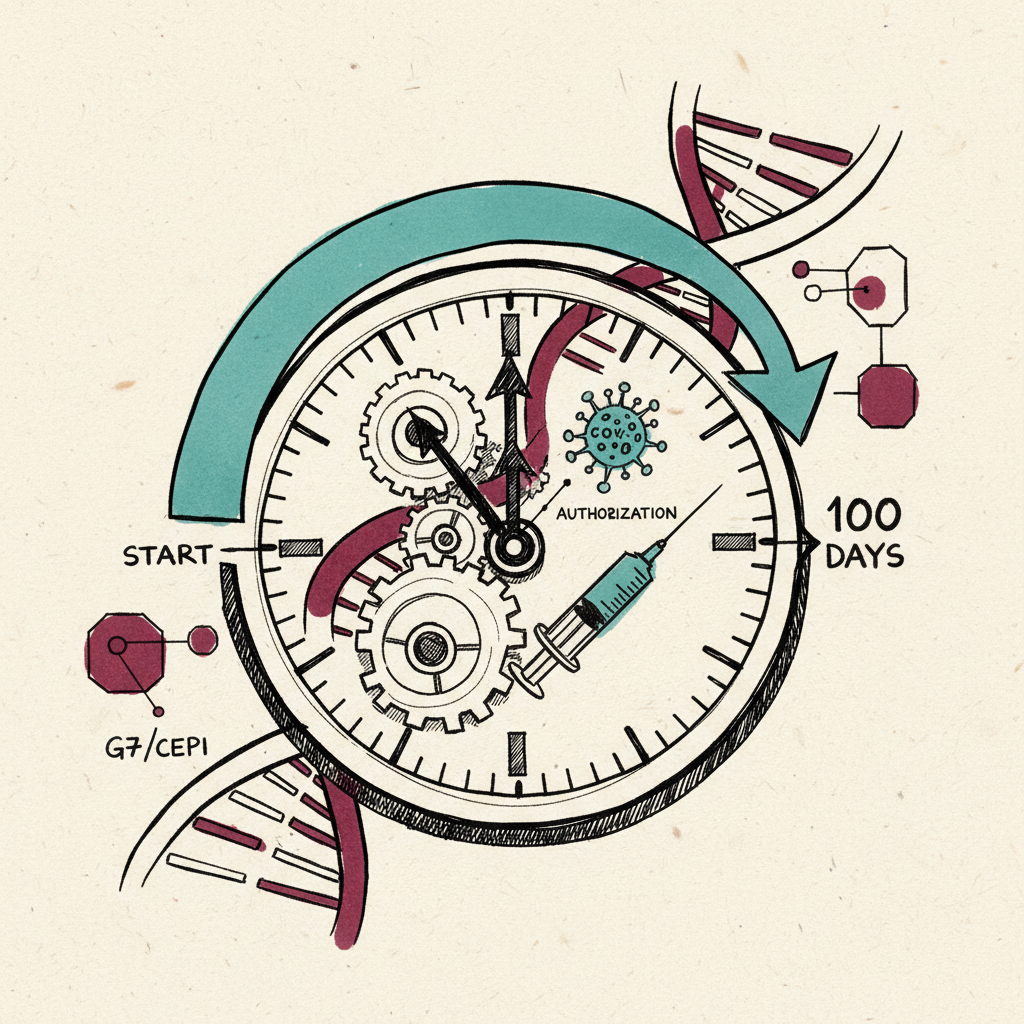
100 Days Mission
G7/CEPI framework to authorise a pandemic vaccine within 100 days of pathogen identification.
Last refreshed: 7 May 2026 · Appears in 1 active topic
Does the Moderna H5N1 Phase 3 trial prove the 100 Days Mission is achievable?
Timeline for 100 Days Mission
Mentioned in: CEPI and GAVI commit $112m, no treatment yet
Pandemics and BiosecurityMentioned in: CEPI rescues Moderna H5N1 vaccine trial
Pandemics and BiosecurityAdvanced by the Moderna Phase 3 trial, which builds pre-pandemic efficacy data for rapid authorisation
Pandemics and Biosecurity: Moderna begins Phase 3 H5N1 mRNA trialBackground
The 100 Days Mission is a pandemic preparedness target established after the COVID-19 pandemic, formalised through the G7's Pandemic Preparedness Partnership in 2021 and operationalised primarily by CEPI (Coalition for Epidemic Preparedness Innovations). The goal is to develop SAFE and effective vaccines, therapeutics, and diagnostics for a novel pandemic threat within 100 days of pathogen identification. The target emerged from a review, led by former GlaxoSmithKline CEO Andrew Witty for the UK Government, which found that the principal delays in the COVID-19 vaccine response were not in antigen design but in clinical trial infrastructure, regulatory interaction, manufacturing reservation, and raw-material procurement. The 100 Days Mission directly addresses clinical-trial lead time by investing in pre-pandemic Phase 3 studies.
The Moderna H5N1 Phase 3 trial, announced by CEPI on 22 April 2026, is the first concrete proof-of-concept for the 100 Days Mission in practice: pre-pandemic Phase 3 data collected before a transmissible H5N1 strain emerges. Without that pre-existing data, an emergency-use authorisation within 100 days of a pandemic declaration would require regulators to compress Phase 1 through Phase 3 into approximately 70 days, a timeline not achieved even under COVID-19 emergency conditions. If the Moderna trial produces immunogenicity endpoints that satisfy regulatory requirements for rapid bridging once a pandemic strain is identified, it would bring the 100 Days target from aspiration to operational reality for H5N1. The equity dimension, whether GAVI and CEPI can also deliver doses to lower-income countries within 100 days, remains the unresolved second half of the Mission's implicit promise.