Skip to content
You can now search across every topic, entity and event.What's new
US Midterms 2026
7SEP

SAVE Act tries the reconciliation door

2 min read
13:32UTC

Speaker Mike Johnson said on 5 July the House will route the SAVE Act through budget reconciliation, its third venue after a failed defence-bill rider and a floor revolt.

PoliticsDeveloping
Key takeaway

Johnson's third route for the SAVE Act still runs into a Byrd Rule wall in the Senate.

Speaker Mike Johnson told Fox News on 5 July that the House will try to pass the SAVE Act, a Republican voter-ID bill, through budget reconciliation, the fast-track process that needs only a Senate majority. He called it a priority he shares with President Trump. The move follows the House stripping his SAVE Act rider from the defence bill 198-224 .

That vote came alongside a 30 June floor revolt led by Republican Representative Anna Paulina Luna, which blocked the procedural motion to open debate on the National Defense Authorization Act. The House has now passed SAVE Act language three times, and the Senate has never taken it up. Johnson has now tried three vehicles rather than winning the Senate votes.

Reconciliation runs into the Byrd Rule, which bars provisions with no direct budget effect from a reconciliation bill. Senate Parliamentarian Elizabeth MacDonough has already ruled that a similar voter-ID measure broke that rule. Unless she reverses herself on this text, the SAVE Act's citizenship-documentation requirement is unlikely to survive the Senate even by simple majority.

Deep Analysis

In plain English

The SAVE Act would require proof of citizenship to register to vote. House Speaker Mike Johnson wants to pass it through budget reconciliation, a special process that lets some bills pass the Senate with a simple majority instead of the usual 60 votes needed to beat a filibuster. The catch is that reconciliation bills can only include provisions that are genuinely about the budget. The Senate's own rules referee, the parliamentarian, has already ruled against similar non-budget provisions before, which is why this pivot faces long odds.

Deep Analysis
Root Causes

The Byrd Rule requires every reconciliation provision to have a budgetary effect that is not merely incidental to an underlying policy goal. Voter-ID requirements govern who can cast a ballot, not how money is raised or spent, which is the textbook profile of a provision Byrd was written to exclude.

Parliamentarian Elizabeth MacDonough already advised against including the $15 minimum wage in the 2021 American Rescue Plan on the same incidental-effect reasoning, a precedent Senate Republicans now have to design around rather than argue against for the first time.

What could happen next?
  • Risk

    Elizabeth MacDonough's prior Byrd Rule rulings against non-budgetary provisions make a similar advisory opinion against the SAVE Act's voter-ID language likely.

First Reported In

Update #12 · Voter-data drive stalls; jobs turn soft

CNN· 9 Jul 2026
Read original
Different Perspectives
New Hampshire student voters
Students who hold no accepted photo ID under HB 323 cannot vote in the 8 September primary after Judge Laplante declined to block the law on timing grounds. Whether the same rule applies on 3 November is still open.
Alaska Democratic Party
The Alaska Democratic Party moved $884,835 in coordinated spending to Mary Peltola between 17 and 30 July, more than the DCCC spent nationally in the same fortnight.
National Republican Senatorial Committee
The NRSC, which sued to remove coordinated-spending caps in NRSC v. FEC, put $2,230,472 behind candidates in the first complete month after winning that case, more than double the total for the prior six months combined.
Supreme Court of Missouri
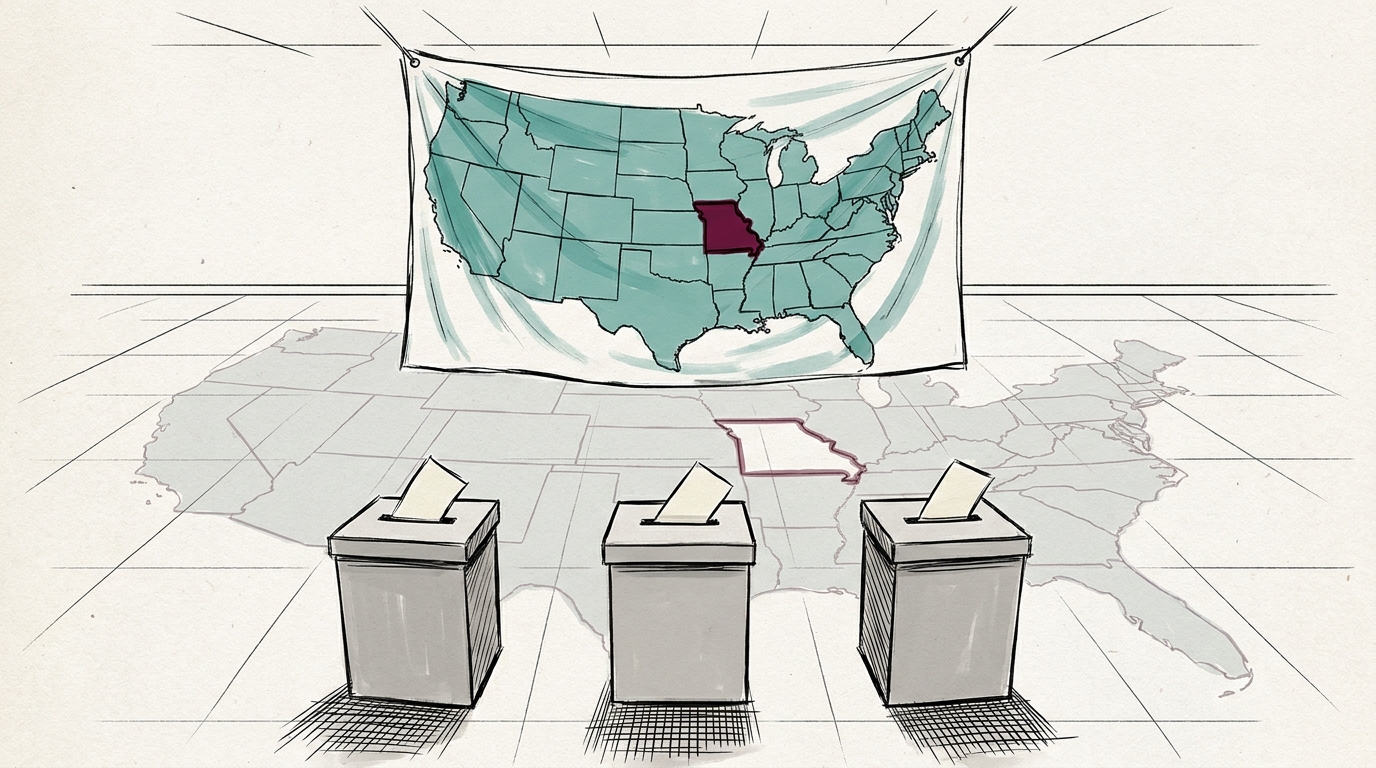
The unanimous court held that Article III, section 49 carries no redistricting exception, so a referendum petition against a congressional map is as valid as against any other law. It ordered the 2022 map to govern unless voters approve HB 1 on 3 November.
Denny Hoskins, Missouri Secretary of State
Hoskins told the Supreme Court that changing the congressional map after 1.2 million primary votes and ahead of the 19 September overseas-ballot deadline violates Purcell and the Elections Clause. He wants HB 1 reinstated before ballots print for November.
Senate Republican leadership
Floor time is finite at 51-47 with a bipartisan funding negotiation running, and a contested procedural fight over grant conditions is not the best use of it this month. Nothing has been abandoned; the resolution keeps its place on the calendar.
