Skip to content
You can now search across every topic, entity and event.What's new
UK Startups and Innovation
22APR

UK and France sign science pact

3 min read
17:16UTC

Liz Kendall signed the UK-France Strategic Biomedical Alliance on 29 May, the first bilateral science deal of its kind since Brexit, linking Bristol's Isambard-AI supercomputer to France's GENCI.

TechnologyDeveloping
Key takeaway

Shared UK-France compute and researcher mobility rebuild the base layer that feeds founders a decade out.

Science Secretary Liz Kendall signed the UK-France Strategic Biomedical Alliance in Health and AI on Friday 29 May, the first bilateral science deal of its kind since Brexit 1. The UK committed £894,000 to a supercomputing partnership linking Bristol's Isambard-AI, a UK National AI Supercomputer, with France's GENCI (Grand Equipement National de Calcul Intensif), the French national high-performance computing agency. A separate fund puts £300,000 a year from the UK alongside €330,000 from France into early-career researcher mobility 2. Named partners include the University of Oxford, Universite Paris Cite, the Institut Pasteur, Imperial College London and France's national research agency, the CNRS (Centre National de la Recherche Scientifique), working on women's health, drug-resistant infections, malaria and emerging viruses.

The practical effect of the compute link is that UK biomedical AI researchers gain access to French capacity, and French teams to British, years before any of that work could spin out into a company. Researcher mobility funding partially reopens the EU talent pipeline that Brexit constrained, letting early-career scientists move between the two systems on funded placements rather than visas and grant applications.

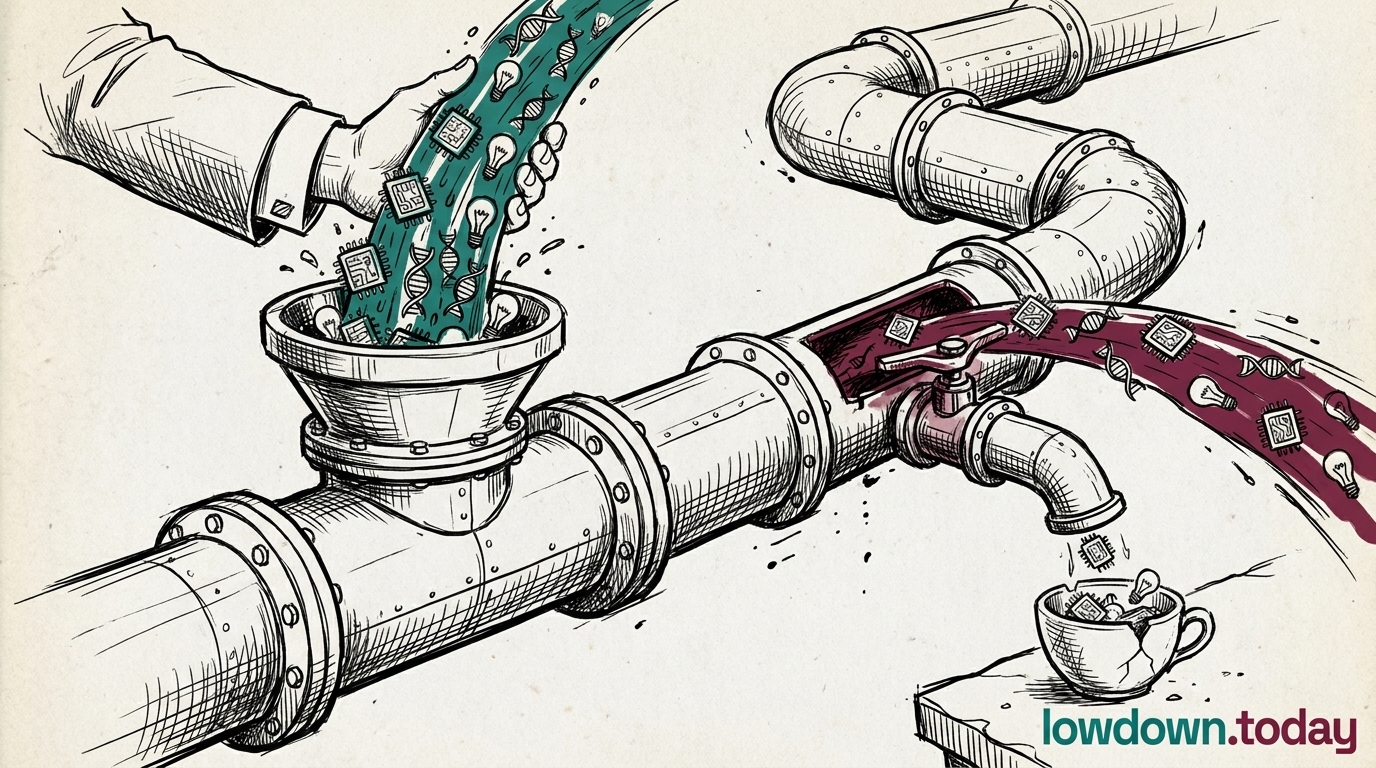
This is the research-infrastructure floor beneath the startup economy, the layer that feeds the spinout pipeline long before any Series A. It follows the same instrument logic as the £2bn quantum commitment that anchored ProQure earlier in the topic : a targeted state cheque into shared infrastructure rather than into individual firms. The sums look small against a major venture round, but shared compute and funded mobility are what produce the founders who raise those rounds a decade later. The alliance also sidesteps the multilateral negotiation that UK association to Horizon Europe required in 2024, operating as a narrower bilateral instrument below the threshold of a formal UK-EU framework.

Deep Analysis

In plain English

When the UK left the European Union (Brexit), it also left joint European science programmes. Researchers who previously moved freely between UK and EU universities to work on shared projects suddenly faced visa requirements, funding eligibility changes, and restrictions on using shared European research infrastructure. Supercomputers are extremely powerful machines used to model complex biological systems, simulate drug interactions, and analyse large patient datasets. Building one costs hundreds of millions of pounds; most countries operate just one or two national facilities. Countries share access so that researchers can use national machines they could not afford to build independently. The UK-France deal links two national supercomputers: Isambard-AI (based in Bristol) and GENCI (Grand Equipement National de Calcul Intensif, France's national facility). British researchers gain French computing power; French researchers gain access to Isambard-AI. A separate fund pays for early-career researchers to spend time in each other's universities, rebuilding the scientific relationships Brexit disrupted. Named research areas include drug-resistant infections, malaria, women's health and emerging viruses.

Deep Analysis
Root Causes

Brexit created two compounding deficits in UK biomedical research: access to European research infrastructure (particularly HPC compute that underlies large-scale biological modelling) and researcher mobility across EU borders. Both deficits are structural rather than temporary; they persist even after Horizon re-association because Horizon covers grants but not compute-sharing or bilateral secondment outside EU programmes.

The alliance's £894,000 Isambard-AI / GENCI link is small but fills a specific gap: UK biomedical AI researchers working on population-scale genomic data and drug-discovery modelling need supercomputing hours they cannot purchase commercially without grant funding.

GENCI access via the bilateral agreement gives them a path to French national compute without requiring a full Horizon fellowship application. The researcher-mobility fund similarly targets early-career researchers who would previously have used Erasmus+ and now have no equivalent programme.

What could happen next?
  • Precedent

    A replicable bilateral below-threshold science instrument that bypasses multilateral EU-framework negotiation; the France deal creates a template for similar agreements with Germany, the Netherlands and Sweden without requiring a full UK-EU science framework.

  • Consequence

    The Isambard-AI / GENCI link lowers entry cost for UK biomedical AI research that later spins out into commercial companies, partially rebuilding the pre-Brexit compute-access pipeline that fed spinout formation.

First Reported In

Update #6 · Orbital's $50m has no UK lead

GOV.UK / DSIT· 29 May 2026
Read original
Different Perspectives
Institute of Physics
The Institute has long argued STFC's national-laboratory infrastructure, not its grant programmes, is the binding constraint on UK physics output, and warns mothballing capacity like Clara removes capability that cannot be rebuilt on a four-year cycle. It represents the discovery-science community absorbing the reallocation the Bank's equity cheques do not touch.
Helsing
Helsing
The Munich-headquartered defence-AI firm chose Plymouth over Continental sites for a £350m manufacturing plant building underwater surveillance gliders, alongside its record raise. Its choice of postcode signals confidence in UK manufacturing capacity for defence hardware even as it looks abroad for the capital financing that hardware.
Dragoneer Investment Group, Lightspeed Venture Partners and Iconiq
The three US growth-capital firms backed Helsing's $1.8bn round at an $18bn valuation, more than doubling the mark set only a year earlier, with demand reportedly exceeding the capital on offer. Their money, not a UK sovereign vehicle, is what funds the Plymouth plant, extending a pattern of foreign capital underwriting British defence-hardware manufacturing this cycle.
British Business Bank
The Bank wrote its largest-ever direct life-sciences cheque into Alchemab and added a £6.5bn SME lending guarantee the same week UKRI confirmed the STFC cuts. It is deploying an April mandate change letting it lead venture rounds and invest directly up to £60m per company, treating equity extension rounds and small-business debt as newly within its risk appetite.
Daphni
Daphni
The Paris seed fund joined Speedinvest and three UK backers in Astral Systems' GBP23m Series A for modular fusion reactors, one of the round's five European co-investors betting on lab-to-market fusion ahead of any working commercial reactor. Unlike CuspAI's all-foreign cap table, this round kept a UK lead investor in Mercia Ventures.
EQT
EQT
EQT, appointed by the European Innovation Council to run the EUR5bn Scaleup Europe Fund, entered advanced talks for a further CuspAI stake reported on 3 July, the fund's first pursuit of a UK-founded winner. A closed deal would put EU sovereign capital, not a UK vehicle, on the cap table of a company Britain's own funds passed over.
