Skip to content
Briefings are running a touch slower this week while we rebuild the foundations.See roadmap
Russia-Ukraine War 2026
13MAY

Trump asks Zelenskyy for drone help

2 min read
20:00UTC

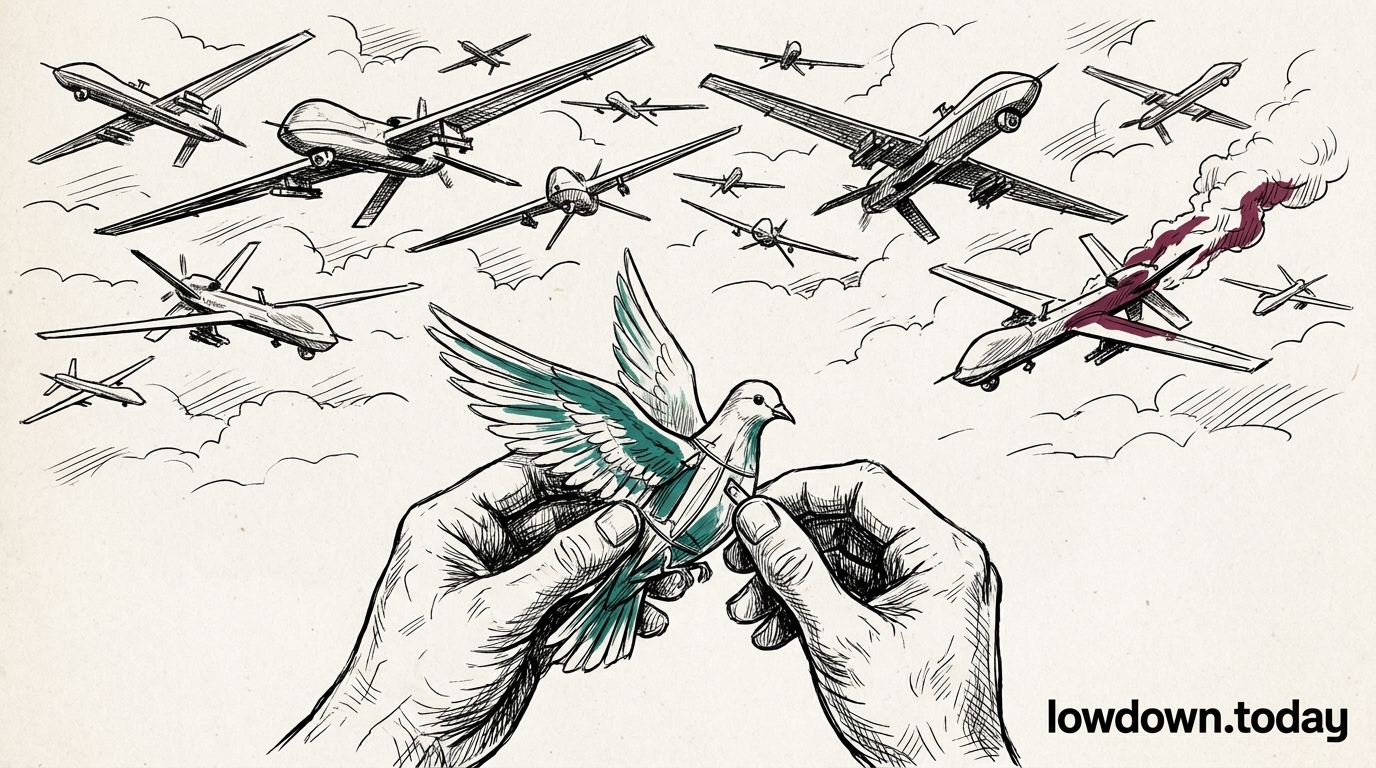
The US president publicly asked Ukraine for help countering Iranian Shaheds — reversing three years of one-directional military assistance on the same day the peace talks froze.

ConflictDeveloping
Key takeaway

Trump's public request permanently reframes Ukraine as a security provider, not merely an aid recipient.

On 5 March, President Trump publicly asked Zelenskyy for help countering Iranian Shahed drones in the Middle East. "Trump will take 'any assistance from any country,'" Fortune reported 1. The request came the same day the trilateral was suspended — and Kyiv moved to exploit the opening within 48 hours.

Since February 2022, the US-Ukraine military relationship has flowed in one direction: Javelins, HIMARS, Patriots, and Storm Shadows from Washington to Kyiv. Trump's request reversed that current. Ukraine has spent three years developing electronic warfare countermeasures, radar signature catalogues, and interception protocols against the same Iranian-manufactured Shahed-136 drones now threatening US forces and Gulf partners. No NATO member has equivalent operational data, because no NATO member has faced sustained Shahed bombardment at the scale Ukraine has — over 8,800 kamikaze drones in a single day by early March .

Ukraine had already announced on 2 March that it would package its counter-drone knowledge — radar signatures, interception angles, electronic warfare countermeasures — as exportable expertise for non-NATO states facing Iranian-pattern threats . Trump's public request turned that policy declaration into a live negotiation with the world's largest defence buyer. The political calculus is direct: Zelenskyy gains leverage with a US president who has been ambivalent about sustained Ukraine support, and Trump gets a capability gap addressed without the procurement timelines that plague the US defence industrial base. The Kyiv Independent reported that Ukraine's backing of the US-Israeli campaign against Iran was explicitly designed to build favour with Trump 2.

Deep Analysis

In plain English

Since Russia invaded in 2022, the basic dynamic has been simple: the US and allies give Ukraine weapons, Ukraine fights Russia. Trump publicly asking Ukraine for military help — specifically counter-drone expertise — reverses that arrangement. Ukraine has spent three years learning to intercept Iranian Shahed drones through battlefield trial and error, and is now the world's most practised operator in this domain. By making the request publicly, Trump implicitly acknowledged that Ukraine has something Washington urgently needs. That acknowledgement cannot be quietly retracted — it is now part of the public record that Kyiv can cite whenever Washington applies pressure on other issues.

Deep Analysis
Synthesis

Trump's public request creates a record of US dependence on Ukrainian expertise that Zelenskyy can invoke in any future negotiation where Washington pressures Kyiv toward territorial concessions. The request cannot be walked back. This shifts the implicit terms of the entire relationship in ways that persist beyond the immediate drone transaction.

Root Causes

The US request reflects a structural gap in Western defence procurement: the Pentagon's acquisition system optimises for high-end platforms and has no streamlined pathway to absorb battlefield-tested counter-drone innovation at speed. Ukraine's advantage is a direct product of wartime necessity bypassing the procurement bureaucracy that NATO allies cannot circumvent in peacetime.

What could happen next?
  • Opportunity

    Ukraine can condition knowledge transfer on concrete ceasefire commitments, creating leverage independent of military aid flows.

    Immediate · Assessed
  • Precedent

    A US president publicly requesting military assistance from an active warzone partner establishes Kyiv as a security provider in the international record.

    Long term · Assessed
  • Risk

    If Ukraine provides expertise without securing binding commitments in return, it depletes its most novel leverage before the most critical negotiating phase.

    Short term · Suggested
First Reported In

Update #3 · Iran war halts talks, drains air defences

Fortune· 9 Mar 2026
Read original
Different Perspectives
NATO eastern flank (B9 + Nordics)
The B9+Nordic Bucharest joint statement on 13 May reaffirmed Ukraine's sovereignty within internationally recognised borders and backed NATO eastern flank reinforcement; the summit accepted Zelenskyy's bilateral drone deal proposal as a structural alternative to the stalled US export approval pathway, treating it as a European defence architecture question rather than aid delivery.
IAEA / Rafael Grossi
Grossi is still negotiating a sixth ZNPP repair ceasefire with no agreement after 50 days of 750 kV line disconnection; the 3 May ERCL drone strike that destroyed environmental monitoring equipment represents a qualitative escalation in infrastructure degradation that the IAEA has documented but cannot compel either party to halt.
Péter Magyar / Hungary
Magyar's incoming foreign minister pledged on 12 May that Hungary will stop abusing EU veto rights; the pledge is a statement of intent rather than a binding legal commitment, and Magyar's MEPs voted against the €90 billion loan as recently as April, while a planned referendum on Ukraine's EU accession preserves a downstream blocking lever.
EU Council and European Commission
The Magyar cabinet formation on 12 May removes the Hungary veto that had blocked the €9.1 billion first tranche since February; the Commission is now coordinating the three-document disbursement package for an early-June vote. The structural blocker is gone; the disbursement question is now scheduling, not politics.
Donald Trump / White House
Trump announced a 9-11 May three-day ceasefire with a 1,000-for-1,000 prisoner exchange attached, then called peace 'getting very close' on 11-13 May while Russia's 800-drone barrage was under way; his public framing adopted Russian diplomatic language without securing any Russian operational concession or verifying the exchange was agreed.
Vladimir Putin / Kremlin
Putin told reporters on 9 May the war is 'coming to an end' while Peskov confirmed on 13 May that territorial demands are unchanged and Russia requires full Ukrainian withdrawal from all four annexed regions; the verbal accommodation costs Moscow nothing and conditions any summit on a pre-finalised treaty Kyiv cannot accept.
