Skip to content
You can now search across every topic, entity and event.What's new
Pandemics and Biosecurity
5JUL

First Ebola treatment trial goes live

3 min read
10:12UTC

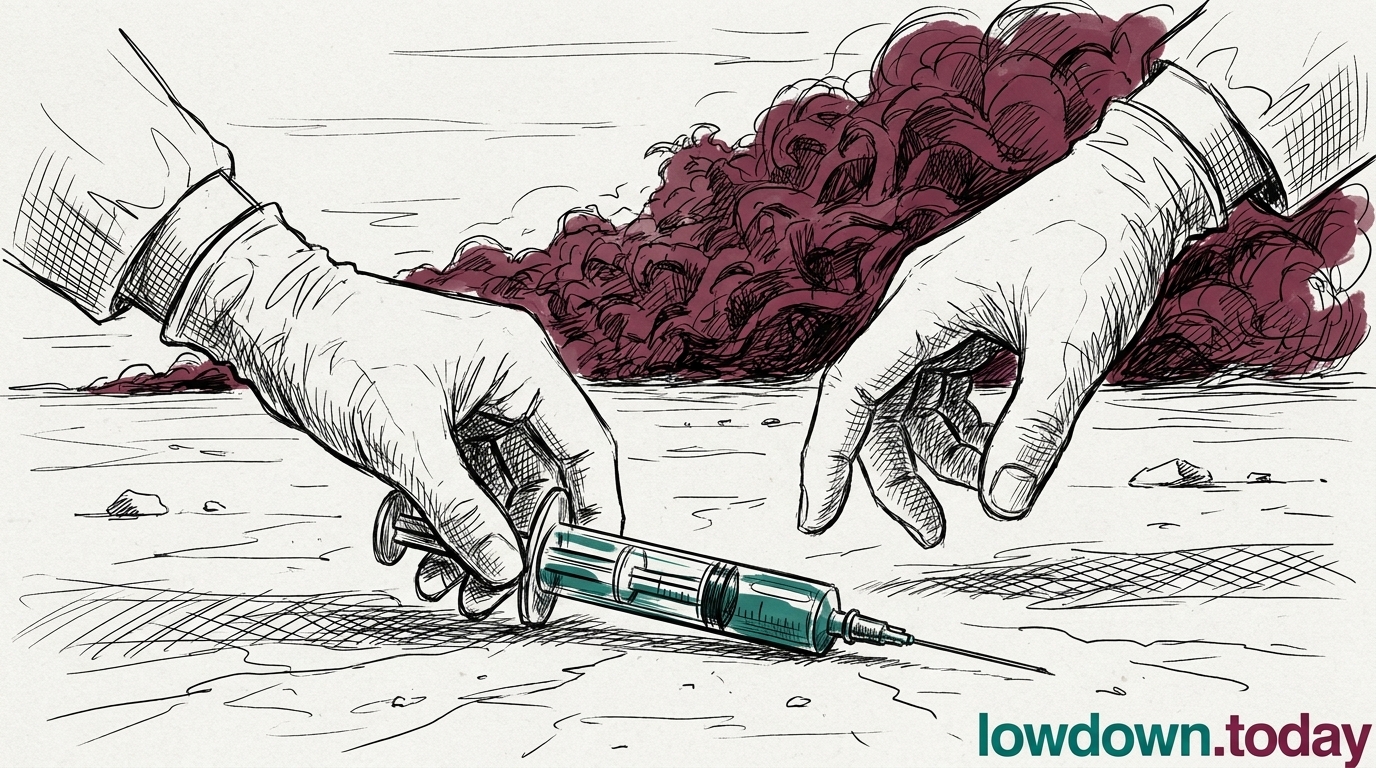
A clinical trial of MBP134 plus Regeneron's REGN3479, with obeldesivir for those exposed, is now underway, the first authorised therapeutic intervention in an outbreak that ran for weeks with nothing to dose.

ScienceDeveloping
Key takeaway

The first authorised Bundibugyo treatment trial is dosing MBP134, REGN3479 and obeldesivir under DRC and Uganda leadership.

WHO Disease Outbreak News 607, published 13 June, reports that a clinical trial of Bundibugyo Ebola treatments is now underway, the first authorised therapeutic intervention in an outbreak that ran for weeks with no drug to offer . The protocol pairs MBP134, a two-antibody cocktail, with REGN3479, a Regeneron monoclonal antibody, for treatment, and adds obeldesivir, an oral antiviral, for post-exposure prophylaxis 1. A monoclonal antibody is a laboratory-made protein that locks onto one structure on the virus; obeldesivir is a prodrug, an inactive compound the body converts to the active drug, which lets it be given by mouth to people exposed but not yet infected.

Both REGN3479 and obeldesivir differ from the drugs named in the 28 May expert advisory, which had centred on MBP134 and remdesivir . WHO attributes the trial design to national leadership with community consultation, pending ethics-committee and regulatory review. The change of drug set is the news; the protocol is owned by DRC and Uganda, not handed down by Geneva.

The drug list matters more than it looks, because a trial is also a gate. Whether obeldesivir and REGN3479 reach licensure depends on the data this outbreak generates, and a haemorrhagic-fever trial in an insecure conflict zone produces evidence slowly. After the long stretch when Inmazeb, Ebanga and Ervebo were confirmed useless against this Ebola species , something is finally being dosed, but a drug in trial is not a drug in routine use.

Deep Analysis

In plain English

Because no approved drug works against this type of Ebola, doctors in DRC and Uganda are running a clinical trial, a structured scientific test, of three experimental medicines. Two are given as treatment if someone is already infected. One, called obeldesivir, is being tested as a preventive drug for people who have been exposed to Ebola but have not yet shown symptoms. The trial was designed under DRC and Uganda national leadership and went through community consultation before starting. Running a trial during an outbreak is difficult but the 2018-20 DRC Ebola response showed it is possible, and that approach produced the two drugs now approved for a different strain of Ebola.

Deep Analysis
Root Causes

No licensed medical countermeasure existed for Bundibugyo ebolavirus entering this outbreak. The two approved Ebola monoclonal therapies, Inmazeb (Regeneron) and Ebanga (Ridgeback Biotherapeutics), target Zaire ebolavirus glycoprotein specifically and were confirmed ineffective against Bundibugyo .

This species-specificity gap was a known R&D Blueprint priority gap three months before the outbreak began; the trial going live six weeks into the PHEIC is the fastest that a de novo trial has launched against a novel filovirus outbreak without a pre-existing candidate in late-stage development.

The regulatory pathway required DRC and Uganda national authorisation rather than WHO pre-authorisation alone, because both governments hold sovereign regulatory jurisdiction over clinical research within their borders.

WHO's role per DON607 was to attribute the trial design to national leadership and community consultation, not to authorise it independently. This governance structure means that the six-week gap between PHEIC declaration and first dosing reflects national regulatory timelines, not international delay.

What could happen next?
  • Opportunity

    If obeldesivir shows post-exposure prophylactic efficacy, it could be applied to healthcare workers and close contacts immediately following exposure, creating a buffer layer that does not depend on isolation-unit access.

    Medium term · Suggested
  • Precedent

    The trial's launch six weeks after PHEIC declaration, against a pathogen with no prior licensed treatment, sets a timeline precedent for outbreak-setting MCM trials against novel filovirus species.

    Long term · Reported
  • Risk

    If enrolment is insufficient to reach statistical power, likely given Bundibugyo's smaller confirmed case count versus North Kivu Zaire, the trial may produce inconclusive results that neither confirm nor rule out efficacy for regulatory purposes.

    Medium term · Reported
First Reported In

Update #7 · Bundibugyo's fork stays open

World Health Organization· 16 Jun 2026
Read original
Different Perspectives
Germany (evacuation recipient)
Germany received the Bundibugyo outbreak's third international medical evacuation on 13 July, a US humanitarian worker infected in Bunia on 10 July. The evacuation, following a French doctor's 24 June departure and May's first US case, tests whether isolation and biocontainment protocols scale beyond DR Congo's own borders.
Pennsylvania Department of Public Health
PDPH retested and retracted a false-positive measles wastewater signal on 6 July, then confirmed and publicised a real airport exposure from 4 July, with commissioner Palak Raval-Nelson stressing there is no broad threat to the general public. The national count, 2,231 cases across 42 states by 9 July, is on pace to beat 2025's 2,289-case record before September.
World Health Organization
WHO published its first dedicated Blueprint on fungal disease and antifungal resistance on 1 July, estimating more than 300 million people suffer serious fungal disease annually. The Blueprint names the gap in WHO's own AMR strategy rather than waiting for an external audit to force the admission.
Africa CDC
Africa CDC
Africa CDC issued a formal 11 July appeal for responder protection, training and psychosocial support after health-worker infections tripled from 34 to 112 in a month. The appeal repeats June's unmet call for a rapid Bundibugyo diagnostic test, showing the ask has shifted from tools to basic safety and pay.
Front-line health workers, Ituri Province
Health workers in Ituri Province walked off the job or threatened to strike over unpaid hazard pay and delayed salaries, even as responder infections tripled to 112 with 35 dead. Their absence narrows the isolation workforce the CDC's model says must reach 70% coverage to avoid a 20,000-case worst case.
ECDC
ECDC
ECDC co-published the isolation and contact-tracing figures behind WHO's DON612, tracking Ituri's isolation rate rising from 35 to 44 percent while still rating EU/EEA import risk as very low. Brussels backs the WHO line against travel restrictions, the position France's own contact-tracing response, not the US entry ban, actually validated.
