Skip to content
Briefings are running a touch slower this week while we rebuild the foundations.See roadmap
Iran Conflict 2026
26APR

B-52s over Iran; 50,000 US troops in

2 min read
13:59UTC

US forces have begun flying B-52 strategic bombers overland into Iran for the first time in the conflict, quadrupling ordnance-per-sortie while Pentagon planners weigh options including seizing Kharg Island. The tactical picture and Trump's victory speech describe two different wars.

ConflictAssessed
Key takeaway

B-52 overland flights confirm US air superiority over Iran and quadruple per-sortie ordnance capacity.

Gen. Dan Caine confirmed on 1 April that CENTCOM has begun flying B-52 Stratofortress bombers on overland missions inside Iran, lifting a 30-day restriction to standoff-only strikes. Bunker-busters had struck Isfahan ammunition depots the previous night , and the B-52 overland authorisation signals that the degradation of Iran's air defences has now crossed the threshold that makes large, slow aircraft survivable.

The B-52 is not a stealth aircraft. Flying one over hostile territory is a statement: CENTCOM has suppressed Iranian air defences sufficiently that it can send the most visible aircraft in its inventory over Iranian territory and expect it to survive. The shift from standoff to overland dramatically increases ordnance per sortie. A B-52 carries roughly 70,000 lbs of bombs versus approximately 18,000 lbs for an F-35. With 200 dynamic strikes logged on Monday alone, CENTCOM has the targeting intelligence and the delivery capacity to accelerate the campaign.

CENTCOM had already logged 9,000 targets through Day 25 and reported 10,000-plus targets struck with 92% of Iran's largest naval vessels destroyed before today's confirmation. The B-52 authorisation is the operational expression of that accumulated attrition.

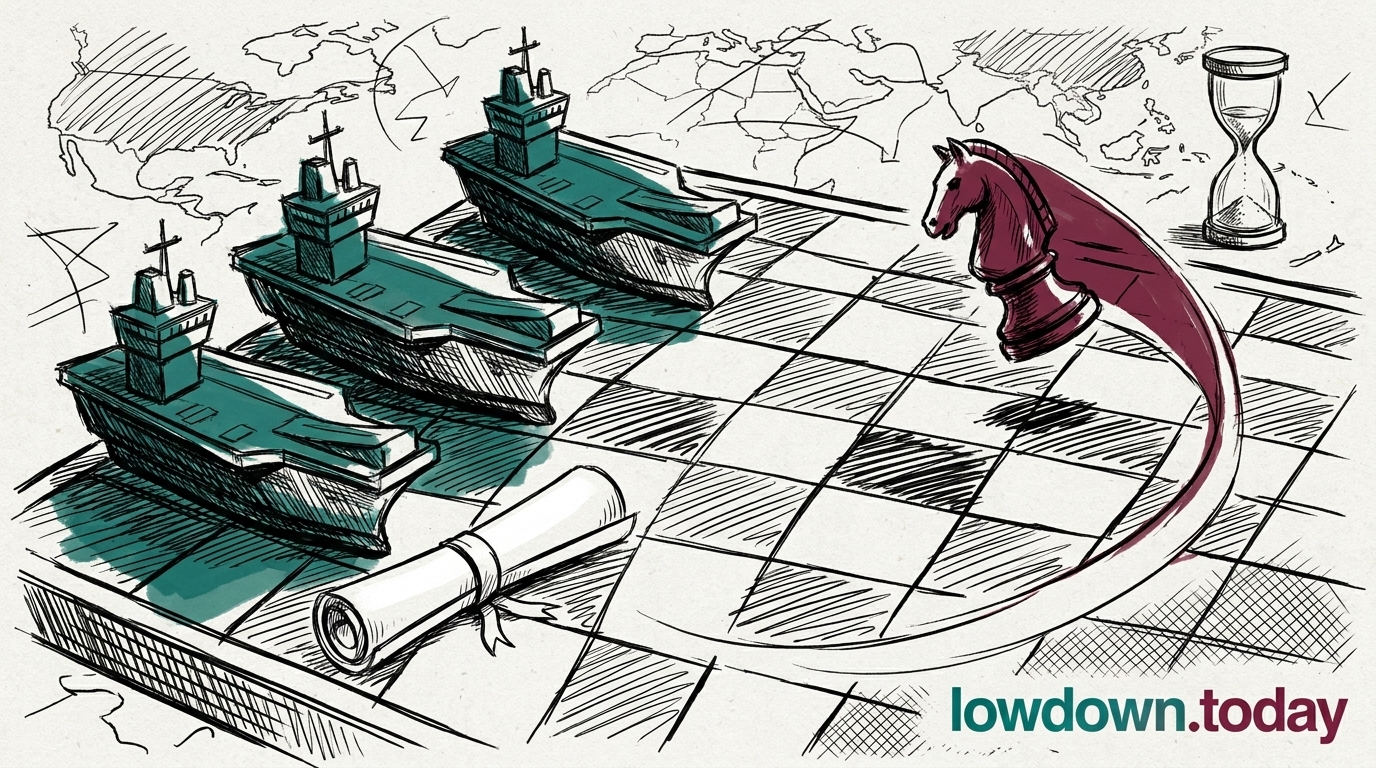
The SOF deployment compounds the picture. Hundreds of Navy SEALs and Army Rangers, options including seizing Kharg Island (which handles 90% of Iran's oil exports), and 3,500 Marines aboard USS Tripoli are assets relevant to a ground phase, not a withdrawal. The Pentagon had drawn up Kharg seizure plans weeks ago. The tactical picture and Trump's victory speech describe two different wars.

Deep Analysis

In plain English

B-52s are enormous American bombers built during the Cold War that can carry vast amounts of weapons. For the first 30 days of the war, they were only allowed to fire missiles from far away, outside Iranian airspace. Now they are flying directly over Iran. This tells us two things: first, the US military believes Iran can no longer shoot them down, meaning Iran's air defences have been severely degraded. Second, each B-52 can carry four times as many bombs as a modern fighter jet. At the same time, hundreds of special forces soldiers have arrived in the region, and Pentagon planners are reportedly considering seizing Kharg Island ; the port that handles 90% of Iran's oil exports. This is not what a military winding down looks like.

Deep Analysis
Root Causes

Iranian air defence degradation results from 30 days of systematic targeting by Operation Epic Fury, which struck over 11,000 targets including radar installations, SAM sites, and command nodes.

The shift from standoff to overland B-52 missions reflects CENTCOM's assessment that remaining Iranian air defences cannot threaten slow, high-altitude aircraft.

Escalation

The combination of B-52 overland flights, 50,000 troops, SOF deployment, and USS Tripoli Marines constitutes a full pre-invasion force posture. Whether this represents actual preparation or coercive signalling, the military infrastructure for a Kharg Island seizure is now in place.

What could happen next?
  • Risk

    B-52 overland flights and SOF deployment signal a potential ground phase that would extend the conflict well beyond Trump's two-to-three-week withdrawal timeline.

    Short term · Assessed
  • Precedent

    Confirming air superiority over Iran means CENTCOM can now target any location in the country, including underground facilities not accessible to standoff missiles.

    Immediate · Assessed
  • Consequence

    Seizing Kharg Island would remove 90% of Iran's oil export capacity and fundamentally alter the economic calculus of the conflict.

    Short term · Reported
First Reported In

Update #54 · Trump declares victory and withdrawal

Army Recognition / The War Zone· 1 Apr 2026
Read original
Different Perspectives
International human rights monitors (NetBlocks, IHR, Hengaw)
NetBlocks recorded 1,704 cumulative hours of near-total internet blackout for roughly 90 million Iranians on Day 74, while IHR documented ongoing executions under emergency provisions. These organisations are the only active monitoring windows into a civilian population cut off from the global internet for 71 consecutive days.
UK / France coalition
The Royal Navy confirmed HMS Dragon's Hormuz deployment on its own website on 11 May, converting a press-reported presence into declared force posture; UK and French defence ministers hosted a coalition meeting the same day. Britain and France are now the only named contributors to a Hormuz escort mission all five allies Trump originally asked had declined.
Saudi Aramco / Gulf producers
Saudi Aramco CEO Amin Nasser warned on 11 May that a Hormuz closure could remove 100 million barrels of weekly supply from global markets (roughly 15 million barrels per day for a week), a figure that dwarfs any OPEC+ swing capacity. The warning functions as both a price-floor signal and a public pressure on Washington to protect transit.
Beijing / Chinese Government
China has not publicly acknowledged the four Hong Kong-registered entities designated on 11 May or extended MOFCOM's Blocking Rules cover to HK-domiciled firms. Xi Jinping hosts Trump on 14–15 May having already de-risked state-bank balance sheets via NFRA's quiet loan halt, entering the summit partially compliant before any negotiation.
Tehran / Iranian Government
Foreign Minister Araghchi described Iran's 10-point counter-proposal as 'reasonable and responsible' via spokesman Baqaei on 11 May, and widened the mediator pool by meeting Turkish, Egyptian, and Dutch counterparts in a single day. Tehran is buying procedural runway while Trump's verbal rejection went unmatched by any written US counter.
Trump White House
Trump White House
Trump called the ceasefire 'on massive life support' and dismissed Iran's 10-point counter-proposal as 'a piece of garbage' on 11 May, while departing for Beijing two days later with no signed Iran instrument to show Congress. The verbal maximum and the paper void coexist: the administration is running a legal pressure campaign through Treasury while the president free-lances the rhetoric.